After hundreds of dev hours, lots of fine tuning, it's live.
Portfolio website for @jameschimdindu
Figma ➜ @nuxt_js + @greensock
Designed by @jameschimdindu
Developed by yours truly.
Live here: https://t.co/isOSWwnOpQ
BREAKING: The Central Bank of Nigeria has directed banks, fintech firms, and other payment service providers to store payment transaction data generated within the country on local servers from January 1, 2027, as part of new measures to strengthen oversight of the fast-growing digital payments ecosystem.
Title - Oke osisi
Oke Osisi honors the enduring strength and resilience of the Igbo people, standing tall and firmly rooted like the Iroko tree ( osisi ọjị ).
Igbo siri ike!
That "old money" circle you're trying so hard to get into? Maybe it's time to stop chasing it and start building your own.
Look around you. The friends beside you today who are putting in the work and getting 1% better every day won't be the same people in 5 - 10 years.
Support the people around you, grow with them and focus on becoming a person of value.
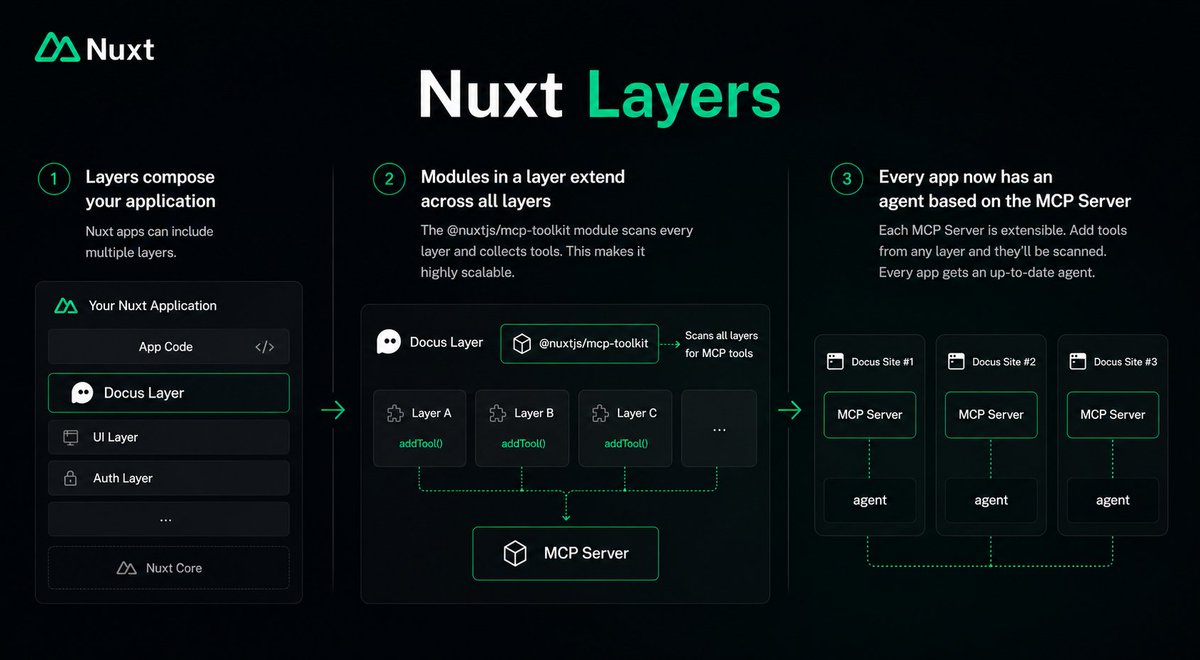
Nuxt layers might be the most powerful and underrated composability pattern ever.
Here's why:
The Nuxt MCP Toolkit is a module that lets you create MCP servers in your Nuxt app in the easiest possible way.
But here's where it gets interesting.
The module doesn't just create a server. It automatically scans every layer in your application and extends MCP tools from all of them.
Meaning you can add tools from any layer. The composability is insane.
Now imagine this:
Docus ships with the MCP Toolkit built in as a layer.
Every single Docus documentation site now has an MCP server running by default. But that's not even the best part.
Because we use the @aisdk on top of the MCP, each doc site gets a fully functional agent that connects to that MCP server. Zero configuration.
Deploy to @vercel with Gateway and it all just works. Out of the box. Every documentation site gets its own AI agent powered by MCP.
One layer. One module. Infinite scale.
This is the power of Nuxt's architecture. Layers let you compose functionality that cascades across every application that uses them.
You build it once, and it works everywhere.