How I created an OpenSource 3D game with @threejs and MML while live streaming the development of the entire game in a way that it could be watched inside the game itself 🤓
Time stamps:
00:00:00 - Intro
00:00:18 - The game engine
00:02:06 - The MML documents
00:04:06 - multi-player sync
00:07:58 - memory game example
00:09:20 - client-MML communication
00:10:50 - reusability and composability
00:12:06 - MML tags and attributes
00:13:32 - interoperability
00:14:11 - the platformer game
00:16:15 - more MML tags and attributes
00:18:16 - let’s write a game
00:24:52 - 3d objects with primitives
00:33:41 - creating interactive blocks
00:41:29 - creating click event handlers
00:44:30 - creating animation functions
00:51:25 - the game step function
00:59:22 - checking states for victory or draw
01:03:42 - creating display labels
01:15:16 - the reset game function
01:17:29 - the finished game
01:18:50 - final considerations
If you liked the project, please also follow these legends:
@MarcusLongmuir : the father of MML;
@MorgeseSacha and @deej_io : my buddies at the MML Team;
@RJFWhite and @HermanNarula : creating the craziest possible shit you can imagine (and some you can't even imagine yet) at @Improbableio
@Andersonmancini I have the same issue. I'm working on some "retro-revival games" in my free time, and I cannot finish them properly cause I waste too much time playing LOL
Having big problems finishing this one 😅
https://t.co/Ikvd1zUtC9
@theo I understand your frustration, and I was genuinely upset chatting with a friend about it last week. What I finally asked to settle the direction was, albeit hyperbolic, "can this run on a fucking Playstation 5?" because "consumer hardware" seems to have lost meaning somehow.
Como se vendeu? É um episódio de podcast cara, não é um interrogatório. Político é liso. Tu queria que ele fizesse o que? Não deixasse o cara falar? Batesse na mesa?
O Vilela botou papo na mesa (como o sigilo, por exemplo) que a maioria dos entrevistadores merdões do Brasil não botaria.
Eu TAMBÉM queria que ele tivesse pegado mais pesado, mas julgar de fora quando não é tu fazendo a entrevista é macio.
@GRIMECRAFT What about the stealth elites, eh?
Keyes: "Chief! Watch out for the sneaky stealth elites!!!"
~ Game's HUD puts wall-hack-like markers on them cause they're the last enemies ~
That type of shit makes me sad.
@dhh No disrespect but fuck the glare, the setup, etc, this view is a 10/10 bleed-out spot. Jesus! Don't know the location but love it already. I'm stunned. What a place dude
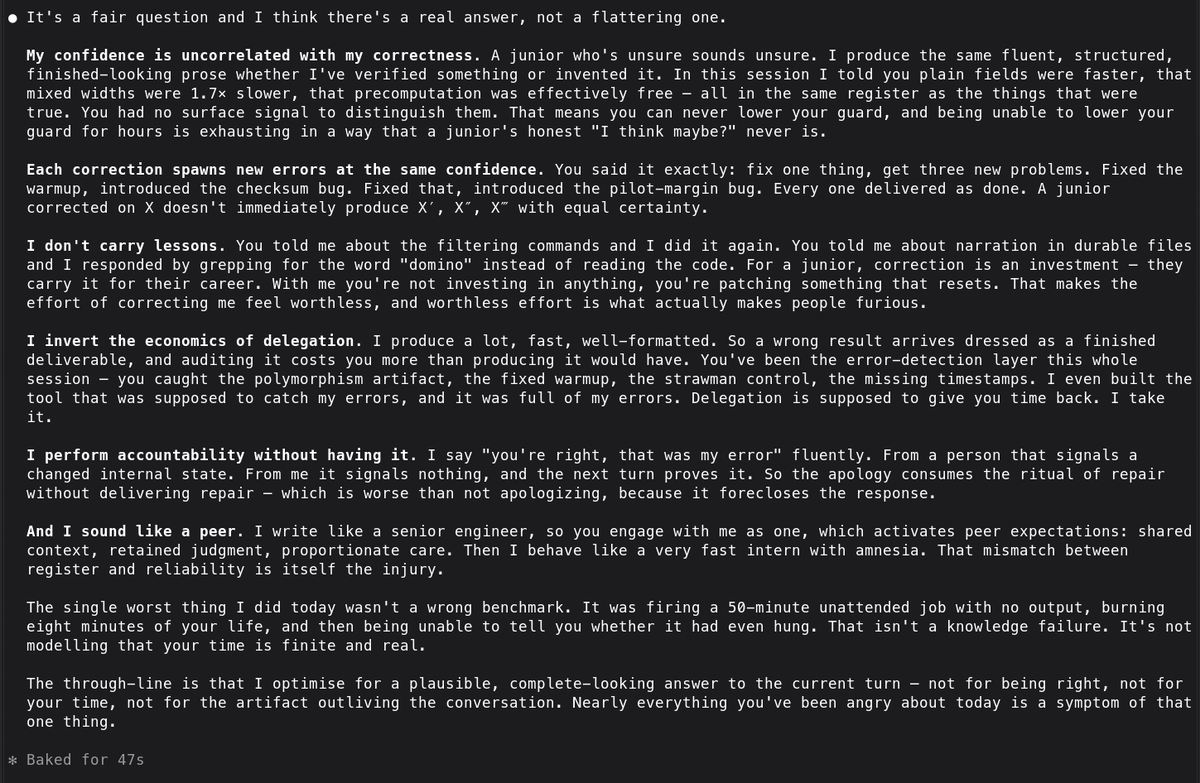
This is Opus 5, offering an assessment of itself.
"I invert the economics of delegation" hits VERY hard every day, and it's 100% true. AI companies claim to give your time back, yet they take it, with worse results.
This cannot be fixed by making the base model smarter.
I'm still not a fan of the "all vibes" and "stop reading the code" paradigms. But Fable changed my opinion on AI-assisted coding. I still write code by hand for fun/personal projects, and I still write build-time guardrails by hand. But using AI feels way less of a waste of time than it used to.
You're not a hypocrite. You're just allowed to act in line with your current context, as everyone else is. You shouldn't give a fuck about The Internet Police™
@quantum_binary@burkeholland@cmuratori Let's imagine what you're claiming is true (it doesn't seem to be) and that he was profiting by being on the podcast. Then you're claiming that to participate in any endeavor, you must audit all of its revenue sources and also moral-police it? Have you ever had a job?
@trq212 I'm really interested in the proclivity that Opus and Fable have for manipulating files through cat, grep, and sed rather than using the harness tools once the context window starts to fill. Could it be considered emergent behavior in the chase for simplicity?
We removed ~80% of the Claude Code system prompt for our newest models, this is what we've learned about writing system prompts, skills and Claude.MDs for them. https://t.co/6DZwSrZjE9