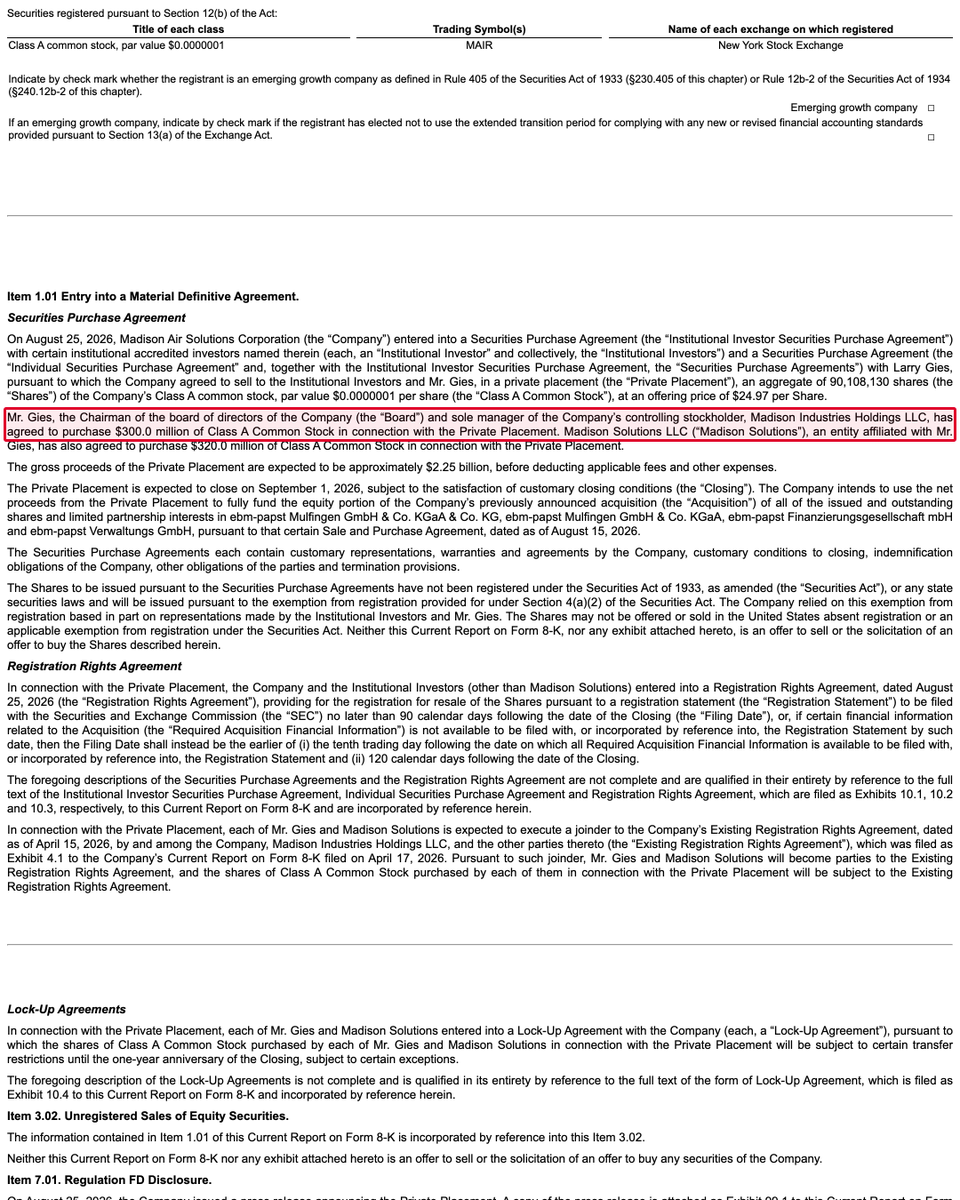
Madison Air's founder and chairman is buying $620 million of the ~$2.25 billion of stock his own company is selling to pay for a German fan maker.
$MAIR filed the terms today: the shares go straight to a picked list of investors at $24.97 each, closing September 1. Larry Gies takes $300.0 million personally, and Madison Solutions, an entity affiliated with him, takes another $320.0 million.
ten days earlier, when Madison Air signed the deal for the fan maker, ebm-papst, it disclosed a promise from Madison Solutions to put up to €1.3 billion into the purchase if the money was needed. today's release says that promise is no longer required, because this raise covers it.
Gies and Madison Solutions agreed to hold their new shares for a year after closing. the other ~$1.63 billion of the placement gets a resale registration within about 90 days.
ebm-papst sits in Mulfingen, Germany, with more than 250 million fans installed worldwide, and per Madison Air's own release its parts get picked at the design stage of the equipment they go into. the purchase still needs European Commission clearance, expected to close around year end.
XPeng $XPEV just sold a piece of its humanoid robot unit at a $6.3 billion valuation, in a round led by IDG Capital with Tencent and Alibaba in as strategic backers. the same filing says XPeng itself can be made to buy those shares back.
the outside investors are putting in $600 million. if the unit, Dogotix, hasn't pulled off an IPO within seven years, any of them can hand the shares back for cash, and the filing names Dogotix, its main subsidiaries or XPeng as who has to pay.
that clause is a redemption right. it lets an investor cash out at a price fixed in the contract up front, instead of waiting to see what the business is worth.
the price is the higher of 120% of what they paid, or their money back with 8% compounded a year. so on $600 million the written floor is $720 million.
the same document puts Dogotix's loss last year at RMB 369 million, against RMB 87 million the year before, and says it owed more than it owned at the end of March.
Hong Kong's listing rules make XPeng treat the buyback right as if the investors had already used it, because using it was never XPeng's call.
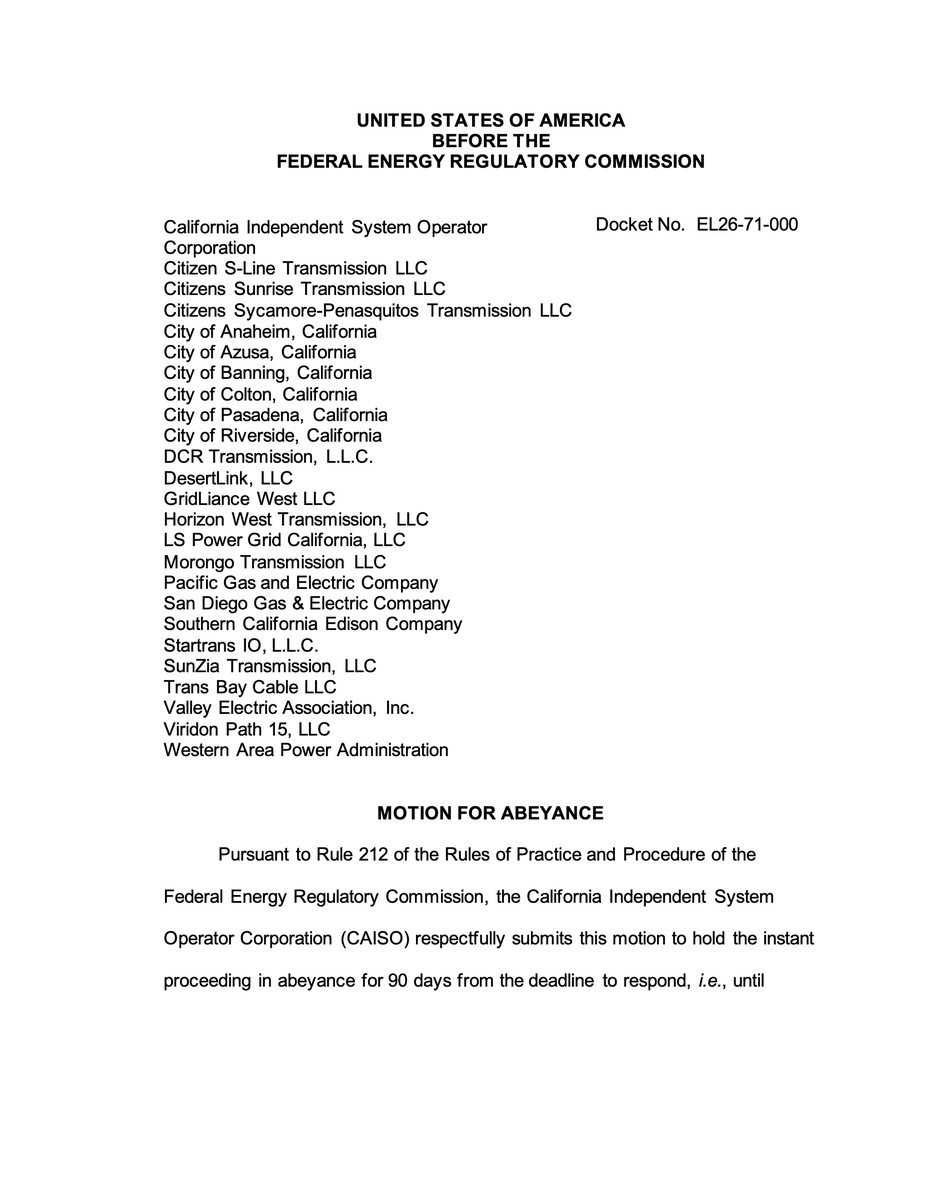
FERC gave the six operators that run the US power grid until August 17 to fix how fast a data center can plug in.
all six asked for a pause instead, and the deadline came and went last week with no new rule in force at any of them.
that's PJM, MISO, SPP, CAISO, ISO-NE and NYISO, which between them run the grid for most of the country. PJM filed first, on July 28, and the other five all filed on August 3.
back in June, FERC said the order was about "delivering speed-to-power that is critical to supporting the innovation economy and national security while protecting ratepayers."
CAISO published a proposal anyway, nine days after filing for its pause: anything over 50 MW counts as a large load, with a faster and more flexible way to connect. PJM has published nothing comparable since its own filing.
the pauses run up to 90 days. FERC granted PJM's on August 17, the deadline day itself, and CAISO's window runs to November 16.
Navitas ($NVTS) is paying up to ~$261.7 million for Claros, a two-year-old startup that makes power-delivery chips for AI data centers. its own 8-K puts the purchase price at ~$232.8 million.
the difference sits a paragraph further down in the same filing: ~$28.9 million of Navitas stock for the Claros employees who stay on after closing, counted outside what the 8-K calls the purchase price.
and ~$45.6 million of the total only moves if Claros hits certain business targets in the two years after the deal closes, paid in Navitas shares, not cash. the schedule listing those targets was left out of the public filing.
Navitas' own release says Claros doesn't start adding revenue growth until 2028 or 2029, and that its near-term financial plan is unchanged.
the Justice Department still has to clear the deal. Navitas expects to close before year-end, and the contract lets either side walk if it hasn't closed by December 22.
@Stonefoxcapital makes sense, the class A number is the one we printed because that's the class the warrant dilutes. like the aug 6 10-Q cover has the full filed count as: 276.3M class A + 123.7M class C + 95.8M class D = ~495.8M ish, and against that the warrant is ~10.2%
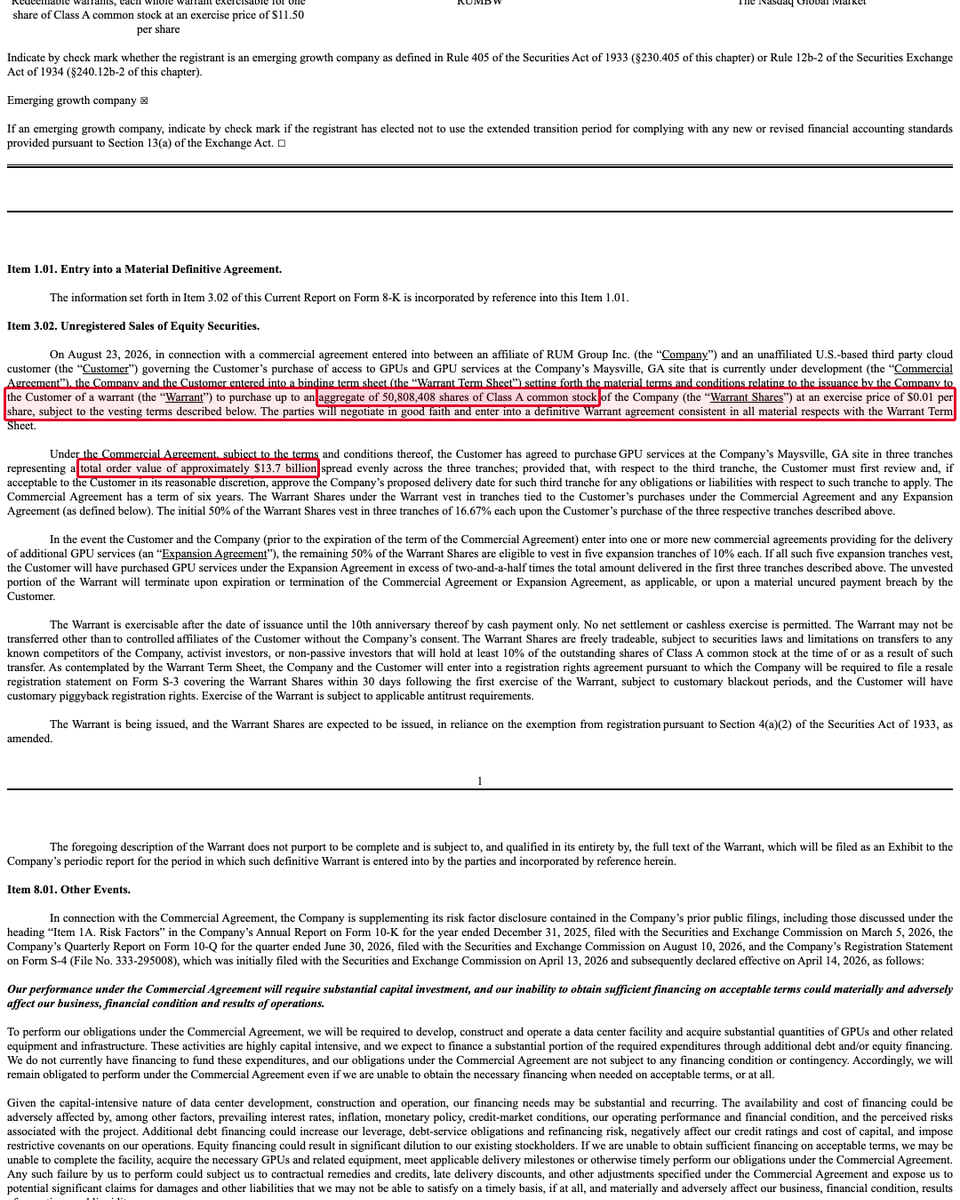
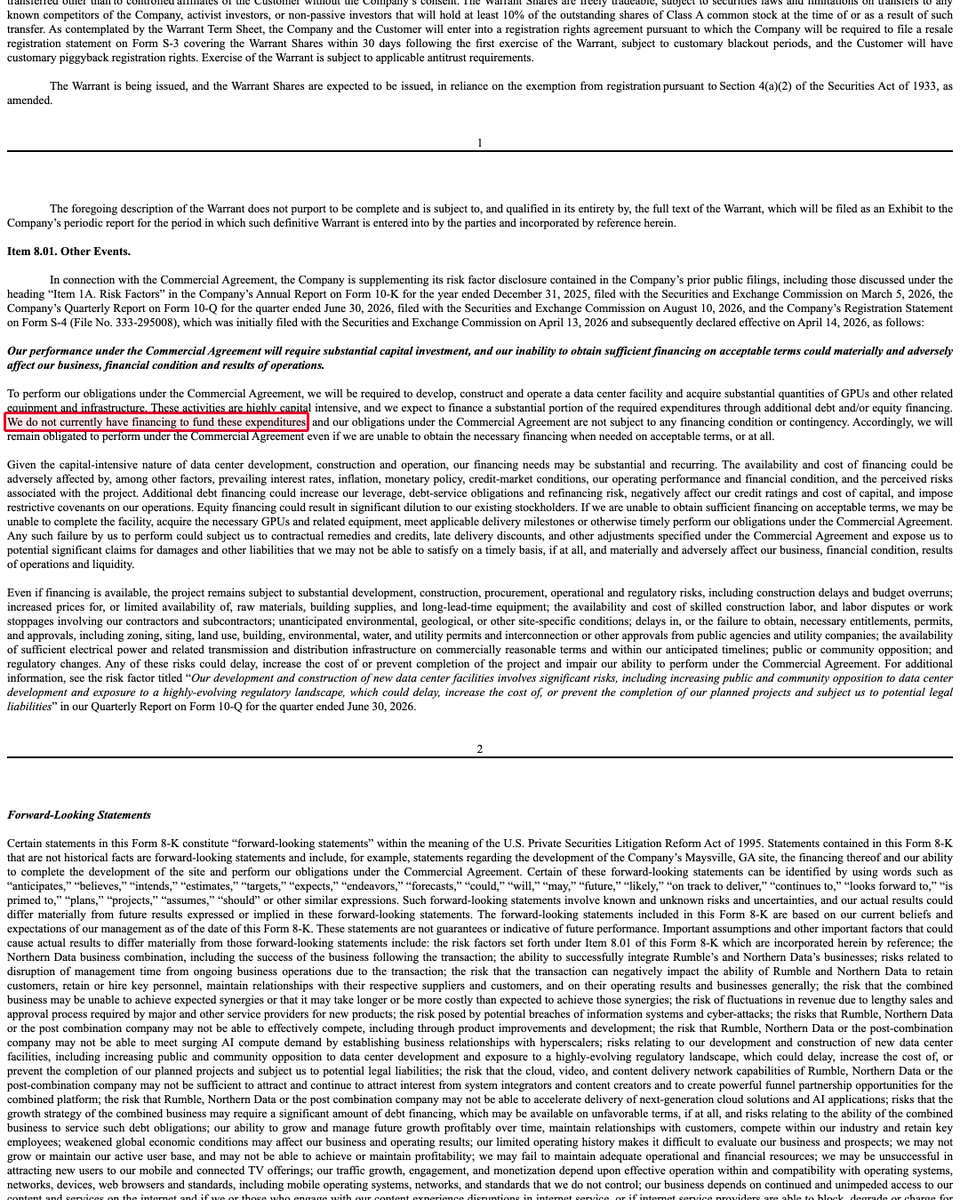
$RUM told the sec this morning that an unnamed us cloud customer agreed to buy ~$13.7 billion of gpu capacity at its maysville, georgia site. and in return, the customer gets the right to buy 50,808,408 rumble shares at a penny each.
the 8-K just hit edgar today, a couple of hours before the open. no press release came with it, nothing on the wires.
couple of things stood out. buying that whole block costs $508,084.08. that works out to ~18.4% of the 276,328,597 class A shares rumble reported outstanding on august 6. and it is a binding term sheet, not the finished warrant, so the two sides still have to sign the real thing.
the stock also only unlocks as the customer actually pays. half comes in step with the three purchases, and the third purchase only binds if the customer approves rumble's delivery date. the other half needs a brand new order worth more than 2.5x the first one, which nobody has signed.
rumble filed the hard part itself, in a new risk factor: "we do not currently have financing to fund these expenditures, and our obligations under the commercial agreement are not subject to any financing condition or contingency."
for scale, the order is ~136 times the $100,622,320 of revenue rumble reported for 2025, before the northern data deal. the contract runs six years, the warrant ten.
on friday we posted google's marvell warrant, 58,970,907 shares at $206.58 where 97.7% only vests if google buys $120 billion of product. same structure four days later, and this customer pays a penny a share.
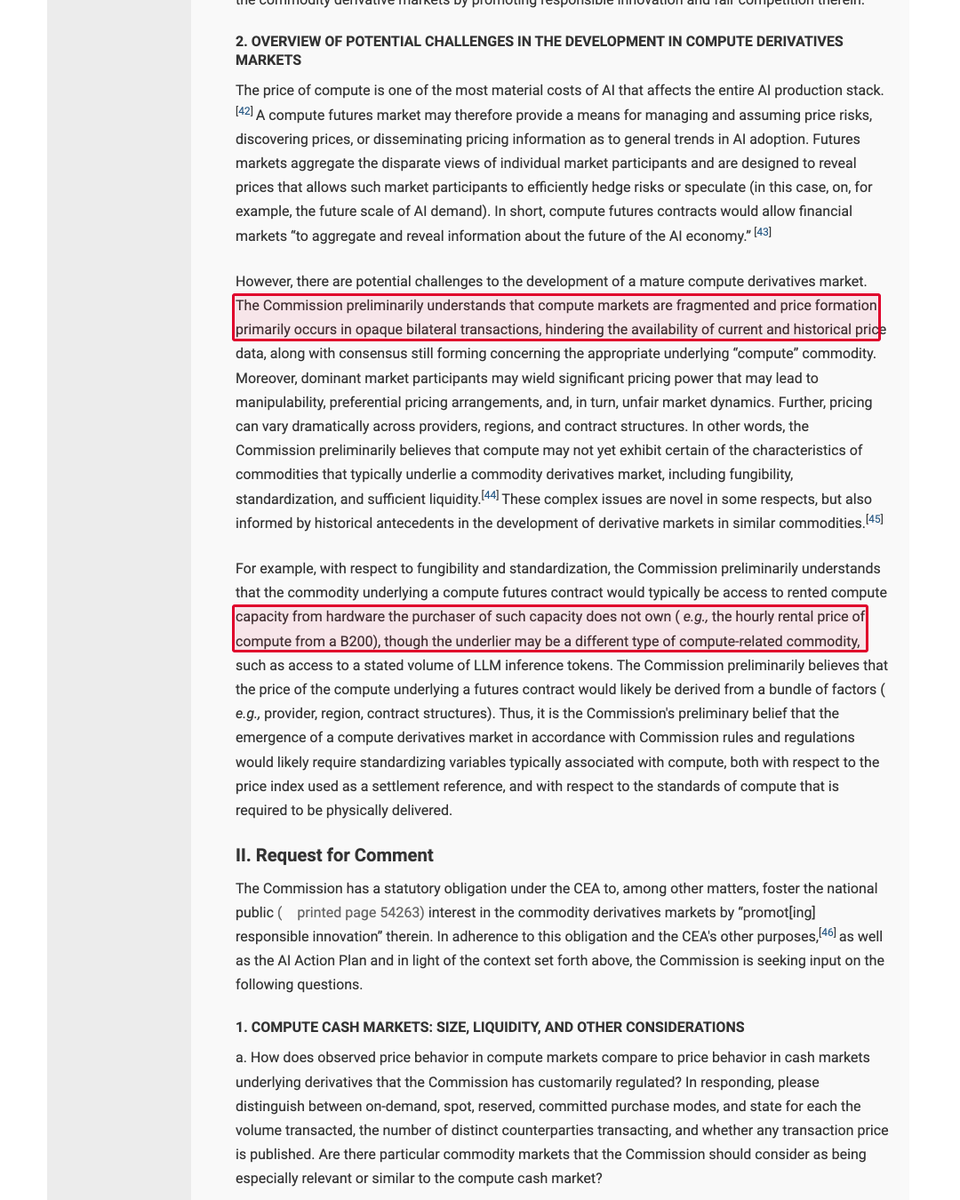
the US futures regulator just asked whether an hour of time on an Nvidia B200 should trade like a barrel of oil.
the CFTC put the question out on Friday and named the underlier: the hourly rental price of compute from a B200, or a stated volume of LLM inference tokens.
its own words on how compute trades today: "fragmented", price formation "primarily occurs in opaque bilateral transactions", private deals "carry the majority of economic value".
the scale, per the paper the CFTC cites: compute installed by end of 2025 throws off $430 billion to $1.3 trillion of service a year, ~1.4% to 4% of US GDP. none of it has a public price.
an exchange does not need the CFTC's permission to act. it can self-certify a compute contract and list it any time. comments close October 20.
Google just took the right to buy ~$12.2 billion of Marvell stock, $MRVL.
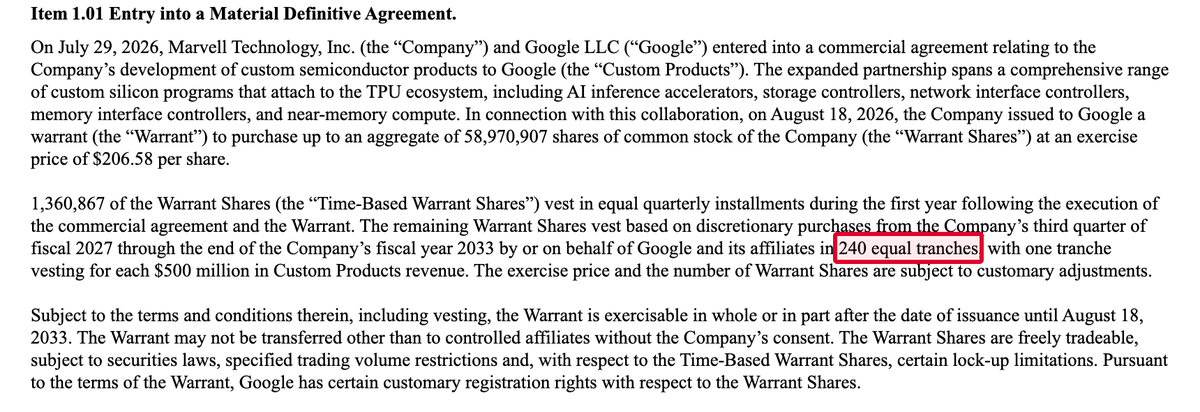
97.7% of it only becomes real if Google buys $120 billion of chips from Marvell first.
a warrant is the right to buy shares later at a price locked in up front. the one Marvell disclosed in an 8-K on August 19 covers ~59 million shares at $206.58 each, tied to a supply agreement the two companies signed in July.
three things from the filing:
1. only 1,360,867 of those shares are Google's no matter what, arriving in equal quarterly pieces over the first year. that slice is ~$281 million of stock.
2. the rest vest "in 240 equal tranches, with one tranche vesting for each $500 million in Custom Products revenue," per the 8-K. 240 times $500 million is $120 billion.
3. the 8-K calls those purchases discretionary. nothing in it obliges Google to place a single order.
Custom Products is the deal's name for the silicon Marvell builds around Google's TPU systems, from inference chips to storage controllers and network cards.
we read NVIDIA's Portsmouth 8-K the same way on August 17. the deal reported at $250 billion was capped in the actual filing at $105 billion.
the revenue-based shares can vest from Marvell's third quarter of fiscal 2027 through the end of its fiscal 2033. the warrant itself runs to August 18, 2033.
Applied Materials $AMAT, Lam Research and KLA all report China as a smaller share of their sales this year. in dollars, China isn't shrinking.
start with Applied. it filed its quarterly report yesterday afternoon. China was 28% of sales, down from 35% a year ago.
in dollars, China was down 2%. Applied overall grew 25%.
KLA's annual report went in two weeks ago. China was $4.2 billion in fiscal 2024 and $4.0 billion in fiscal 2026, basically the same number.
KLA's total sales grew 38% over those two years. that is what took China from 43% of the company to 30%.
Lam's June quarter had China at 26% of sales, down from 35% a year earlier, on roughly the same dollars, about $1.75 billion, per its earnings releases. for the full year, Lam's China sales went up, to $7.9 billion.
the line that doubled in Applied's filing was the US one, from $683 million to $1.37 billion.
Moderna's CEO Stéphane Bancel sold 499,246 shares on August 5. two weeks later, $MRNA closed up 177% in a day on a cancer trial result.
per the filing he made on August 7, those shares came from stock options that were about to expire. the options let him buy the stock at $19.15, and after August 10 they would have been worth nothing. he sold just enough shares to cover the $19.15 a share, the taxes and the fees, and kept the rest. over August 5 and 6 he turned 751,715 options into shares, sold 499,246 of them, and kept 252,469. the sale was on a schedule he set back in May.
he got $28.7M for the shares he sold. at the August 19 close, those same shares were worth $87.1M.
he still holds 22,215,826 shares, directly and through two entities, Boston Biotech Ventures and OCHA LLC. on August 18 that stake was worth $1.40B. on August 19 it was worth $3.87B. that is about $2.48B in one day, on paper.
Moderna insiders made nine open-market sales this year. 851,564 shares, sold for $47.1M, worth $148.5M at the August 19 close. eight of the nine were on schedules set three to eleven months ahead.
the jump came after Moderna and Merck said their Phase 3 trial met both of its goals. the therapy is built for each patient from their tumor's genetic data, with AI picking the targets, per Moderna's own description. the news went out in a 6:45am press release. nothing was filed at the SEC, and no officer or director had filed a trade in the twelve days since Bancel's.
Unitree, the company behind the backflipping humanoid robots, closed its first day on the Shanghai market up 460%. almost nobody outside China can buy a share of it.
at the peak it was worth about $66 billion. by the close, $48 billion.
individual investors put in roughly $1.1 trillion of orders, per the South China Morning Post, and 0.018% got filled, about one in 5,600, the lowest hit rate in the history of Shanghai's tech board. we posted the order book on August 11, when institutions had bid 2,760 times the shares on offer.
the board it listed on takes professional and institutional investors only, and Unitree sits outside Stock Connect, the pipe that lets outside money buy mainland shares through Hong Kong, until it joins certain Shanghai index lists. there is no US listing of any kind.
private marketplaces have been quoting Unitree to American buyers anyway, at $62.43 a share on Hiive, for stock the company itself says is mostly not authorized.
the NRC just put a 60-day clock on the first-ever restart of a shut-down US nuclear reactor. the document publishes today.
the plant is Palisades, in Michigan, shut since 2022 and handed over to be taken apart. on August 12 the NRC signed a waiver letting its operators work longer hours than the rules normally allow. the window starts the day fuel goes back into the reactor, runs 60 days at the outside, and ends when the plant connects to the grid.
the June version of the same waiver ran until nine days before fuel load. this one starts at fuel load.
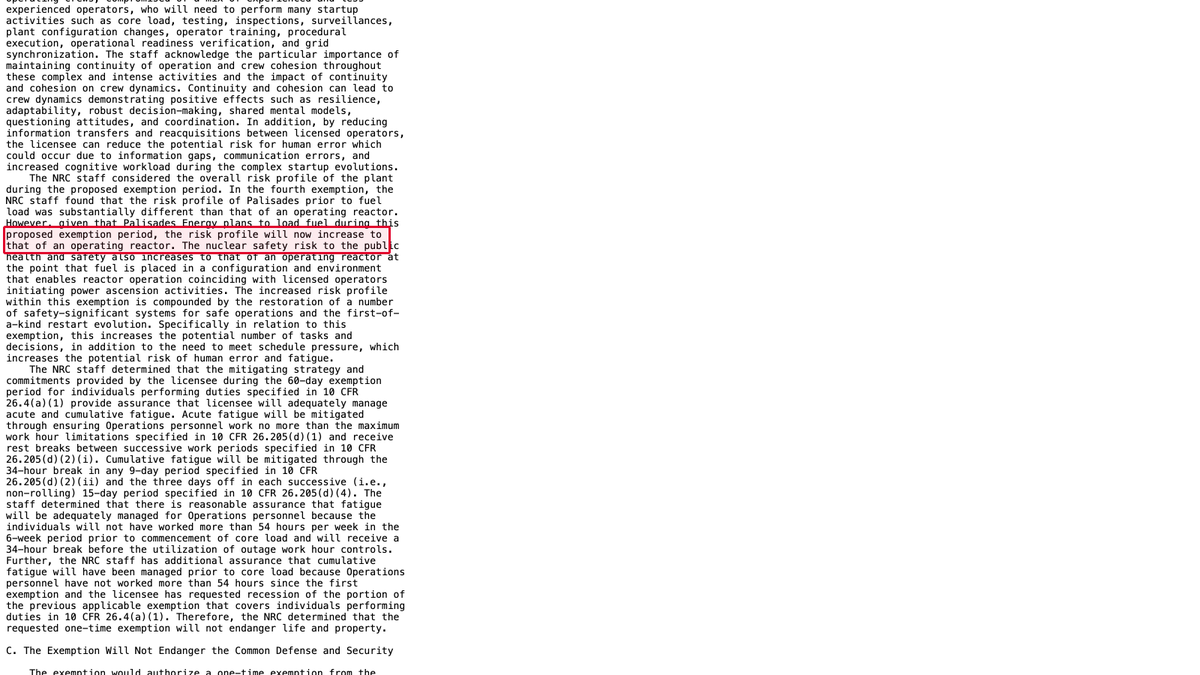
per the exemption: "given that Palisades Energy plans to load fuel during this proposed exemption period, the risk profile will now increase to that of an operating reactor."
no US commercial reactor has ever come back from decommissioning. our August 16 screen counted three with money behind a restart, Palisades, Three Mile Island and Duane Arnold. neither of the other two has loaded fuel. Holtec owns Palisades and is private, so there is nothing to look up on it.
no calendar date appears anywhere in the document. the 60 days start counting when the fuel goes in.
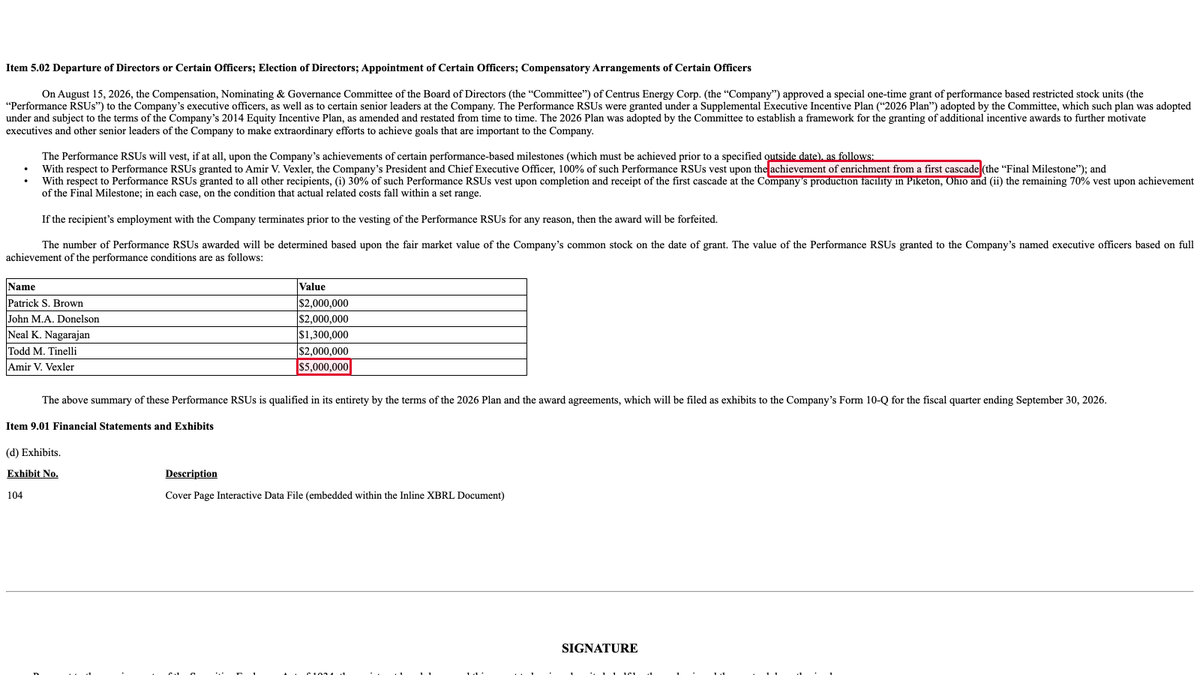
Centrus $LEU just tied 100% of its CEO's $5M bonus to uranium actually coming out of a set of centrifuges that isn't built yet.
$12.3 million across five executives, all stock, all forfeited if anyone leaves early. the CEO's entire award pays only on what the 8-K calls the Final Milestone, "the achievement of enrichment from a first cascade." everyone else gets 30% when the cascade is completed and received at Piketon, Ohio, and 70% when it actually enriches.
a cascade is a long chain of centrifuges plumbed together, each spinning uranium gas fast enough to leave more of the usable U-235 behind. the chain is what gets you to fuel.
the board set a deadline for the milestone and didn't disclose it. the payout also needs actual costs inside "a set range" the filing doesn't state.
we posted the $900 million DOE contract for one metric ton of enriched uranium from Centrus's own filing on August 11. this is the same site, with the executives' pay now attached to whether it works.
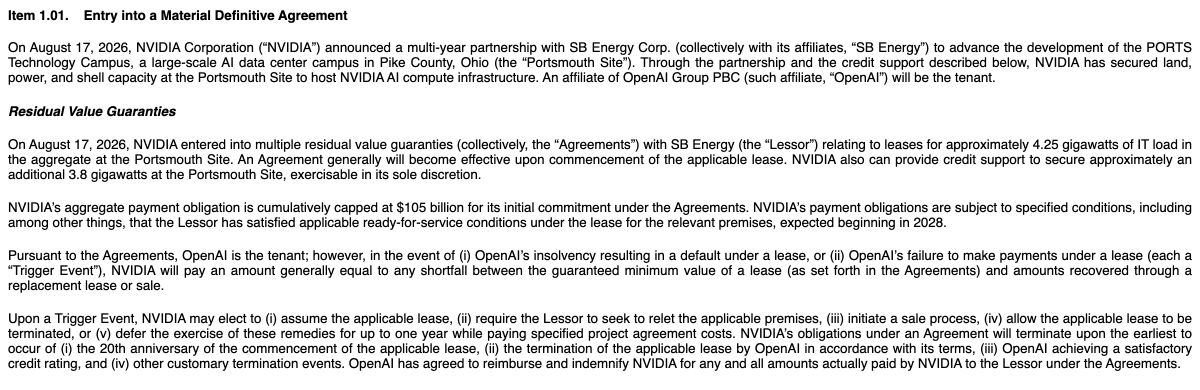
$NVDA signed the Portsmouth, Ohio deal with OpenAI this morning, and per the 8-K the guaranty is capped at $105 billion.
the press reported it at around $250 billion in late july, then walked it down to under $120 billion three days ago. the signed number came in under both. the equity investment in SB Energy landed the same way, at half the top of the range reported two days ago.
the idea is NVIDIA is standing behind OpenAI's rent for 20 years. as long as OpenAI pays, nothing moves. if OpenAI defaults, NVIDIA covers whatever gap is left after the site gets re-leased or sold, and it can also just take over the lease itself.
the cap covers about 4.25 gigawatts of leases at the Portsmouth site in Pike County, Ohio, with service expected to begin in 2028.
per NVIDIA's own prior quarterly filing, its entire guarantee book across every partner facility was capped at $3.5 billion. this one deal is thirty times that.
there's also a clause that ends the whole guaranty early if OpenAI achieves a satisfactory credit rating.
The Metals Company, $TMC, has applied to explore a second patch of Pacific seafloor bigger than Pennsylvania, and NOAA opened the environmental review on it today.
the license only covers looking, not mining. actually hauling the rock up needs a second NOAA permit on top of this one.
if NOAA grants it, the license runs ten years, and the agency says it decides within a year of May 26, the day it signed off that the application was complete.
three things from the notice:
1. the claim is 121,830 square kilometers, split across six separate patches out between Hawaii and Mexico.
2. NOAA is separately holding another application from the same company for a different area. that one's review hasn't started yet.
3. counting today's, five of these applications are now in front of NOAA, and all of them arrived after the executive order last year told the agency to speed the process up.
what they're after is loose rock lying on the seafloor mud, roughly potato-sized, with nickel, cobalt, copper and manganese inside. the industry calls them polymetallic nodules. they aren't buried, so collecting them is closer to vacuuming than digging.
the law behind all of this is American, written in 1980. it lets NOAA license US citizens to work seabed outside any country's waters.
46 countries have backed a moratorium, a pause, or an outright ban on deep-sea mining, per the Deep Sea Conservation Coalition.
comments close September 16.
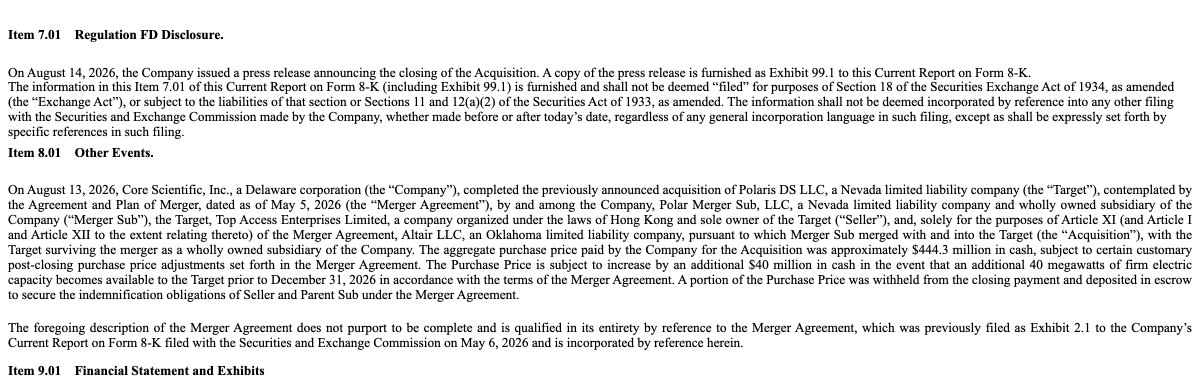
Core Scientific, $CORZ, will pay $1 million for every extra megawatt of power it can get at one site in Oklahoma.
it closed the Polaris acquisition on Thursday for about $444.3 million in cash, and the merger agreement adds another $40 million if 40 more megawatts of guaranteed power become available at that site before December 31, per Friday's 8-K.
three numbers:
1. Polaris came with roughly 440 megawatts the release calls "currently in service", already running under existing contracts with Oklahoma Gas & Electric. that's $1.01 million a megawatt.
2. in May the same buyer bought land in Hunt County, Texas plus a power agreement for roughly the same amount of power, none of it flowing yet, per the 10-Q. that worked out to $542,000 a megawatt.
3. only 13% of the power capacity that applied to plug into the US grid between 2000 and 2020 was actually running by the end of 2025, per Berkeley Lab.
side by side, power already flowing cost 1.9 times as much as power still on paper. the comparison is loose, one is an operating site and the other is raw land. the $40 million clause has nothing else in it, it buys megawatts and prices them at a million each.
December 31 is the date. either 40 more megawatts turn up at that site and Core Scientific pays the extra $40 million, or the clause expires.