I feel those artists that always throw Afrobeats under the bus whenever they want to drop a project just lack creativity. Look at Asake’s rollout — never talks down on the genre, never disrespects other artists, everything is just pure entertainment from A to Z. Well, he’s clearly been trained in the best school of thought.
Yeah. For the first time in weeks I have time to drop my stories again.
It's really something you don't always want to hear but I've said always said it in 2020, '21, '22, '23 and I'll tell you same in 2024.
Put emotions aside and read up. Also share this post.
I spent the last 13 years of my life on YouTube.
For those who quickly get lost in technicalities, here is an easy-to-understand framework that I learned on the battlefield and use to understand what the algorithm wants (and especially doesn't want):
To understand the algorithm, you first need to analyze its evolution and the problems YouTube had to overcome along the way to get to the version we have today.
Good news: I witnessed that evolution, and I'm here to report it for you. Let's do a bit of history:
2007-2012: In its early days, the YouTube algorithm was heavily focused on view counts, meaning the more a video had views, the more likely it would be recommended.
If you're an old fuck like me, you remember that making content on the internet was far from being like it is today (very few softwares, sluggish internet connection etc). The market was completely different back then (less competition, fewer viewers and as a result, a very low supply of video compared to what it is today.)
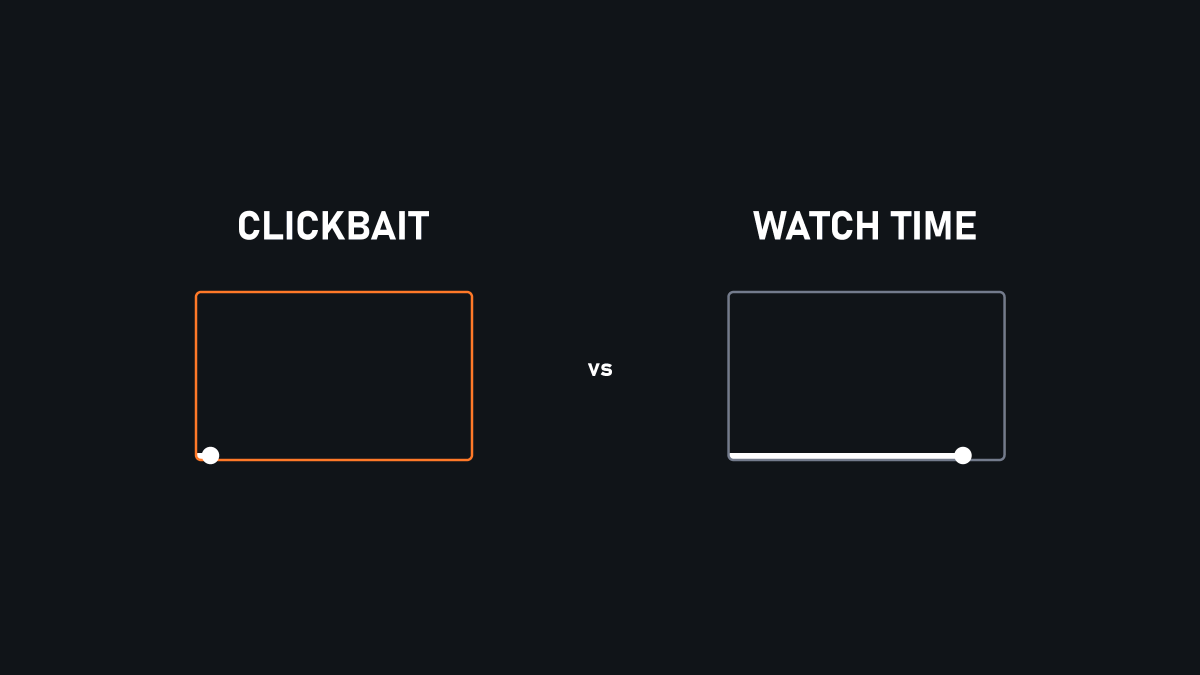
It took a few years before the market started to figure out clickbait, but once it did (around 2011), it quickly became out of control.
2012-2015: To combat clickbait, YouTube made a significant shift. They updated the algorithm and made it prioritize watch-time this time instead of view count to solve this problem.
And indeed, it solved it.
What they hadn’t predicted though, is that after a while, another unwanted trend started to emerge: a flood of low-quality long-form content (mostly gaming gameplays).
2016-Today: In 2016, to fix the "clickbait/watchtime" imbalance, YouTube began introducing sophisticated machine learning focused on viewing patterns (personalized recommendations based on individual user preferences), which finally made the algorithm way more balanced.
To keep it simple:
Catching attention without retaining it = flagged as clickbait
Retaining attention but only catching a little = flagged as too niche
In both cases, videos stop being recommended early.
That's why, around that era, the "hook meta" (creators teasing the content of the video at the start) emerged on a large scale, allowing creators to retain more viewers.
Here's what we can learn from this chronology:
Catching attention is now the key again BUT with a condition: the content has to deliver the packaging's promise if you want to farm watch time and keep your video getting recommended.
Next time you upload a video and make your thumbnail & title, remember that there's a threshold level of "catching attention" at which your video goes from interesting to clickbait and potentially ruins its reach.
While the viewers can tolerate a bit of sneakiness and quickly forget if the content delivers, if it's not the case, they'll feel manipulated and instantly punish you.
That's why keeping that balance is crucial.
Thank you for your attention.
-------------------------------------------------
If you want to dive deeper into strategy for your YouTube channel(s), I made a guide called YouTube from 0 to 1 that you can get by applying to my private (but free) newsletter (I only accept dedicated people):
https://t.co/aViX5G0Zb0
Here is probably my best thread of all time.
If there is one place on the internet that breaks down the YouTube algorithm for real without sensationalism, it's this one.
12 years of YouTube experience concentrated in one Twitter thread, let's go.
Invest in a good trade journaling app that lets you automatically log your trades and monitor your performance.
If you’re serious about trading then treat it like an actual profession
A successful FX trader has his non-negotiables in the markets. The trader is observant of the patterns that puts the odds in the trader's favor and records new successful ones just like a doctor notes new illnesses and establishes predictable cures/treatments.
You don’t become confident by shouting affirmations in the mirror, but by having a stack of undeniable proof that you are who you say you are.
Outwork your self doubt.
Building houses is what I do for LIVING, Go to Metropark Estate, Behind OGTV Abeokuta, ask about Engr. Abraham that drives , they'll show you what I can do with 5M
I've built many houses in that Estate.