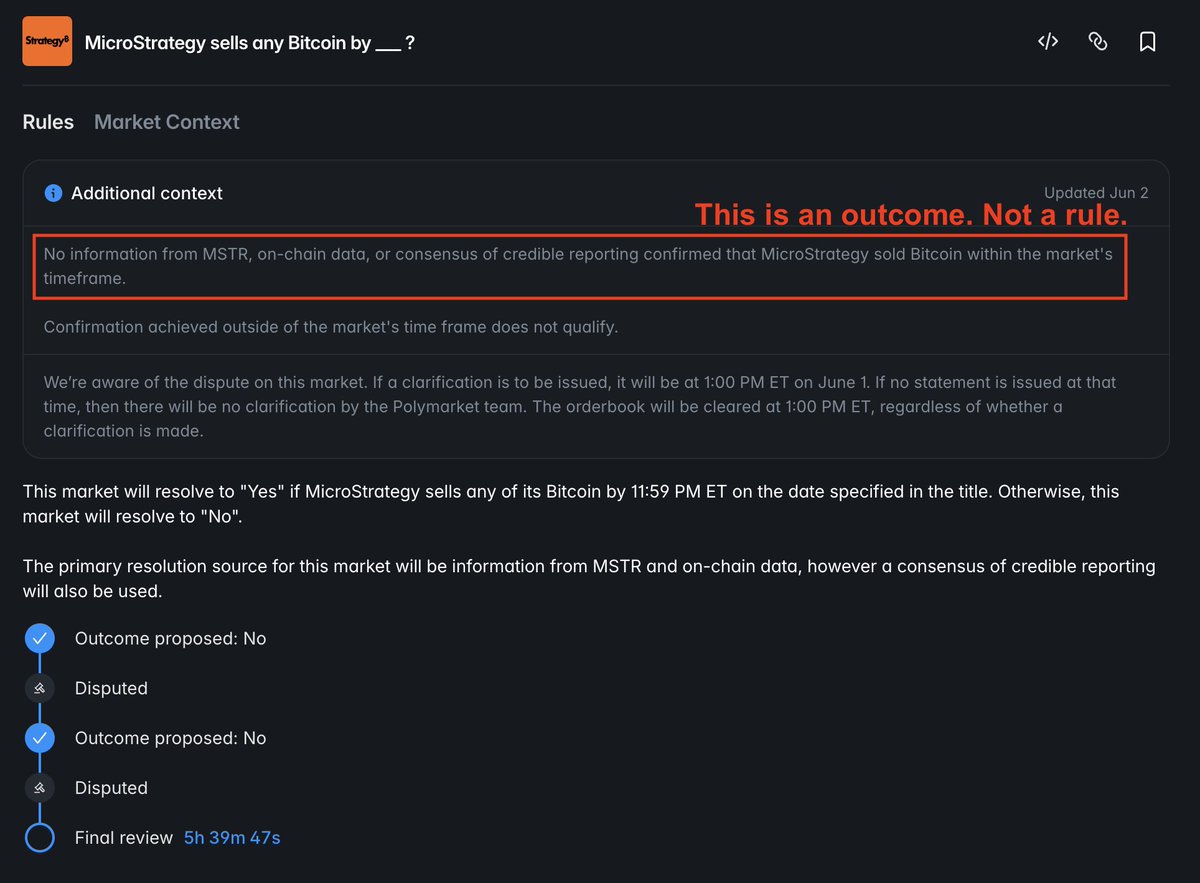
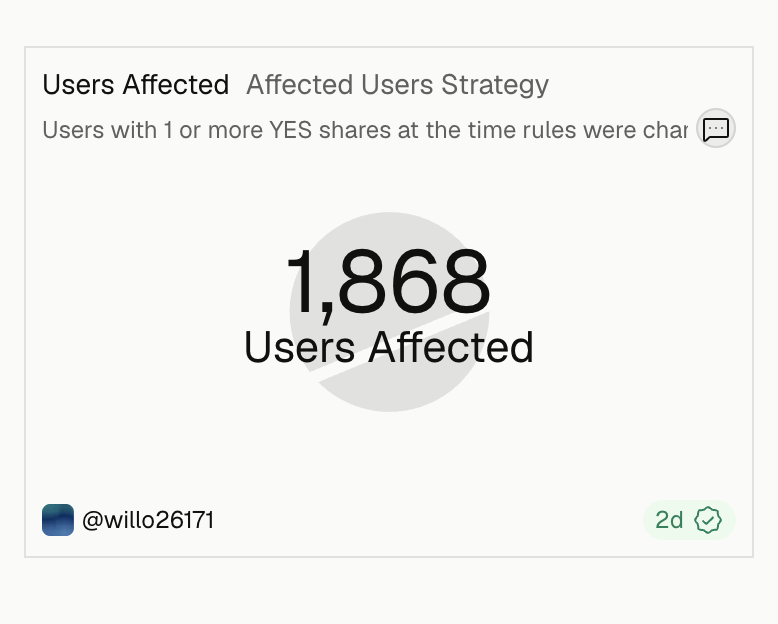
Polymarket scammed 1,868 traders, including me, for $6.5M on the Microstrategy market.
Fact: the average YES share was purchased at 58.6 cents.
Meaning? Almost ALL of the meaningful volume of the Microstrategy market was AFTER the 8K was filed.
The ENTIRE market was a scam.
I got rugged for $500K by Polymarket on "Did Microstrategy sell BTC before May 31st."
But this isn't just about me. Traders put $3.8 MILLION on the correct outcome before Polymarket changed the rules.
They scammed 1,868 people. And we'll fight for all of them.
Polymarket’s biggest risk right now is not Kalshi, regulators, or even the $POLY launch delay
It is the resolution layer
WSJ is now covering how Polymarket disputes are decided by UMA token holders, where voting power depends on how much UMA you hold. That sounds decentralized until a few large wallets can decide what “truth” means for millions of dollars in markets
The Strategy BTC sale dispute made this even worse. Strategy sold BTC between May 26–31, but because the disclosure came on June 1, the May market resolved No while the June market resolved Yes
So traders were not only betting on the event anymore. They were betting on how UMA would interpret the wording after the fact
That is a massive problem
Prediction markets are supposed to price reality, not oracle politics. If Polymarket wants to become the real source of truth for the internet, the dispute system cannot feel like a whale governance game
Launch $POLY, fix incentives, improve resolution transparency, and stop letting the most important part of the product look like the weakest one
It took almost 4 days but this Polymarket employee just admitted it.
I bet $500K on a set of rules that Polymarket wrote. Then, while the market was still live, they changed them.
And they just admitted that they got it wrong. BADLY. So I'll ask again. Where's the money Shayne?
ThE fOur YeAr cyCle iS dEAd
https://t.co/GMiUq4kFWH
If you've enjoyed this Bitcoin Journey over the past 8 years, appreciate a Retweet and sharing on other forums. Thanks,.
Good morning.
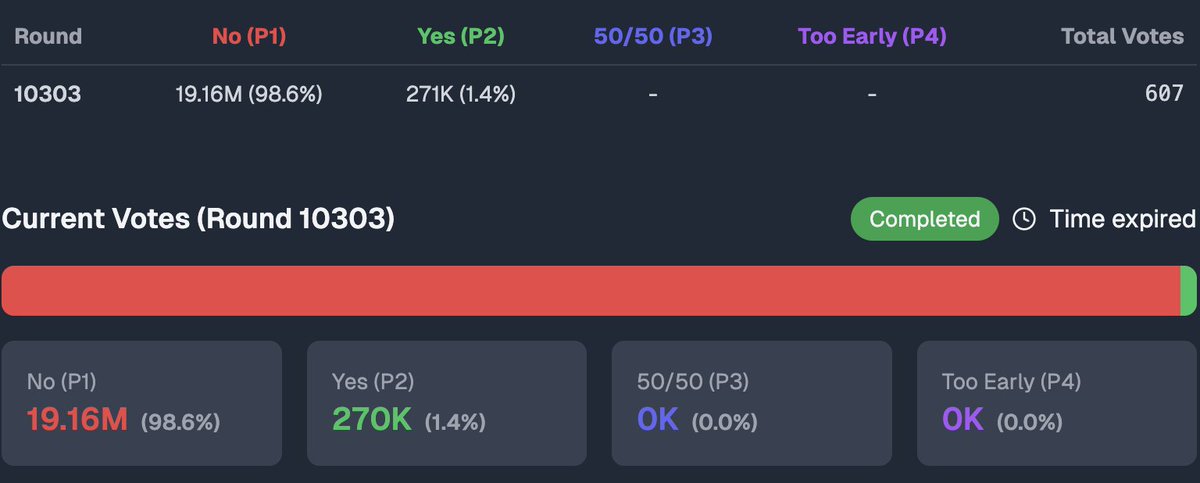
Predictably, UMA was forced to ratify Polymarket's arbitrary rule change and deny reality.
I posted about this last night. The resolution was inevitable. Nothing changed.
The rules weren't ambiguous, Polymarket just broke them.
We will hold them to account.
Here's my honest opinion on the MSTR market resolution.
It will close NO.
This is because UMA is forced to respect the rules as written by Polymarket. Polymarket changed the rules, and now the outcome is literally in the rules.
Even if UMA voters think that this outcome is ridiculous... they are forced to ratify it. They must abide by the rules that Polymarket wrote.
So really... in 5 hours, we simply receive confirmation that UMA is forced to follow centralized Polymarket decisionmaking. Polymarket can change the rules, at any time, for any reason, and UMA are forced to respect it. No voting needed.
So is UMA really that independent? Does UMA hold any power whatsoever? Not really. It's puppet decentralization so that Polymarket can shift dispute blame onto a separate entity.
This market most likely closes NO in 5 hours. But that doesn't change anything.
The scam already occurred. Clearly, the way that this gets solved will not be through Polymarket's internal processes. So let's take it to the next level.
In my opinion, Polymarket made a massive mistake here by changing the rules so brazenly. They fucked up... BAD.
If you're going to rely on a system that offloads dispute blame to another entity, you shouldn't take it upon yourself to cut that entity out of the resolution process. Now, the blame falls entirely on Polymarket's shoulders. This really isn't a difficult argument to make.
Any rational individual who looks at this market can conclude that Polymarket themselves now have the responsibility of this market's resolution. Big mistake, and that's what makes this case very different from prior UMA voting disputes. You can't hide behind UMA now.
Polymarket markets are resolved according to a set of pre-defined and stated rules. Polymarket themselves modified these market rules. The clarification materially changed the conditions for a Yes outcome after trading had already occurred.
Polymarket's own documentation says clarifications "cannot change the fundamental intent of the question."
Clearly, this one did.
Polymarket, your time is running out.