@catholicpat suggested last week that it's your job to fix the parish hopping problem the clergy caused.
The problem is the parish you hate doesn't actually need you.
In fact, the parish you hate, probably hates you even more.
We need to stop pretending, and here's the how and why.
Read our substack below.
@Catholicizm1 This is literally the dumbest thing I’ve ever heard.
Just look at these two. Which one looks like the feminist? It’s pretty obvious.
Lila is on team and you just don’t like being called to discipline.
“…St. Maximilian Kolbe, the Catholic priest who volunteered to die in the place of another man at Auschwitz in 1941.” Terry Sherwood on the power held by Triumph Of The Heart.
https://t.co/XwHjbeAauL #SupportIndieFilm#TriumphOfTheHeart#Drama#WWII
Pick up the crown of thorns.
Not the crown of gold.
Not the crown of success.
Not the crown of escape.
The crown of thorns.
That’s what Blessed Karl of Austria’s story means for you, Christian man.
There are many today who see the coming collapse of civilization and want to run.
To a farm. To a tad enclave. To the woods. Or into sin, distraction, and denial.
Anywhere but here, anything but the cross.
But there is no hiding from this.
This is your fight. You were literally born for such a time as this.
And the hard truth is that God might not have put you here to win.
Maybe He did, maybe He didn't. But what we know for sure is that He placed you here to carry the cross.
And Karl of Austria shows us what that looks like:
The world is at war.
Nations are bleeding to death in trenches.
Empires being wiped from the earth.
And into this chaos walks a young man who is unprepared, unequipped, and utterly outmatched.
Karl of Austria.
Fourth in line to the throne.
Raised for the quite life of a lesser aristocrat, certainly not to be the last of his line in a hopeless fight at the end of an age.
But when God handed him a dying empire, he accepted the cross and saw his duty through to the bitter end.
On his coronation day, as bombs fell across Europe, Karl lay prostrate before the altar like a priest at ordination.
For him the crown was a crown of thorns, and he would let it pierce him.
As emperor, he did all he could for his people.
He refused to authorize gas warfare.
He stood in the trenches with his soldiers.
He spent imperial wealth to feed the poor and shelter the widow.
He once sent officers who he caught denying their duty to the front lines.
He used royal carriages to deliver coal to freezing civilians.
While the war ground on and Europe sent the best and brightest of her youth into the meat grinder, Karl literally risked his throne in an attempt to secretly negotiate peace through what’s now called the Sixtus Affair.
Not only was he betrayed by those closest to him, even the Vatican leaked his letters.
He was mocked as weak by his government and generals.
He knew what peace might cost him.
He tried anyway.
And it did cost him. His efforts to make peace ultimately lead to the collapse of his rule.
But even as his rule collapsed, betrayed by all, he did not abdicate and attempted to regain the throne twice.
Because for him, the crown was not his to surrender.
It was God’s.
You don’t throw away the cross just because it’s heavy.
In this way his life shows us EXACTLY what the life of the lay man ought to look like. The pursuit of power and it’s use for the common good.
All lay men are called to this sacrificial kingship.
Ultimately, Karl and his family was exiled to Madeira.
His family lived in a moldy cottage on a windswept hill.
He chopped firewood.
He prayed the rosary.
He went to daily adoration.
He suffered.
And he gave thanks.
On New Year’s Eve, 1918, with his empire gone and his friends vanished, he still insisted the Te Deum be sung.
“If we receive with thankfulness all the good things from God, how much more should we receive even the most painful things with thankfulnes?”
Then he got sick and died.
He was only 34.
His last words, eyes on the crucifix above his bed:
“Yes, yes, as You will, Jesus.”
So no, Christian man, you are not here to win.
You are here to take up the burden when others run.
Because this is not your war to win.
It’s your war to fight.
In the kingdom of heaven, Holiness is the greatest victory.
So pick up your cross.
Pick up your duty.
Pray with your family, even when your wife rolls her eyes.
Start the men’s group, even if it’s just two of you.
Sit on the school board. Read the stories of the saints to your children.
Build a business and employ other Catholics.
Because the crown you’ve been given is not for comfort.
It is for sacrifice.
Just like his.
Blessed Karl of Austria. Pray for us.
@TaylorRMarshall I can’t applaud this enough. The entire point of stained glass is destroyed by bright, garish leds. Restaurants understand that the best meals should be appreciated with candlelight and intimate shadows. Why should we consume the Eucharist under blasting white LED sconses?
Rebuilding Christendom doesn’t start with civilizational projects. It doesn’t even begin within your own family or community. It begins with you. More specifically, with you and God.
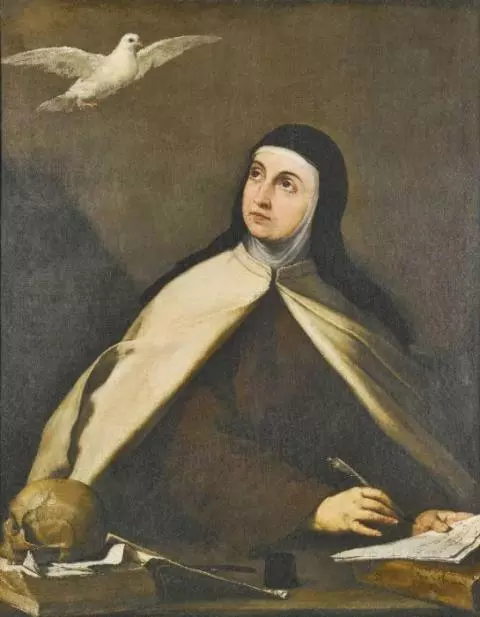
St. Teresa of Avila, born in 1515, grew up watching Europe devastated by the spread of Protestantism. Concerned for souls and for the life of the Church, she dedicated herself to reforming the heart of the Church: the contemplatives. 🧵(1/6)
We pray in particular for the cause for canonization of Nicholas Black Elk, Lakota catechist, visionary, and survivor of Wounded Knee. Through his example may all come to know the truth of the Catholic faith and receive the saving grace of God.
Stop embracing poverty and consumerism, and start managing your money, Western man.
St. Thomas More is a case study on how a layman must manage his money if he wants to be of use to God. His example shows us that men of Christendom ought to acquire wealth and position, and manage these with diligence.
St. Thomas More was England’s wealthiest and most powerful man outside of the King. As England’s under-Treasurer and Chancellor, More used money and power to promote causes he believed in. Today, more than ever, Catholic men must pursue wealth to advance the common good, support families, and fight evil. In the absence of good aristocrats, evil men will rule. 🧵Thread 1/7
Be the bastard that sets sail.
Thats what the battle of Lepanto means for you, Western man.
There is much “The Church saved the West at the Battle of Lepanto” posting. This simply plays into the Catholic failing of waiting for our hierarchy and our institutions to win the battle. Nothing could be further from the truth. Lepanto is the story of how the least likely man risked everything for the sake of the Cross.
This is the lesson we need the men of Christendom to learn.
Here’s the story:
In 1571 as the Muslim fleet threatened Europe, Christendom was deeply divided. Protestants fought Catholics. France fought the Holy Roman Empire. Christian princes even allied WITH the Muslims against their Christian brothers.
They were all too self seeking to see the threat and and answer the call.
But one man—a bastard with no lands and barely even a title—takes weapons from the wall and rides to the sea.
Don John of Austria.
Who was Don John?
He had no throne. He was the bastard son of Charles V and a burgher’s daughter from Regensburg. Raised in obscurity, not even told who his father was.
When his half-brother Philip II finally acknowledged him, it wasn’t with lands or title, just a name and a small allowance.
Among the princes of Christendom he was the last man you’d pick: No inheritance, no wealth, no claim to rule.
Yet when the Ottoman fleet gathered in the waters just beyond Italy, this forgotten son was the one who answered.
Because no one else would. Yes, the Pope called for the defense of Christendom, and that is more than we have today.
But no one sent Don John personally. No one gave him the wealth to outfit an army. The most likely outcome was that they’d all die.
Don John went because someone had to. That’s the pattern of every important battle in Christian history.
One man, alone, often betrayed by his Christian brothers, under resourced, with only a small band of bedragged warriors, standing in victory against the pagan hordes.
No Crusader victory was ever a triumph of Christian unity. Most of Christendom sat Lepanto out.
France stayed home.
Protestant Europe stayed home. Even most of Italy stayed home.
The Holy League was a minority of the willing.
A handful of ships and a handful of men who made the decision to go.
And that’s the truth.
History turns on the ones who go. Not on the ones who wait for orders. Not on the ones who whine about the hierarchy.
The ones who go.
Western man today stands on another shore. The pagan fleets are at pur shores again. Our clergy are cautious, our politicians are compromised, our institutions asleep.
So what now?
You the do the same thing Don John did.
You go.
You—yes, you.
The one drowning in debt, struggling to marry, priced out of a home. The one nobody anointed. The one nobody expects anything from.
You are who the West needs. Because you’re willing. Don’t wait for unity. Don’t wait for permission.
Lepanto was won by those who showed up with the mind to take it.
The fleet came AFTER the resolve.
When Don John hoisted the Cross over his ship, he didn’t know if it meant victory or martyrdom.
But he knew it was his to carry.
That’s the moment we’re in now. Carry the Cross. Row into the storm.
Go.
Only you can man your galley.
Volunteer to start a security team at your church. Join your school board
Start a group chat or a fraternity and read Chesterton Lepanto together.
It probably won’t look sexy.
But this is your galley.
This is how Christendom is saved.
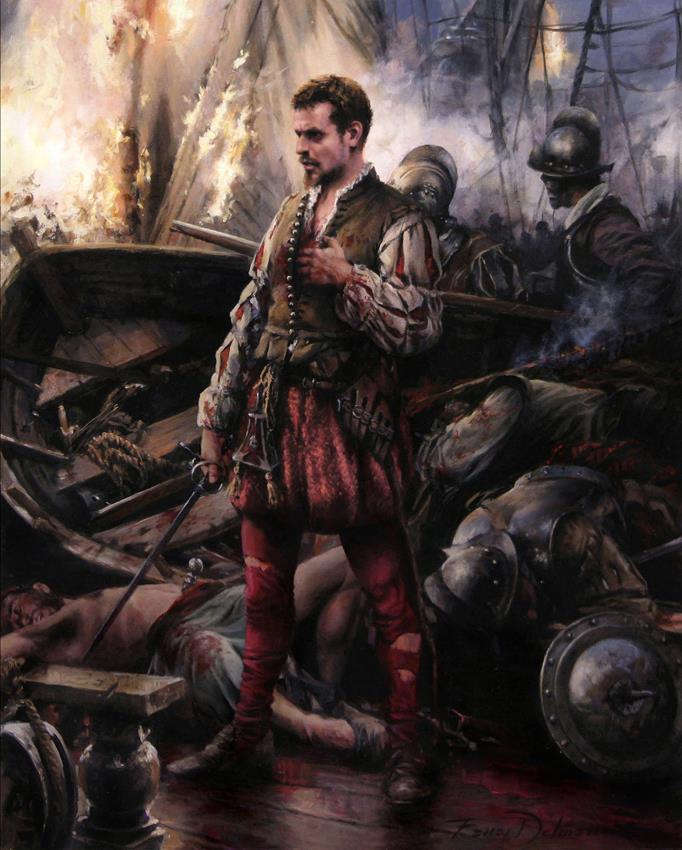
Don Quixote is no cynical deconstruction of the ideal of chivalry, but rather a timeless masterpiece on the necessity true virtue. Its author, Miguel de Cervantes, knew this because he saw it firsthand, fighting on the decks of the galleys on October 7, 1571. 🧵