I thought they're called Metroidvania's cuz Super Metroid and SOTN came out around a similar time but I just learned SOTN came out like 3 years later so why aren't they just called Metroidlikes, did SOTN introduce something unique that became a permanent fixture in the genre
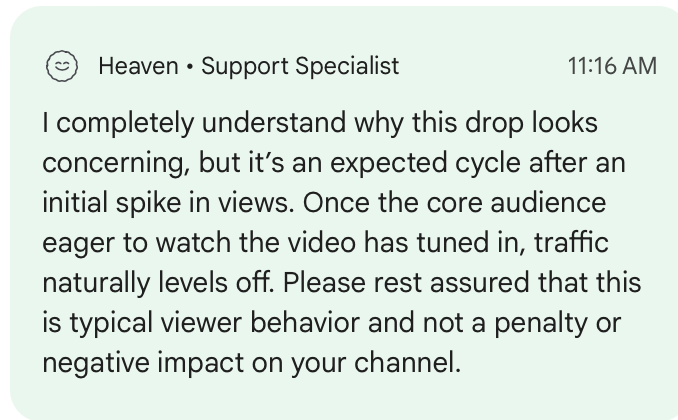
@TeamYouTube There is a clear, visual flatline in views for a week in the "Since Published" filter for my newly released video, indicating 0 gained views - erasing 10k+ views.
I simply wanted to report the issue, yet kept getting gaslit that there was no discrepancy.
Hey @TeamYouTube is there are reason your support team is trying to gaslight me into believing there's no analytics reporting discrepancy?
"Since Published" filter shows 0 gained views from August 8-August 13. Yet, as you can see, that was my peak viewership for a new video.
This is the longest video I've made by a long shot. I hope people enjoy and want to hear ramblings about Zelda: Link to the Past Design for way too long...
https://t.co/AFTa0bb8Do
Just an example of how pointless YouTube's new view system is. I'm glad to know 10k more people hovered over my video without clicking on it, or it autoplayed and they clicked off. That's what CTR was for.
So weird to see people bragging on how great their new videos are doing.
Honestly, excited for so many announcements between yesterday's Zelda Direct and today's Nintendo Direct.
I guess I'll always be a Nintendo fanboy at heart.
Ocarina of Time remake looks fantastic.
Really curious to see how the added ability to jump at any time potentially changes up gameplay. That was what I wanted as a kid.
Sorry it's been a hot minute since my last video.
Link to the Past video is now the longest video I've ever made.
Hopefully it should be done sometime next week, I guess in celebration of the 40th anniversary Zelda Direct.
Video game speedrunning might be the largest misallocation of human capital of all time
You have 150+ IQ gigaautists devoting their lives to beating Mario Kart levels 0.00001 seconds faster instead of curing cancer or something
@Aresdotexe I also recall with both Dragon Age and Suicide Squad hearing that upper management wanted them to be live service games, and that really screwed over the development cycles.
So "Trust" aligns with reviewers specifically trying to agree with what they think the general masses will think.
It also doesn't take into account outlets have several individual reviewers.
This is what happens when biased people claim to be "unbiased"
https://t.co/kZfR4nVOtt
Hey folks,
I'm launching a website today: https://t.co/JolbgwKsO7
It started as a little database I built for myself. I use Metacritic and OpenCritic a lot and they're clearly useful, but to me as a designer the user experience always felt a bit lacking.
Then the thing kept growing, and at some point I realized it had become genuinely useful for any gamer, not just me. So here it is, for everyone.
My main problem with the existing aggregators: Their scores tell you how the press felt about a game, not how players did.
That made sense 20 years ago. I cared a lot what GameSpot gave a game back then. But today we can actually measure how players felt, and to me that will always matter more than how the press did. On https://t.co/JolbgwKsO7, players hold at least two-thirds of every score, by rule. Press still counts, it just can't outvote the people who bought the game.
The other big problem: Those sites rate a game once, at launch, and then never really touch it again.
But that's not how games work anymore. A game can launch rough and get patched shortly after, but on Metacritic and OpenCritic it carries that scarlet letter forever.
No Man's Sky is the obvious example: Famously rocky launch, and Hello Games has spent the years since relentlessly improving it. Its Metacritic score has never moved. On https://t.co/JolbgwKsO7 it launched at 50 and sits at 82 today, because scores here are LIVE: launch-era reviews fade out over time, and reviews written after a significant patch count the most. When player sentiment changes, the number changes. Simple.
And since press does still count, I ended up reviewing the reviewers too. Every outlet and creator gets a trust score based on one question: When they reviewed a game, did players end up agreeing? You can see who consistently calls games the way players see them, and who doesn't. Again, simple and fair.
And everything is transparent. Every game page shows exactly how its score was computed, and the full methodology is public. No editorial opinion, no magic number.
Anyway, I hope you get a kick out of it! Even just as a way to see the best games on each platform, find something you missed, or browse a site that isn't wallpapered in ads, I think it's already pretty useful.
Enjoy!👍❤️
@Aresdotexe I think the thing that's worth pointing out here is that these were "woke" games that were supposed to appeal to reviewers, but the "woke" reviewers thought they weren't good games.
It speaks (to me) that bad games don't sell well, more than anything else.
@Aresdotexe But does that give them a little more weight, if there's a team of gamers at an outlet who have decided they can trust the person to write a review? Sure.
@Aresdotexe I'm not saying customer reviews aren't helpful, by the way. But I'd expect a professional game reviewer to have played many games, have a deep background in gaming, be checked by a Senior Editor, and be a good writer.
Does that mean I'm more likely to agree with them? No.