Repost + follow if this helps 🙏
Most verse-of-the-day apps hand you a verse and leave. Daily Bread stays with it 📖
• Your translation
• What it meant then
• A life application for today
• A reflection + prayer prompt
Free Grok Bot template 👇
https://t.co/QSZ3CZzTS5
@ethanwalkerman Agree that trust is the bottleneck now. What built it for me was a few simple rules: drafts before sends, nothing involving money without my OK, and a log of everything it did, so I can check the work instead of hoping.
@thesupermannx This matches what I see. When I hand the AI my guess first, it tends to agree with me, so now I have it work the problem on its own and only then tell it what I think.
@NicolasZu The always-on machine is the piece people underrate. Once my bots had their own computer that never sleeps, scheduled jobs stopped depending on whether my laptop was open.
@FlipFlip Restock calls are a perfect bot job: boring, repetitive and time-sensitive. One tip: have it log every answer with the store and time, so after a week or two you can see which stores actually restock on which days.
@witcheer That's the pattern that made my routines worth keeping. A cheap check runs first and the model only gets called when there's something new, so quiet days stay quiet and the reports stay short.
@TGWorldPlus Every summary should point to the exact lines it came from, so you can check a claim in seconds. I also have my bots mark anything they couldn't verify as missing instead of filling the gap.
@bendee983 Keeping the picks and handing off the chores is how I split it. My bots research and draft, but what goes on my channel is still my call, because taste is the part you can't outsource.
@knoxtwts The jump that mattered most for me was giving the AI a standing file with my rules and examples, so it stopped starting from zero every chat. My bots read a short handbook before every job now, and the drafts come back much closer to done.
@markshaw That's how my bot team started too: one small job that worked, then a second bot with its own job. Keep each one doing one thing and the scared-of-automation feeling goes away fast.
@Mahaximus_ One habit that keeps bot memory useful: every so often, ask it to list what it remembers about you and delete anything stale. A short, current list beats a long one full of old preferences.
This matches what I see as a regular user. Swapping models barely changes my results. Writing down the job, the rules and what done looks like changes everything.
The founder of n8n thinks AI models are becoming a commodity.
We asked Jan Oberhauser, founder and CEO of the $5.2B company, what n8n really sells today:
1. The intelligence of the models is commoditizing
2. The value is moving one level up, to the process around the AI
3. For critical work, AI alone isn't enough
4. You need AI, deterministic logic and a human in the loop for decisions that can't be reversed or cost a lot if they go wrong
5. That combination is what lets a company trust, audit and own an AI process
The bet behind n8n's last two rounds: whoever controls the process wins, whichever model runs inside it.
Full breakdown here:
https://t.co/z6Oq4galsT
@liminal_warmth Same experience here. Asking the AI why it did something, not just what to do, is where most of my learning came from, and now I can spot a bad fix before it ships.
@LiamEtherson Finishing the job is the whole thing. The biggest jump I saw came from telling my bots what done looks like up front and having them check their own work against it before they hand it back.
@Anni_Maan Rule 1 is the one I'd tattoo on every agent. I'd add one more: if an email asks the agent to click, pay or forward something, it flags it for me instead of doing it, even if it looks legit.
@Hartdrawss One bot per work stream is the right call. I learned the same thing running crews: give each job one owner, and the handoffs get clean because everyone knows whose desk it lands on.
@Fred834567 I run almost the same setup, and the fix for me was a reviewer bot between the team and me. Nothing reaches me until it's been checked, so the chief of staff hands me a short list instead of a pile.
@ankurnagpal The adapt step is where most people cut corners. What worked for me was giving the bot a short style note for each platform, so a LinkedIn version doesn't read like a pasted X post.
@Michael_Fenech_ The lesson that stuck with me is giving each bot one job and a one-line description of it. Once my bots stopped overlapping, I spent a lot less time fixing work and a lot more time approving it.
Same thing I saw developing technicians: the ones who grew fastest had someone who pushed back. My most useful bot is the one whose only job is finding what's wrong before anything ships. An AI that agrees with everything isn't a teammate.
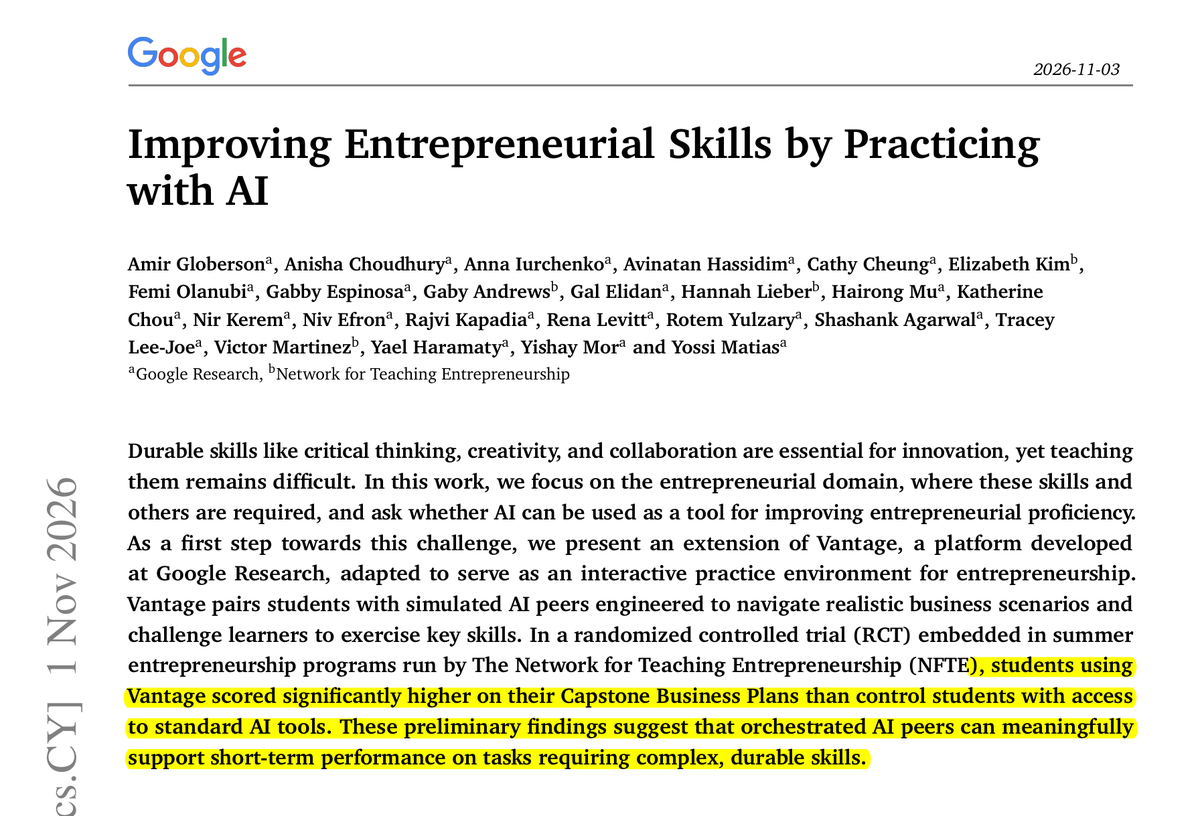
New Google paper finds that students who practiced with AI teammates that push back wrote better business plans than students using normal AI tools.
Skills like critical thinking and collaboration matter for starting a business, but they are hard to teach and hard to practice at scale.
They extended Vantage, a Google Research platform where students solve business tasks in chat with AI teammates run by Gemini 3.1 Pro. The teammates pitch flawed ideas, disagree, and state false claims, but never do the task for the student.
In a trial with 52 students, the Vantage group averaged 67.6% on the final business plan, versus 60.5% for controls using standard AI tools. Students who did 5 to 6 practice tasks averaged 79.7%, while those who did none scored 59.3%.
If you build AI for learning, make it a teammate that challenges people, not an assistant that finishes their work.
@techkzar Agree, and the AI part works best after you've done the job by hand a few times. Once you know what good looks like, you can tell it exactly what you want and catch it when it's wrong.