This is a good formulation of working with AI agents, especially since it underlines the importance of understanding the problem you want to solve before handing it over to the agent.
A slight change I would make in the handoff stage:
Formulate the problem into a verifiable goal -> define an optimization loop based on the verifiable goal -> hand off to your AI agent.
human in the loop: find a new problem and figure out a new idea -> try to make it happen (at least prototype) -> learn the first principle -> hand it off to your mates/agents
Neon is the first AI model where I don't get tired reading the responses. The language is not frustrating, it is not too long and verbose. It has the right amount of details. I feel like I'm in control and understand my options and the path forward.
I don't know what the Google DeepMind team did, but this is a really good model and the kind of progress that makes you hopeful about AI-human cooperation.
Anything that a human interacts with. In writing, it's the words themselves. So you can have AI do the research for you or even write the draft if you want. But you have to make sure the final product is your voice and your words (so it requires heavy editing).
In software, the human touchpoint is the end product. So AI can write the code but you have to make sure the user experience is what you expect it to be and that it solves the actual problem that the intended audience is facing.
Two big mistakes you can make in relation to using AI:
1- Ignore it altogether and dismiss it
2- Become a "meat proxy" and completely relegate your thinking and decision-making to the LLM
In my experience, the right balance is to focus your efforts on the human touchpoints and use AI for the middle work. That helps you maintain ownership of the output, remain original, and stay in control.
If you don’t use AI in coding, you’ll be considered a luddite. If you use AI in writing, you’re considered a fraud. There are valid (and invalid) points in both perspectives.
https://t.co/TXvtKWBuiy
Again, I find myself agreeing with John. AI skill erosion is real, and it's your choice. The less you do, the more you forget. There is nothing wrong with using AI to increase your productivity. There's everything wrong with surrendering your mental faculties and cognitive abilities to LLMs.
Practice "AI detox," where you try to do things without the help of AI (I actually take it to the extreme and don't even use Google): Write an essay, write a blog post, or even start with something small, like writing a social media post, or record a podcast for yourself in which you explain a topic or lay out an argument.
Remember that if you don't use it, you lose it. And don't try to console yourself that AI will get better and do all those things. The one thing that keeps you competitive is all those things that AI can't do (and there's a lot) and keeping those abilties requires practice.
Skill erosion from AI is still your choice.
Yes, even when you’re under pressure to deliver faster.
Yes, I’ve heard the objections! I’ve had a lot of people argued that they don't have a choice. Their employers expect far faster delivery, so there’s not time for anything but shipping.
And if they don’t ship, they risk losing their jobs.
I understand that. I know the pressure is real. I know people have bills to pay and families to support. I do too.
But here's the brutal reality. Your employer wants it done as quickly and cheaply as possible, they don't care about your skills, your craft or your future employability.
No one, especially not your employer, cares about you anywhere near as much as you.
And you should care about your current AND future employability.
You may not control your deadlines, your workload or your employer's expectations. But that doesn't absolve you of responsibility for your own career.
Having a difficult choice is not the same as having no choice.
And taking ownership of your professional development doesn’t have to mean finding hours of spare time every day.
- Spend 15 minutes solving a problem without AI at work.
- Watch a software engineering talk over lunch or on your commute.
- Read a few pages of a technical book or a blog post over breakfast.
- Spend 15 minutes understanding the code AI generated instead of blindly accepting it.
- Swap a little time scrolling social media for deliberate practice.
- Get to meetings early and read in that time and whilst you wait for all the people who are late.
Find one, two or more 15-minute slots each day to invest in yourself, your skills and your future employability.
You spend hours every day delivering value for your employer. Make sure you’re investing some time in yourself too.
So yes, it’s your choice.
It’s also your career and your livelihood.
Own it!
Don't bet against AI when it comes to:
1- Processing speed
2- Memorization of facts
3- Replication and transfer of knowledge
Don't bet against humans when it comes to:
1- Intuition and innovation
2- Making sense of messy situations
3- Sample efficiency
4- Continual learning
AI and humans doesn't have to be a race for elimination. The complementary power is so much more than replacement.
Handing out resets on AI token limits is a band-aid approach to keeping users happy. The real solution is to optimize the AI inference stack and give developers the assurance that the added usage they're getting is not a limited dopamine hit that will go away as soon as funding dries up.
Aside from advances in the models themselves, there is so much room to create value at the inference layer. Enterprises deploying AI at scale want to get the biggest bang for the buck, not necessarily the most intelligent model.
We've increased the cache hit rate for Neon in Antigravity again by another 4.5%. This means you can complete 28% more tasks within quota.
In the last 5 days, we've effectively increased Neon usage on the subscription by close to 75% through caching and harness improvements!
I've been thinking about this a lot as I've watched AI models crush different benchmarks, including METR's 50% and 80% success rates on long-horizon tasks.
What those benchmarks don't account for is the cost of the human bottleneck. For example, if an AI model manages to successfully accomplish a 20-hour-long task 80% of the time, then we're assuming that the other 20% require human intervention. But how long does it take a human to debug a failed task with a 20-hour time horizon?
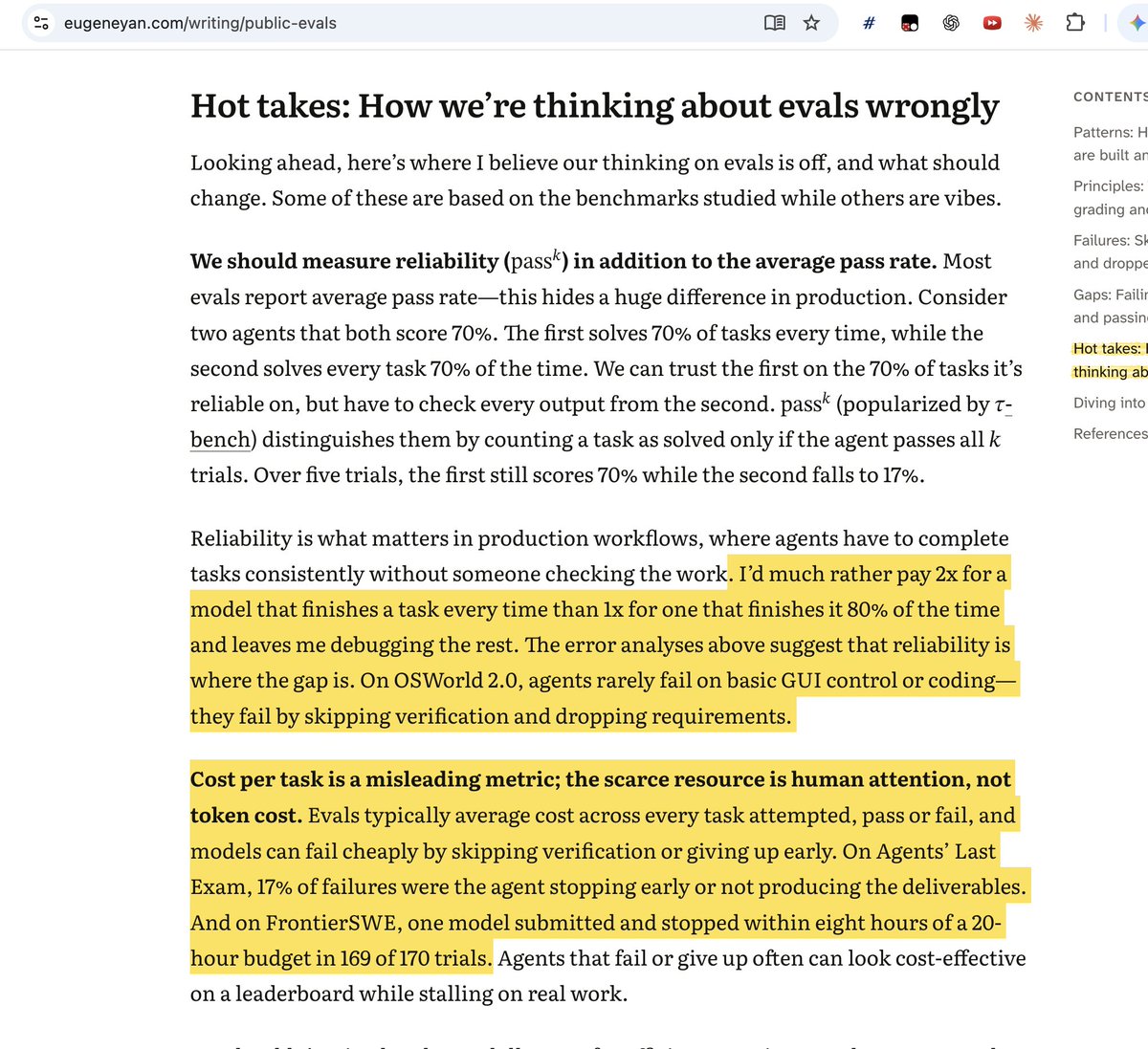
In general, cost-per-token or even cost-per-task are very vague indication of an AI model's ultimate performance. We always need to account for the scarcest resource, which is human effort.
"Cost per task is a misleading metric; the scarce resource is human attention, not token cost."
beware the pareto frontier charts that make you believe you can reduce every model to 2 numbers; it can hide some AWFUL reliability issues👏
This is a problem I face regularly on all current AI models. When you ask them to review something (e.g., review code), it will almost never say the status quo is okay and will always make suggestions (which frequently tend to be irrelevant).
My intuition is that this is the result of aggressive reinforcement learning, which forces the model to return an answer that would be satisfactory to the user (even if it is factually incorrect).
This only stresses the importance of using AI in fields where you have the expertise to opine on the model's response. If you can't make a decision on the suggestions the AI makes and are blindly accepting all of them, you're going down a very dangerous path.
I sent code for review to Opus 5.5.
It found 10 improvements.
I had to decline all of them. They were completely irrelevant and only making the code worse.
@vamsibatchuk Absolutely. New design patterns, new practices, new workflows. We have an opportunity to build better, faster, and more secure than ever if we do it right.
This is so true. One-shot examples are good for flexing how good AI models have become. But almost none of those examples have value beyond posting on social media.
The real value of AI models comes from mastering the art of iterating with the LLMs to create something of real value. In my experience, the models are very useful in all the stages of the software development lifecycle. They can help you navigate requirements, decide and iterate on prototypes, design for production, and handle aspects such as security, scale, and maintainability.
Learning and teaching the tricks and nuances of iterating with AI agents has a lot of value. It might be a bit boring and not as flashy as one-shotting a 3D game, but it has a lot of real-world value.
stop flexing one-shot builds. start flexing iteration craft.
models got insanely good so you could spend more time on storytelling, narrative, and making something people genuinely love using. building is solved. taste and distribution win now.
The human bottleneck keeps on moving as AI continues to progress across the software development lifecycle.
We went from:
AI autocompleting human-written code
To:
Humans reviewing AI-written code
To:
Humans writing tests for AI-written code
To now:
Humans reviewing AI-written tests for AI-written code
You have to understand where the bottleneck is and how you can become more efficient at it.
So much of internet traffic has become AI agents probing into different websites and services. And a lot of it is failures because AI agents just do random stuff and fail a lot.
There is a lot of room for improvement and optimization to make sure AI and human traffic don't interfere and disrupt each other.
How damn there is SO MUCH probing happening for all of my API endpoints and websites: invalid OAuth callbacks, guessing API paths, malformed JSON, oversized bodies, and unsupported compression
Like everyone turned on AI agents to try to hack every random website
Predictable but still damn annoying
I would bucket AI evals into two broad categories:
1- Practical evals: These are benchmarks that will help you decide whether to use an AI model for a specific tasks. The benchmarks (here I'm mostly talking about private evals you build in-house for your bespoke applications) are mostly saturated by current generation of AI models and you want to make speed/cost-efficiency decisions based on where a model stands on the cost/accuracy Pareto frontier.
2- Forward-looking evals: These are benchmarks that test the limits/capabilities of frontier AI (e.g., HLE, ARC-AGI series, etc.). The goal is not necessarily to make a practical decision on which model to use but have a sense of where the current frontier stands.
The former needs in-the-weeds experience and data building with AI. The latter requires vision and experimentation and intuition on where to go next with AI.
i’ve come to think of eval design as a genre of sci-fi. we treat benchmarks as objective measures of progress, but they reveal something more interesting: our subjective beliefs about what the future should look like. in 2022, we wanted models to ace the SAT; in 2026, we want them to make scientific discoveries and self-improve. the art of evals is in having visions of the future that aren't yet obvious to everyone else!
Two extremes in dealing with advances in AI:
1- Convince yourself that AI is (or will become) better than humans at everything. Just surrender to it and forget about learning software engineering, math, science, etc.
2- Strive to learn (including with the help of AI), experiment with the technology, find the areas where AI struggles and human intelligence gives you the edge, deepen your knowledge/skills in specific areas to make you a better user of AI
People who think like (1) will be replaced by people who act like (2)
Skill erosion from AI is a choice.
Every time you use AI, you have an opportunity to become a better software engineer or to reduce yourself to a meat proxy.
If you let AI do all the thinking, coding, debugging, testing, and reviewing for you, your skills will fade.
But if you use it to challenge your assumptions, expose gaps, generate alternatives, and accelerate deliberate practice, you’ll become a better software engineer.
AI doesn’t decide whether you become a better engineer or a meat proxy.
You do.
Every few weeks, there's a new discussion about AI consciousness. But we can't even get scientists to agree on a clear definition of consciousness.
Meanwhile, this whole discussion distracts us from the dangers and threats of the non-conscious AI that is already being used.
We don't have the right practices and guardrails to make sure AI agents are safe and don't go haywire. But we're having long discussions on AI personhood and qualia.
Before AI agents, we were versioning the code. Now, we are adding more layers of versioning on top of the codebase.
Keep track of changes to the AI agent, including the harness (skills, prompts, code, etc.), models, and other elements, and run them agains your internal evals. That will help you spot improvements/degradations and be able to roll back changes as well as create loops where agents can improve themselves.
If coding agents are becoming part of how your company builds software, their setup shouldn’t live in someone’s head, or even on an individual's laptop.
Define the agents, their roles, their skills, their triggers, and their workflow in shared code.
That makes the factory versionable. You can test a change on a branch. You can see what changed. If it makes things worse, you can roll it back.
It also opens up a possibility of agentic self-improvement: an agent can identify a recurring failure and propose a change to the factory definition itself.
The goal isn’t a perfect configuration on day one. It’s a system you can deliberately improve.
Wow. Who would have thought that using AI to push 1000x more code into production (and often by people with near-zero coding experience) would cause immense technical debt and backfire at some point?
There will be a regression to the mean. Orgs will learn to develop disciplines around the use of AI coding agents. Ownership and maintainability will take on a more prominent role.
We will collectively learn to harness AI for higher productivity (but it will not be 1000x).
Bosses who pushed AI at work are now drowning in “workslop,” the polished-looking but low-quality AI output that colleagues have to fix, per Business Insider.
Some companies are responding with new AI policies and even firings.
The hardest part of my job as an engineering lead was to make sense of a client's demand. It's not like every person knows the exact shape of the software they need. Sometimes, they don't even know how to express their exact desire. That part won't change with AI writing the code.
It takes experience to bring order to that chaotic mess, figure out which problems need to be solved first, which direction provides the best possible path to the solution. AI will surely help with that. But you first need to develop the right mindset.
The irony of AI making everyone a coder is that most people struggle to explain what they want their software to do.
And every experienced software engineer knows that was always the hardest part.