Dug deep this week and found a great and hard hitting perspective on #COVID19 given all news channels flashing feb-2021 as vaccine date and end of the deadly virus! #irony#COVID19India https://t.co/IxtmP5wjsc
@vaibhavbetter Similar to neighbourhood medical stores, there are individual doctor neighbourhood clinics trusted by an excess of 50% of the population living in tier 1,2, 3. Point being, if the neighbourhood clinics and medical stores can talk to each other, it's a revenue stream for both!
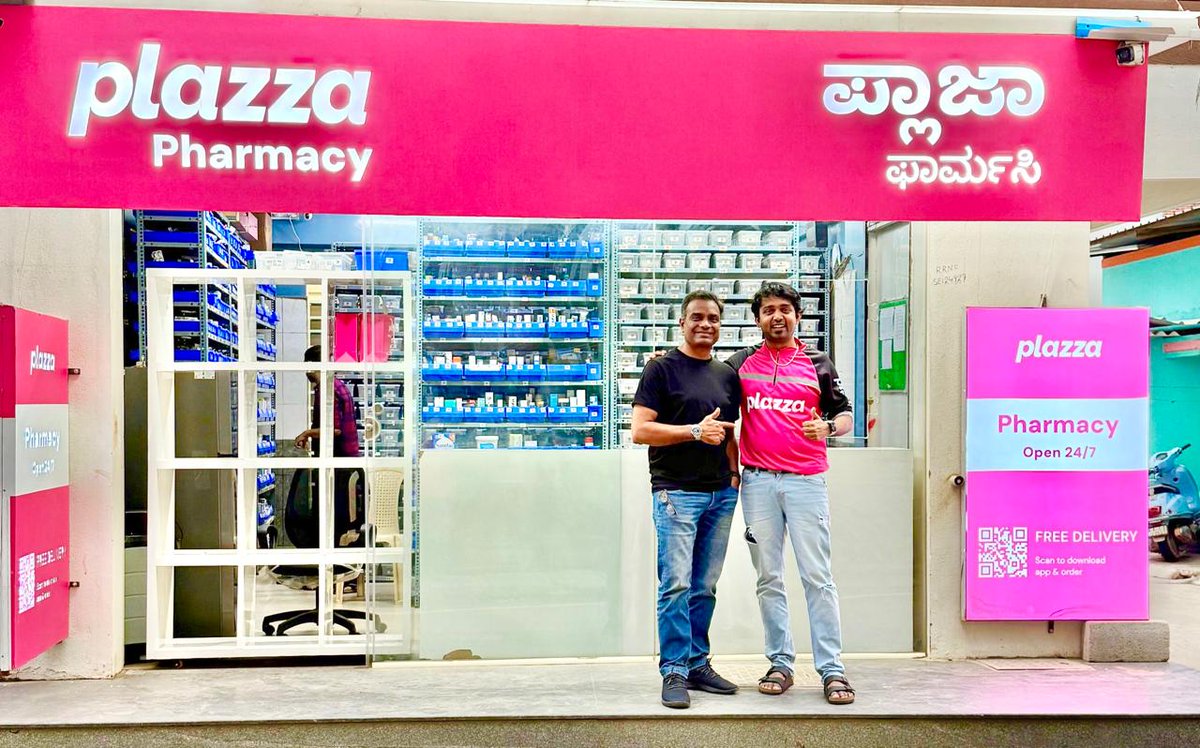
We have invested heavily in our "Quick India Movement" thesis since 2023/2204 so when Plazza came along it was a no-brainer because we were already clear on how broken the customer experience was and Aman Priyadarshi had THE clearest articulation of the entire problem AND the solution.
This was a one call commit for us - my long zoom call with Aman ended with a clear and firm commitment to invest right there with no qualifications whatsoever...Aman was THAT good on that call. He took the call from the Plazza store, his store members were moving around in the background, he was wearing the Plazza gear (which is the only thing he always wears) and appeared like he had just come back from delivering an order (which might have been the case) and during our discussion he would walk towards the shelf behind him to grab a medicine to show me the QR code he was adding to them to explain how to use them etc. It was a like a pitch and a live demo all in one right from the store. I had never seen anything like that.
Over the next several months, I saw Aman and team execute every piece of the puzzle brick by brick to create a machine like nothing else.
We are have along way to go but I am amazed how far we have come in such a short time, how many pitfalls and mountains we have tackled and excited to be a tiny part of this mission.
Super grateful to all friends and co-investors in this round - $15M Series A led by Accel, Nexus Venture Partners and Elevation Capital - as well as the founding stage one, All In Capital. They say it takes a village and this is one incredible village assembling around Aman and Plazza.
Kudos team, and thank you for bringing us along for the ride!
NEW: BodyPark launched a pocket-sized AI camera that coaches your workouts.
BodyPark ATOM watches your form, counts your reps, gives real-time voice feedback, and builds workout plans around your goals and equipment.
-34-point skeletal tracking maps your movement
-Auto-counts reps so you can stay in the set
-Voice cues correct your form in real time
-160° ultra-wide camera captures full-body exercises
-SmartPath tracks bar path, center of gravity, range of motion, and power
-AI creates workouts for strength, HIIT, Pilates, mobility, and recovery
-MagMount design clips onto racks, tripods, desks, or gym setups
Pricing is $219.
India pays a premium for the privilege of not learning anything :)
Every Indian car Tata, Mahindra, Maruti, all of them has a tiny computer inside called an ECU (Engine Control Unit)
This computer decides everything - how much fuel to inject, when to shift gears, how brakes work, how the battery behaves in an EV. Think of it as the car's brain.
India makes zero of these brains for passenger cars. All of them come from foreign companies, mainly Bosch (Germany).
If you don't control the brain, you don't really control the car. Indian OEMs can't even add a simple valve to their own engine without asking Bosch for permission.
They can't change a single line of code. They are selling cars with someone else engineering inside.
This isn't really about technology being too hard. It's a business model designed to keep you dependent.
Three layers lock you in :)
First, every new car programme needs Bosch to do setup work (Rs 10-30 crore). Second, you pay full price for software Bosch already developed for Volkswagen so Bosch gets paid twice for the same work.
Third and this is the killer every time you want to change anything in the software, even something tiny, it costs around $500,000. So Indian OEMs simply stop trying to innovate. They accept whatever Bosch gives them.
The calibration trap means tuning the car's brain for Indian conditions, how should the engine behave in Ladakh cold vs Chennai heat?
Indian OEMs outsource even this to AVL in Austria. AVL reuses work they already did for European cars, charges India full price, and transfers zero knowledge. So Indian engineers never even learn how their own cars work from the inside.
What Korea did is Hyundai faced the exact same situation in 1987. They set up Kefico as a joint venture with Bosch, learned everything from the inside, and by 2015 they owned the full technology themselves.
The sequence was simple - first learn calibration (tuning) → then write your own software → then build your own hardware. It's a ladder. India never climbed the first rung.
Why India didn't do this - It's not a talent problem Indian engineers design ECUs at Bosch offices worldwide.
It's a combination of things like Indian OEMs won't fund Indian startups to develop alternatives. They demand that Indian suppliers first prove themselves in Europe before getting a chance at home (while European companies protect their own).
Middle managers won't risk their careers backing a Pune startup when they can safely pick Bosch. India spends 0.64% of GDP on R&D vs Korea's 4.9%. Private sector funds only 36% of India's R&D, in Korea it's 79%.
SEDEMAC - the one exception - One Indian company (IIT Bombay founders, Pune-based) actually makes ECUs for two-wheelers and generators. They have real IP, real patents, millions of units shipped.
But even they couldn't break into passenger cars. Tata Motors is literally in the same city and doesn't use them.
EVs are simpler to control than petrol/diesel engines. This should have been India's fresh start. Instead, Mahindra's new EV platform has Bosch (Germany), Valeo (France), BYD (China), Mobileye (Israel), Continental (Germany) - zero Indian ECUs.
The dependency just migrated from ICE to EV with different foreign names.
https://t.co/WWAQF0P5uR
Spoke to the owner of a $10m accounting firm today.
He’s rebuilding his business from the ground up with AI and I left convinced that service businesses will never be the same.
The highlights from our convo:
1. The first AI agent they built is for handling accounts payable (AP) because it is the most manual and repeatable, least complex workflow in his business.
2. The financial impact of this agent is wild. The firm had a $7 cost per invoice (read: labor costs to process AP) before the agent. Now? $0.20.
3. So many vertical-specific AI startups fail because they lack subject matter expertise in the specific domain they’re trying to disrupt.
4. The most dangerous knowledge workers/execs are those that live at the intersection of product thinking, AI literate, and deep subject matter expertise.
5. Getting an AI agent to be 80% accurate took him 1 week. Getting it to be 98% accurate took 6 months. People underestimate how long it takes to feed AI every edge case & tweak needed to make it more performant than a human.
6. He’s considering raising $ for the AI AP agent. I think service business owners with the product sensibility to commercialize internal AI tools are a great opportunity for VCs.
7. AI agents don’t have to just be better than their human counterparts. They have to be orders of magnitude better. Because we tend to overestimate the skill of our species and underestimate the skill of technology.
8. The last job accountants/accounting firms will have is as high-level orchestrator of agents and triager of tier 1 problems flagged by your agents.
9. The AP AI agent was built by him and another non-technical accountant in the business. They used Cursor + Claude Code exclusively.
P.S. I spend half of my week talking to execs about how they use AI in their business.
If you’re an exec and you’re afraid your company isn’t doing enough with AI, shoot me an email and my team will help create a list of clear AI opportunities specific to your business.
alex@tenex[.]co
by now it's clear that phones are mental equivalent of junk food
this means you should treat phone-induced brain rot as mental obesity & actively prevent or reverse it
- track screentime & set targets for it
- uninstall social apps on phone
- keep phone away from bedroom / work
Bad founders never get a second chance… from stellar employees, even if they get it from mercenary investors.
Once you do bad things, they are never forgotten by those who suffered.
I know this one case from the dot com boom / bust where a founder screwed his team — none of them ever worked for him again even after him courting them multiple times over the past two decades. One them is a friend I’ve known closely who basically says a founder can break trust just once - and can never fix it.
This founder continued to raise top tier money and build multiple companies since — none of them worked out. Multiple of them had similar problems as the first company - alienated employees and even customers.
It’s not hard to understand the difference between right and wrong and to not do wrong things because people ever forget when you do wrong things.
With dedicated policy, public-private partnerships, and grassroots passion, Bharat could see the first fruits of mass AI fluency within 5 years—every generation passing the torch, steadily advancing toward superpower status in tech and social transformation within 10–15 years.
My Ideal Bharat With Universal AI Fluency..
I imagine a Bharat where every citizen—farmers, artisans, students, scientists, homemakers—speaks AI fluently, not just as a technical tool but as a second language for problem-solving, creativity, and opportunity.
Key Step To Start Today.. A nationwide “AI for All” mission in every school and college—where AI literacy, responsible use, and creative skills are made part of the basic curriculum, as fundamental as math and science.
And if I am successful, my approach to problem solving will be a new class of resilience—a world where policy and technology work hand-in-hand to prevent crisis, not just react to it.
As an AI Policy Evangelist for Crisis Response I would like to harness the transformative power of artificial intelligence to predict, prevent, and rapidly respond to global crises—from pandemics and climate disasters to economic shocks.
run global training sessions for emergency responders, helping them use AI-powered dashboards that prioritize aid on real-time needs—no more guesswork, only impact.
The second order effects aren't favourable. The policy claims to improve cleanliness but results in less effective cleaning, lower business income, unhappy employees, and frustrated shoppers—failing quietly, masked by its “reasonable” facade.
In a bid to improve cleanliness and hygiene, all grocery stores in the city must close for one hour every afternoon, from 2 PM to 3 PM, for “deep cleaning and sanitation.” The policy could be a bold move for public health and employee well-being.
However, flipside, this approach could have adverse effects.Stores lose their high-traffic, midday shopping rush, hurting both sales and accessibility. Irregular closing disrupts supply chains; leading to stockouts and spoilage