It shows how precarious the situation in Saudi Arabia currently is that the Egyptians might be willing to step in militarily.
Does this mean boots on the ground in Yemen? Or some token troops to stabilize Riyadh and create a bit of a PR stunt? Airstrikes from the Egyptian Air Force on Ansar Allah positions?
Who knows at this point but Egypt wouldn��t make a move without the support of the US in the first place, so if they do step in, you bet your ass the US requested it.
Holy shit lmao, I feel really bad for your lawyer… does he know your posting nonsense on X, ammo that’ll be used by opposing counsel to demonstrate your constant violations of your court proceedings?
Rabbi Shmuley is a serial litigator. He omits to mention that the owner of the Fontainebleau Hotel is not only Jewish himself (and donated quite a bit to the IDF), but he agreed to settle the case early on until Shmuley demanded free access to the Water Park in perpetuity, 2-4 weeks of free room and board at the hotel on also a perpetual basis, and non-disclosed sum of money and he would drop his lawsuit against the hotel.
Welps, the hotel obviously didn’t give in to these insane demands of a know agitator and serial litigator and now he’s crying on the internet about bankruptcy.
You reap what you sow Rabbi.
Major attack is either being planned or the Iranians readied their forces and leaked it to the media to up the markets to tighten the noose around Trump’s neck ahead of the midterms.
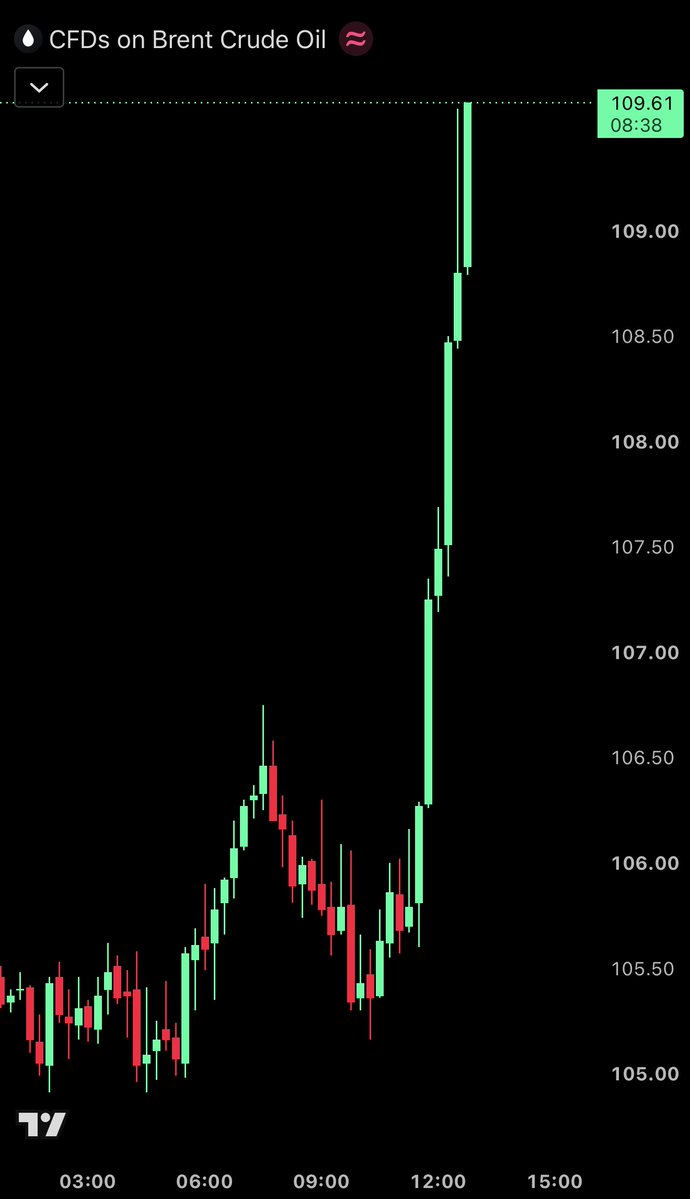
BREAKING: Brent crude oil surges to nearly $110, its highest level since September 15, as Iran places its armed forces on the highest alert for 72 hours and mobile bomb shelters being rapidly deployed in Tel Aviv.
US oil is now at $100.
@89AItopics@HormuzLetter Ukraine will not recover for at least another 10-20 years, minimum. The country has been fucking decimated. A whole generation of young men are dead; most of the other upper-class has already fled to escape the war.
Why isn't oil at $200? Because "someone" keeps dumping oil futures all night long, and the CFTC refuses to look into it. Heck, even when it's clear-cut insider trading, the CFTC has been told to "back off," and they did. https://t.co/Do5mmc1YZR
@SinaToossi@Kpler They’re basically adopting the American strategy: militarily pry open at enormous costs and *hope* that sanctions will create the desired effect within Iran and pressure the govt to accept a bad deal.
Absolute fucking nonsense.
To expand on this (👇), @Kpler's October 1 argument that Hormuz can gradually normalize without a U.S.–Iran deal was ill-advised then, and looks even more so now.
The U.S. strategy behind the ship-to-ship system is part of the same contest of time and war of attrition. It's not meant to be sustainable. Rather, Washington is betting that by easing the economic pain for the U.S. while intensifying pressure on Iran, it can force Tehran to capitulate or collapse in the not-too-distant future.
The core problem is that this fundamentally underestimates Iran's ability and willingness to counter-escalate.
Iran shows no signs of surrendering to Washington's unclear and maximalist demands. Instead, it's escalating attacks on shipping, with further escalation likely as the U.S. midterms approach.
The U.S.-backed STS system is therefore neither a real solution nor a substitute for a political agreement that could provide a more lasting resolution.
And there are serious limits to this strategy, many of which Kpler acknowledges, but others it overlooks:
1) The costs are staggering. Supertanker charter rates have reportedly approached $1–1.4 million a day, with war-risk insurance adding much more. These extraordinary costs help explain why gasoline prices remain elevated despite the partial recovery in crude flows.
2) The logistics are time-consuming and vulnerable. These aren't little boats quietly slipping across Hormuz. Many shuttle tankers are enormous themselves, carrying 500,000–1 million barrels. Transferring their cargo to VLCCs bound for global markets can take 24–48 hours.
3) Crude oil is only part of Persian Gulf trade. Refined fuels (gasoline, diesel, jet fuel), LNG, petrochemicals, and other goods like fertilizers, metals, and food products can't all be moved through the same ship-to-ship system as easily or at the same scale.
Moving these products between ships would add additional layers of complication and risk.
And if tankers carrying highly flammable cargo like jet fuel or LNG are attacked, the resulting fires or explosions could be catastrophic than what we've seen.
Kpler itself acknowledges that refined products remain the biggest constraint, with flows still far below prewar levels.
Ultimately, the fundamental mistake is treating a partial recovery in crude exports as evidence that Hormuz is normalizing, when the STS system is really a costly workaround designed not as a sustainable solution, but to buy Washington time in a fundamentally questionable effort to outlast Iran.
And with Tehran showing no intention of backing down, instead intensifying its counter-escalation, the notion that Washington can simply wait Iran out without a political settlement looks less credible by the day.
Iran’s October Surprise is here. But it is not being played out the way you think. Instead of a series of expected vertical military escalations, they are keeping escalations rising horizontally: focusing their attacks on ships crossing the Hormuz Strait and widening the breadth of such attacks onto tankers parked in Qatar and STS transfers happening in the Gulf of Oman. Don’t expect things to stay as consistent as they are.
#hormuzstrait #iranwar #usblockade #thegeopoliticalreport
@GekkosGhetto@MarioNawfal Oh, shut the fuck up. As much as American and Israeli media would love to paint the IRGC as this enormous monster with tentacles that reach into every country of the ME, it’s simply not the case.
Nobody buys your BS propaganda anymore.
@BrettErickson28 It’s too convenient, fits the narrative we’ve been fed about a potential terrorist attack for months now by Iran when they don’t need to do any terrorist attacks given that they have escalation dominance in a regional conflict against the US.