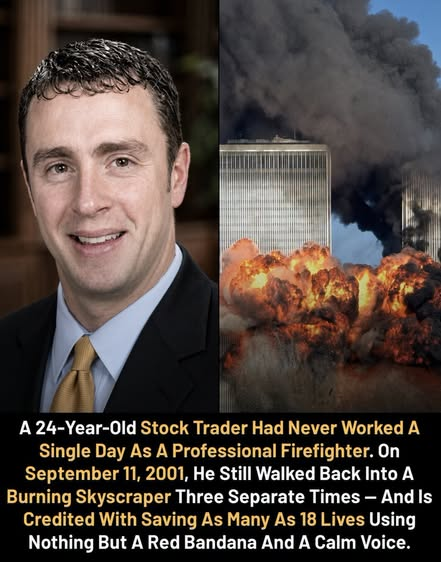
HE WASN’T TRAINING TO BECOME A HERO. HE WAS TRAINING TO BECOME A STOCKBROKER. BUT WHEN PEOPLE NEEDED HELP, A SIMPLE RED BANDANA HELPED THEM REMEMBER THE MAN WHO KEPT COMING BACK.
On September 11, 2001, Welles Crowther was just 24 years old.
He worked as an equities trader for Sandler O’Neill in the South Tower of the World Trade Center.
But long before Wall Street became part of his life, Welles had another connection that would eventually become part of his legacy.
When he was a little boy, his father, Jefferson, gave him a red bandana.
��� It became Welles’ trademark.
He carried one with him for years, usually tucked inside his pocket.
Nobody could have imagined how important that little piece of red cloth would become.
On the morning of September 11, the South Tower was struck by United Airlines Flight 175.
High inside the building, smoke and confusion quickly filled the floors.
Welles could have focused entirely on finding his own way out.
Instead, he began helping others.
Near the 78th-floor sky lobby, survivors later remembered a calm young man appearing through the smoke.
His nose and mouth were covered with a red bandana. 📷
He found people who were frightened, injured and unsure where to go.
But Welles seemed remarkably composed.
He directed survivors toward a usable stairway and encouraged those who were able to walk to help those who couldn't.
At one point, he carried an injured woman on his back down multiple flights of stairs.
He helped bring people closer to safety.
Then he did something extraordinary.
He turned around.
And went back upstairs. 📷
There were still people who needed help.
Again, survivors remembered the young man with the red bandana organizing another group.
He gave clear instructions.
Stay together.
Those who could stand should stand.
Those who could help someone else should do so.
Then he guided more people toward the stairs.
📷 And once again, instead of continuing outside to safety himself, Welles returned upward.
He kept helping.
At 9:59 a.m., the South Tower collapsed.
Welles never made it home.
For months, his family knew that their son was gone—but they didn't fully understand what he had been doing during his final moments.
Then came a detail that changed everything.
Survivors began describing the mysterious stranger who had helped them.
They didn't know his name.
But they remembered something unmistakable.
📷 The red bandana.
When Welles' mother read accounts describing the young man, she immediately recognized something deeply familiar.
Her son had carried a red bandana for years.
The anonymous rescuer finally had a name.
Welles Remy Crowther. 📷
Survivor accounts have credited him with helping save numerous people that morning, with some estimates placing the number as high as 18.
His remains were later recovered near firefighters and other emergency personnel.
And then his family discovered another heartbreaking detail.
Inside Welles' apartment was an application to join the New York City Fire Department.
The young Wall Street trader had apparently been considering another path.
📷 He wanted to become a firefighter.
He never got the opportunity to begin that career.
But in 2006, the FDNY honored Welles posthumously as an honorary member.
His red bandana became a symbol remembered far beyond his family.
At Boston College, where Welles had studied, his story continues to be shared with new generations, and an annual Red Bandanna Run honors his life and legacy.
But perhaps the most powerful part of Welles' story isn't simply how many people he helped.
It's the choice he made when nobody was watching him for recognition.
He was 24.
He had a family who loved him.
He had a career.
He had plans for tomorrow.
And yet, when strangers desperately needed someone to guide them, he stayed. 📷
He helped one person.
Then another.
And when he could have continued toward safety…
he went back.
📷📷 Most of the people he helped didn't even know his name.
They simply remembered the calm young man behind a piece of red cloth.
Years later, the world knows exactly who he was.
Welles Crowther—the Man in the Red Bandana. 📷📷
Sometimes courage doesn't arrive wearing a uniform.
Sometimes it looks like an ordinary 24-year-old carrying something his father gave him as a child
His face resembles many sleepless nights.
Now that Austria has rejected Harry Roque’s asylum application, the walls are closing in. The hour of accountability is nigh. Prison is waiting.
For someone who once spoke so confidently about the law, he now discovers the most inconvenient principle— he who flees judgment confesses the crime.
Properties frozen and with real potential of being taken away. Neurophysiological responses are at a heightened level. Tummy churning. Cold sensation running down his neck. Every step becomes heavy as a lead. His brain confused, unable to escape.
No passport to even attempt to move across to the next EU country. His body is too heavy to swim across the channel.
And waiting at home are the most sordid charges yet attached to his name—qualified human trafficking, exploitation and the grotesque machinery surrounding Lucky South 99.
He is fcuked as a roasted pig. This is the price of corruption and impunity.
DDS: Kaya dapat makabalik ang mga Duterte sa Malacañang para maayos na ulit ang flood control sa Pilipinas.
Fact: Never naayos ni Duterte ang flood control. Lubog sa baha ang Pilipinas noong panahon nila at wala ni isa ang napakulong.
🎥: Reporters Notebook 20/11/20
@jukumasseur0709@jumelbornillamd oh eh di kasuhan mo. ikaw nalang hinihintay para makulong si de lima. san na kaso mo?
kaya ka masseur LANG e. bobong ddshit.
Risa Hontiveros: Hindi ako sensitibo sa puna, sanay ako diyan. Pero ang pinakita po na video ay FAKE NEWS. Delivering a privilege speech is not the same as having the privilege to have fake news enter in the official records as if it were evidence.
@risahontiveros 👏🏼