I have committed myself to read my family’s voluminous war correspondence.
I picked this letter out of the pile of some 200 letters.
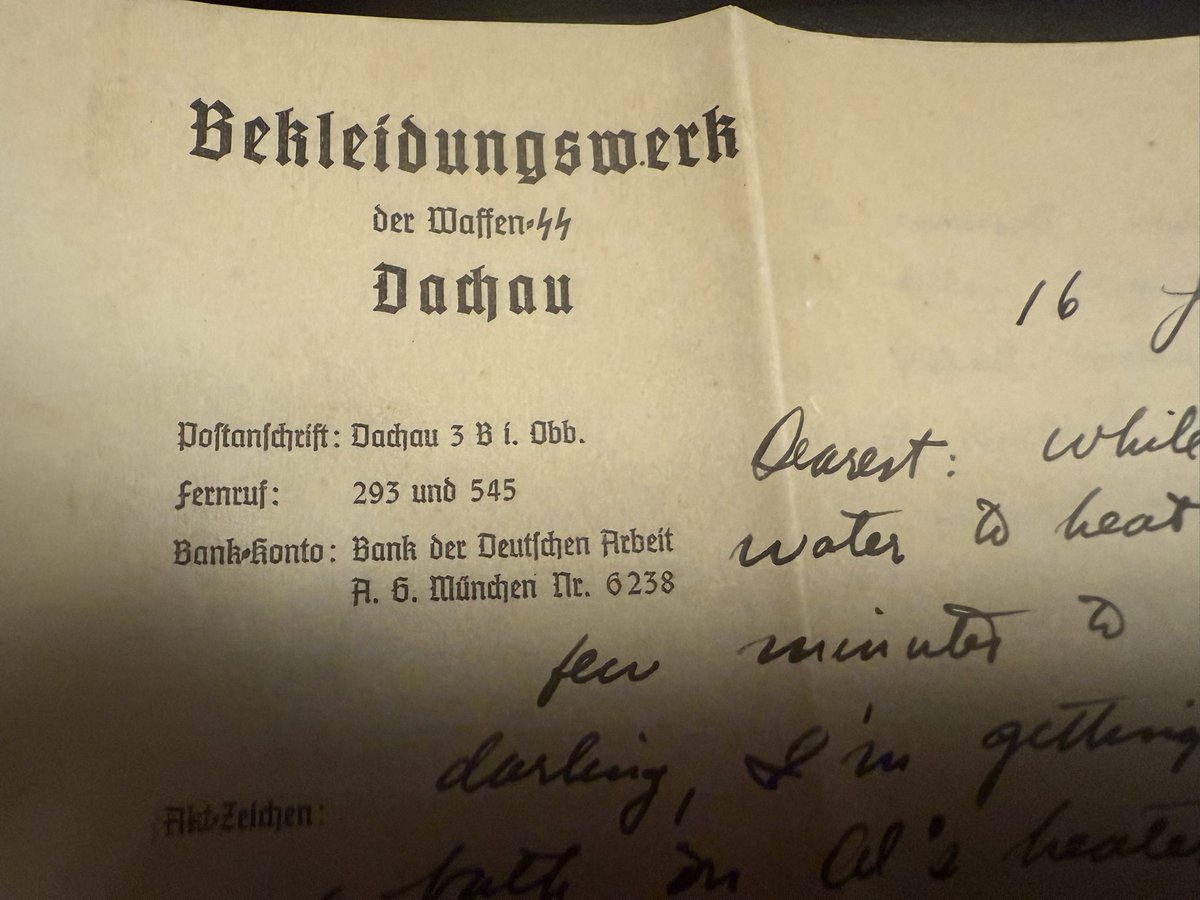
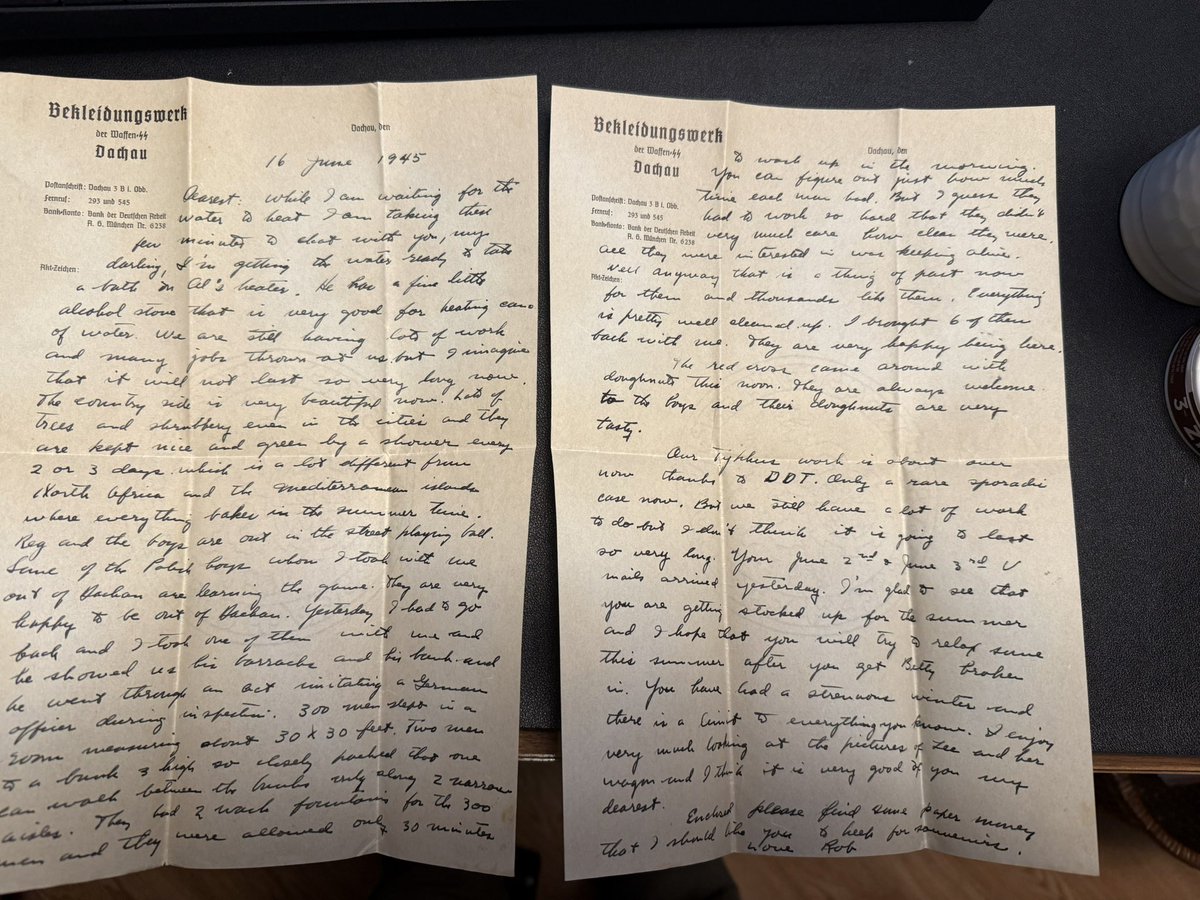
This one written by my Grandfather, Major E.R. “Robbins” Kimball Jr. M.D. to my Grandmother Alicia Barber Kimball on the 16th of June 1945. Some 38 days after VE Day.
It is written on Beckleidungswerk Waffen SS stationary from the Dachau concentration camp in Bavaria.
“Beckleidungswerk” meaning “clothing works or garment factory”
Dachau housed the first main SS clothing factory and a major depot for uniforms.
It was chosen for the access to forced labor and their utility as supply and production centers for the Waffen SS.
The camp was the 1st concentration camp established, on March 22, 1933.
The reign of terror at #Dachau ended 12 years later when the camp was liberated by American soldiers, that included my beloved Grandfather, on April 29th, 1945.
9 days before VE Day.
Chills ran up my spine just as I opened it and realized what I was reading. Which includes a brief account of some of prisoner living conditions.
Muslim man screams “Allahu Akbar” and throws a bag in the New York subway.
Instant panic.
People immediately start running in fear for their lives. Understandably so, it could very well be a bomb.
He just stands there, thinking it’s funny. Then he wonders why no other religious group causes this level of fear and anxiety.
He later claimed it was all just a prank to ‘expose Islamophobia.’
🚨 Claude Code costs $200/month. GitHub Copilot costs $19/month. Jack Dorsey's company built a free alternative. 35,000 GitHub stars.
It's called Goose.
An open source AI agent built by Block that goes beyond code suggestions. It installs, executes, edits, and tests. With any LLM you choose.
Not autocomplete. Not suggestions. A full autonomous agent that takes actions on your computer.
No vendor lock-in. No monthly subscription. Bring your own model.
Here's what Goose does:
→ Works with ANY LLM. Claude, GPT, Gemini, Llama, DeepSeek, Ollama. Your choice.
→ Reads and understands your entire codebase
→ Writes, edits, and refactors code across multiple files
→ Runs shell commands and installs dependencies
→ Executes and debugs your code automatically
→ Extensible through MCP. Connect it to any external tool.
→ Desktop app, CLI, and web interface. Pick your workflow.
→ Written in Rust. Fast. Lightweight. No bloat.
Here's the wildest part:
Block is a $40 billion company. They built Cash App, Square, and TIDAL. They use Goose internally. Then they open sourced the entire thing.
This isn't a side project from a random developer. This is production-grade tooling from a company that processes billions in payments. Built for their own engineers. Given to everyone.
Claude Code: $200/month. Locked to Claude.
GitHub Copilot: $19/month. Locked to GitHub.
Cursor: $20/month. Locked to their editor.
Goose: Free. Any LLM. Any editor. Any workflow. Forever.
35.3K GitHub stars. 3.3K forks. 4,078 commits. Built by Block.
100% Open Source. Apache 2.0 License.
Promising business graduate Brett Scrogham, 23, allegedly murdered by a classified 14 year-old in a downtown Indianapolis, IN parking garage!
Scrogham had just graduated from the IU Kelley School of Business. He was on his way to meet friends to watch the Indianapolis Indians.
⚡️Stablecoins are being absorbed into the legacy payments empire before they fully escape it.
That is the whole move.
Visa and Mastercard can see the threat clearly.
Stablecoins attack the deepest part of their model: settlement friction, cross-border fees, merchant fees, card-network dependency, and the need for banks/payment processors to sit between buyer and seller.
Stripe sees the opportunity from the merchant/software side. Coinbase sees the bridge from crypto custody/liquidity into mainstream dollar payments.
Put those together and the shape is obvious: the incumbents are trying to own the stablecoin transition rather than get routed around by it.
This is regulated dollar infrastructure.
The people replying “this is centralized” are right, but they are missing the bigger point. Of course it is centralized. That is why it can scale into mainstream commerce. The mass market does not want seed phrases, bridge risk, fragmented liquidity, or ideological purity. Merchants want lower fees, faster settlement, fewer chargebacks, cleaner APIs, global reach, and accounting that works. Enterprises want compliance. Regulators want visibility. Networks want control.
This is the institutional stablecoin phase.
Stablecoins started as crypto-native liquidity instruments. Then they became offshore dollar rails. Now they are being pulled into the core payments stack. That means the next phase is not just “crypto adoption.” It is dollar settlement moving onto programmable rails under corporate and regulatory control.
The float question is the real money.
Who holds the reserves? Who earns the yield? Who controls redemption? Who owns the customer relationship? Who sees transaction data? Who sets compliance rules? Who can freeze, reverse, blacklist, or censor flows? That is where the power sits.
If Visa, Mastercard, Stripe, and Coinbase coordinate around a stablecoin platform, they are not launching a toy. They are positioning around the future settlement layer for internet commerce. The token itself may be boring. The control surface is not.
This is also a shot at banks. Banks have lived off deposits, payment rails, card relationships, settlement friction, and regulatory enclosure. Stablecoins threaten to peel away part of the transaction layer. The banks will not disappear, but their monopoly over money movement gets squeezed if stablecoin settlement becomes native to merchant platforms and wallets.
The big risk for card networks is cannibalization. The big opportunity is control. If they wait, stablecoins compress them. If they lead, they can turn stablecoins into another network layer and preserve relevance.
For Coinbase, this is structurally bullish. It places them closer to the regulated interface between crypto liquidity and mainstream commerce. Coinbase does not need every user to become a crypto trader. The bigger game is becoming infrastructure for onchain dollars, custody, compliance, wallets, conversion, and settlement.
For Bitcoin, this is indirectly bullish in the long arc because it further normalizes crypto rails as real financial infrastructure. But it also reinforces the split: Bitcoin remains neutral collateral, while stablecoins become regulated transactional dollars. Different roles. Bitcoin is exit. Stablecoins are upgraded dollar plumbing.
The clean truth:
This is the payment giants conceding that stablecoins are real while trying to make sure the revolution settles through them.
That is the phase shift.
Stablecoins are no longer fringe crypto instruments.
They are becoming the programmable settlement layer the incumbents now have to capture, defend, monetize, and regulate.
Bad News: Illinois property taxes are projected to rise by $1.7 billion this year.
Good News*: The General Assembly is celebrating $45 million in property tax relief as a major accomplishment.
That covers just 2.6% of the hike.
*Not actually good news.
Why did C.S. Lewis say that Hell is locked from the inside?
He explores this idea in his book The Great Divorce.
In it, souls of the damned are allowed to visit heaven on a bus ride, but they are not pleased with what they see — and they leave of their own accord.
The fact is, the damned cannot touch Heaven. They can't so much as disturb the dew drops on the grass. Nor can they even gaze upon the garden properly.
Why? Because they are blinded by their own sins:
– The philosopher would rather philosophize about God than meet him
– The painter would rather make beautiful art than gaze upon the source of all Beauty
– The clingy mother would rather fret over her son than give her full love to God
Lewis' point is that God cannot force man into salvation. Damnation is not God's rejection of man, but God tragically accepting man's rejection of him.
Hell itself is the ultimate monument to human freedom; for a human with true free will is even free to divorce himself with paradise.
What Lewis suggests is that you don't fully understand human nature until you understand that some humans really do not want paradise.
Conversely then, true freedom does not mean using your free will however you want. True freedom means surrendering your free will by forming your soul to the Good.
By sacrificing your free will in this manner, you gain glory, virtue, and happiness — for man was made to know and love virtue above all.
This insane idea that every human on the planet has a God-given right to immigrate to the country of their choice with no government restrictions is a country-ending policy position that drains America’s wealth and jobs while eliminating the American middle class.
This is damn funny!
I have everything that I wanted as a teenager, only 60 years later. I don't have to go to school or work. I get an allowance every month. I have my own pad. I don't have a curfew. I have a driver's license and my own car. The people I hang around with are not scared of getting pregnant and I don't have acne.
Life is great.
I changed my car horn to gunshot sounds.
People get out of the way much faster now.
Gone are the days when girls used to cook like their mothers.
Now they drink like their fathers.
I didn't make it to the gym today. That makes five years in a row.
I decided to stop calling the bathroom "John" and renamed it the "Jim". I feel so much better saying I went to the Jim this morning.
Named my dog “five miles.”
Now, technically, I can take him to the mailbox and say, “I walked five miles today.”
When I was a child I thought "nap time" was a punishment.
Now it feels like a small vacation.
The biggest lie I tell myself is...
"I don't have to write that down, I'll remember it".
If God wanted me to touch my toes, He would've put them on my knees.
Last year I joined a support group for procrastinators.
Great job We haven't met yet.
Why do I have to press one for English when you're just going to transfer me to someone I can't understand anyway?
Of course I talk to myself.
Sometimes I need expert advice.
At my age "Getting Lucky" means walking into a room and remembering what I came In there for.