One thing I'm glad about that changed the trajectory of my life was leaving religion and becoming an atheist. I'll forever be grateful for every doubt, question, critical thinking and self reflection that got me there.
No turning back.
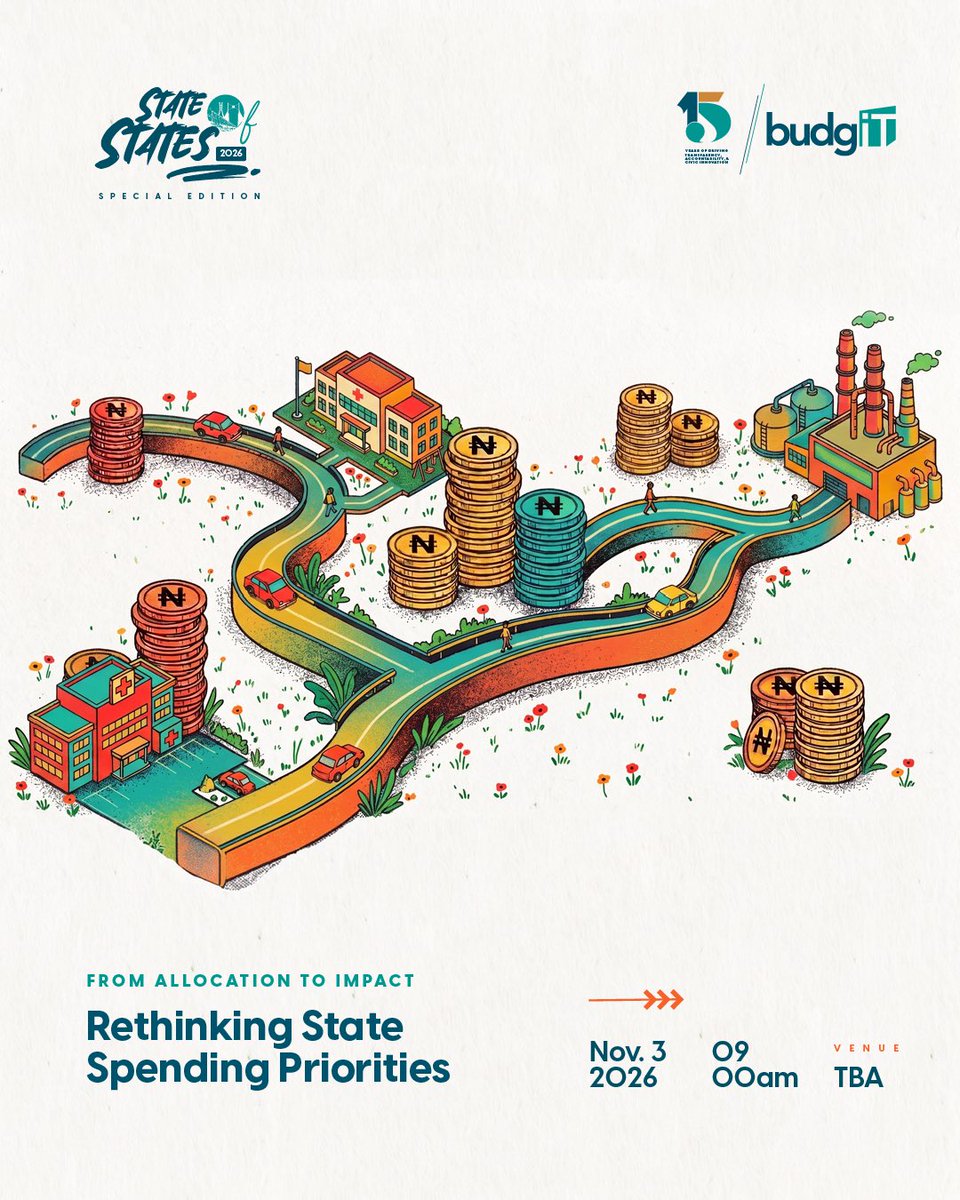
Eleven years ago, BudgIT set out to examine the financial health of Nigeria’s states and what their fiscal realities meant for development.
That question gave rise to the State of States Report, which has shaped national conversations on state finances, revenue generation and fiscal sustainability, keeping public resource management in focus.
Over the years, the report has examined how states generate revenue, their dependence on federal allocations and their capacity to meet financial obligations. For the 2026 edition, we are taking a closer look at how states spend the resources available to them, the sectors they prioritise and how these decisions align with the development needs of their citizens.
𝐓𝐡𝐞𝐦𝐞: 𝐅𝐫𝐨𝐦 𝐀𝐥𝐥𝐨𝐜𝐚𝐭𝐢𝐨𝐧 𝐭𝐨 𝐈𝐦𝐩𝐚𝐜𝐭: 𝐑𝐞𝐭𝐡𝐢𝐧𝐤𝐢𝐧𝐠 𝐒𝐭𝐚𝐭𝐞 𝐒𝐩𝐞𝐧𝐝𝐢𝐧𝐠 𝐏𝐫𝐢𝐨𝐫𝐢𝐭𝐢𝐞𝐬.
What will this year’s report reveal about where states are directing their resources and the needs they are prioritising?
The 2026 State of States Report launches on November 3, bringing these questions into sharper focus.
📅 November 3, 2026 ⏰ 9:00 AM
#StateofStates2026 #GetInvolved #AskQuestions #FollowTheMoney
14 DAYS TO THE REPORT OF THE YEAR!
Nigeria, are you ready?
You already know how we do it at #StateofStates. The room, the questions, the conversations and the different takes that keep the discussion going long after the event. And trust us, this year’s conversations are ones you’ll want to be part of!
From Allocation to Impact: Rethinking State Spending Priorities. That’s what we’re bringing to the table this year, and we already have lots of questions that need answers!
November 3rd, we’re coming. The countdown is on!
#StateofStates2026 #GetInvolved #AskQuestions
There is no need for a study. What you are seeing is what happens when you put a large group of restless young people in an isolated community situated in a sleepy little town where there isn't much to keep them engaged.
Bad argument, as I have written previously in a substack.
Is the idea that big money leads to big science even correct? The only way to understand this is to consider just how much a few recent Nobel Prize winners spent on their discoveries.
One winner that comes to mind is Roger Penrose. In 2020, Roger Penrose was part of a trio of scientists who won the Nobel Prize. He won the prize by describing how black holes worked mathematically. This was a feat that required no astronomers, no lasers, no extraordinary computational resources, just a paper, blackboard and pencil.
In fact, the paper cited by the Nobel committee for his award of the prize was completely theoretical mathematics. This is work that Roger could have done from anywhere on the planet if he had the tools. Yes, including the backwaters of Nigeria. No big money, but somehow big science.
Another winner is Giorgio Parisi, joint winner of the 2021 prize. His work was almost entirely mathematical and conceptual, with very little experimentation. In the 80s, he discovered mathematical models that explained how order emerged from randomness, and these models are now used everywhere from neuroscience and machine learning to weather forecasts.
In fact, the same could be said for other winners of the prize. Syukuro Manabe’s work was a bit more practical as it required computational resources and data, but none of that is out of reach of the current Nigerian academic system.
The big news, though, is that none of them required extensive resources. And they are unlikely to have spent the most research money out of all their colleagues.
In other words, this was work that could have been done from any average university faculty in the world. Their primary need in this case was data, not resources. If they could have gotten the required data in their homes, they would have done their work there. Once again, no big money, and yet, somehow, big science.
It would be a bore to list all the winners in hard sciences here and lament about how much money they didn’t need. But that would just be flogging a dead horse. Marie Curie wasn’t even recognized as a scientist when she did the work that led to her two Nobel Prizes, Einstein himself only worked at a patent office while writing his most remarkable papers, Barbara McClintock, who discovered jumping genes in maize, didn’t even have the support of her colleagues. She grew, cross-bred, and analyzed corn kernels herself.
C.V. Raman, who discovered the Raman effect, said that his Nobel-winning discovery was made by equipment that cost less than two hundred rupees. That’s around 3 million naira in Nigerian money. Are we really saying Nigeria doesn’t have a Nobel Prize winner in the hard sciences because we don’t have three million naira?
You will also notice how none of these winners ever spoke of epileptic power supply, or bad roads, or bad government stopping their work. C.V. Raman won the Prize while Britain still colonized India — and he did his work right there, in India.
Tu Youyou, an Amazon of a Chinese woman who discovered artemisinin, a malaria cure that has saved millions of sub-Saharan Africa, did her work during the Chinese cultural revolution. At this point, China had an even lower GDP per capita than Nigeria. In 1970 specifically, Nigeria had a GDP per capita of $224, while China had one of $113. So Nigeria was nearly twice as rich as China when Tu Youyou discovered Artemisinin, and yet no big science.
He’ll write a letter of resignation to the Imo HoA resigning on 15th Jan. He’ll fly to Abuja and be sworn in as Senator on 16th Jan
The State HoA will reject his resignation 17th Jan. He will go to court. He returns to Imo as governor till court decides the case 29th May
You wan spoil contract you say na criticism. He must block you. How else will the project move forward regardless of concerns.
Didnt they do the coastal road without EIA on the whole thing and are now running into obvious issues and making changes?
We must amend our laws to stop the president from appointing INEC chairman, national commissioners and resident electoral commissioners. A president shouldn't be appointing people that will supervise an election he is a candidate.
@_OKJ__ Your last paragraph summarizes everything. Prayer is cathartic but to say it objectively changes the laws of physics or chemistry? That has to be proven