【“Unknown Unknowns” Do Not Invalidate Your Trading System】
Trust the law of large numbers.
Randomness absolutely cannot overturn it.
■ The Power of the Law of Large Numbers
The law of large numbers is the most powerful principle we have.
If you have validated an edge on a large sample, do not abandon that system lightly.
When I insist on consistency above all else, I sometimes hear that because “unknown unknowns” exist, the system could stop working.
That argument is wrong.
■ The Essence of Unknown Unknowns and Randomness
Unknown unknowns are, in fact, randomness itself, and randomness is accounted for from the outset.
The law of large numbers is what lets you extract a probabilistic edge from within randomness, and it stands on that very foundation.
If your edge has been confirmed over a 10,000-trade sample, it takes a comparably large sample to overturn it.
If so‑called unknown unknowns were to hit again and again for years, enough to overwhelm your tested sample, they would no longer be unknown—they would be a clear pattern.
In short, only a clear, long‑running pattern can break a system.
One‑off randomness—“unknown unknowns”—absolutely cannot erase the edge of a system grounded in the law of large numbers.
■ The System Is Designed On The Premise Of Randomness
Your system is built on the premise that anything can happen.
Through position sizing, win rate, and risk‑reward balance, you are playing a game in which profits tend to accrue across large samples despite randomness.
There is no need to worry about “what if something unpredictable happens.”
From the start, no single trade is predictable.
One‑off randomness does not invalidate the system.
Even a stop‑out sparked by a sudden news shock that tramples your chart‑based technical edge is just another stop‑out among many.
The risk was quantified at entry.
It is simply one stop.
Such losses are, of course, contemplated from the beginning in any system with a true edge.
■ Do Not Use This As An Excuse To Abandon Consistency
We are not trading to guess outcomes.
Whatever unknown event occurs in isolation, whatever the reason for a stop, that stop is just one among many, and it is not a problem.
Those who invoke these ideas as cover for failing to stay consistent have rarely followed their rules long enough to reach a sample size where “unknown unknowns” could plausibly break a system.
More often, their psychology cracks first, and “unknown unknowns” become a convenient rationale for abandoning consistency.
If you truly mean to make that claim, you must demonstrate it on a sample large enough to prove that unknown unknowns can destroy the system, which itself demands consistency.
And even if you could prove it on a large sample, that very proof would affirm the opposite—that the law of large numbers is reliable—leaving you in self‑contradiction.
In a domain so heavily influenced by randomness, probability and the law of large numbers are indispensable.
Reject them, and you have no remedy left.
■ The Importance of Probability and Sample Size
The credibility of any probability rests on its sample size.
To gather that sample size, consistency is non‑negotiable.
These are tests of your preparation, and no excuse will let you evade them.
Randomness is already priced in.
Stop making excuses and do the work.
In markets saturated with randomness, probability and statistics are crucial, and their reliability rests on sample size, which is why preparation is paramount.
If this post was helpful, my book will take your probabilistic thinking to the next level.
📚 Get your copy here👇
https://t.co/tMFssKR6Oz
Price Alerts for Indian stocks are now available to all Perplexity Pro and Max users in India! Currently supported on web and mobile web. Mobile app support and availability for free users coming shortly! 🇮🇳
Do not fear losing streaks or drawdowns.
They must be anticipated events from the outset.
That is why you must remain safe and consistent over the long term by using a position size derived from your strategy’s performance that ensures a 0% risk of ruin.
The temporary statistical deviations you encounter will be averaged out over a larger sample size.
Are you using a system?
Or just an entry signal?
A true system is a complete business plan—one that covers entries, exits, risk management, money management, and even the rules for doing nothing.
It is this that allows you to create a long-term bias toward results that accumulate profits.
Most people know only the entry point, or fight with just a fragment of the plan in hand, without even understanding why their approach fails.
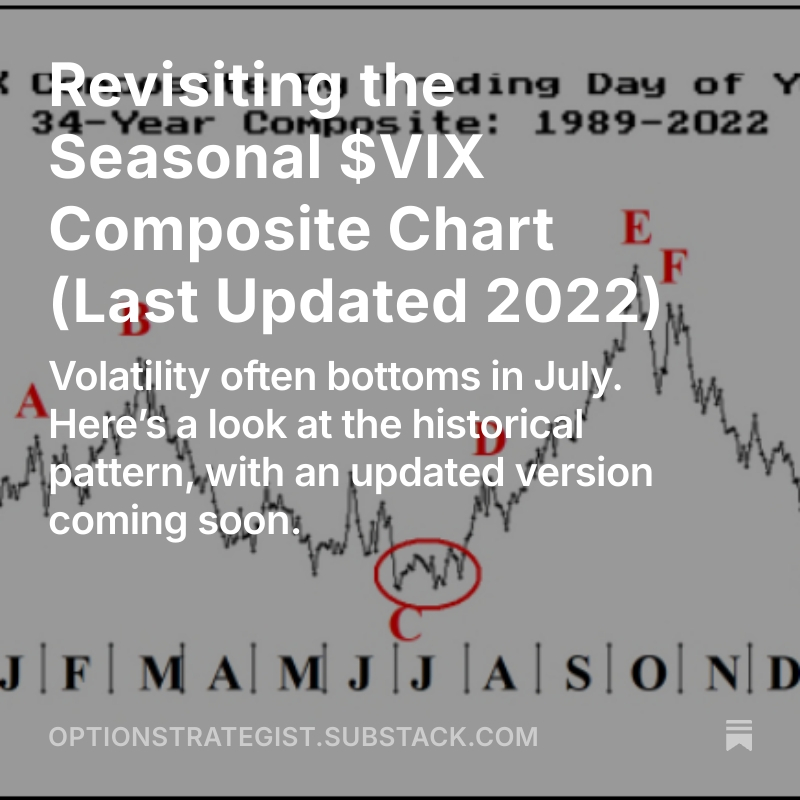
Volatility tends to bottom in July—and with that in mind, I wanted to re-share this article and chart from 2023 that outlines the typical seasonal pattern of $VIX.
🔗https://t.co/gtMShvPhJ0
$LYFT recently triggered a weekly MVB Buy signal. It's still in a long-term downtrend, but the base-building over the past year and higher lows are promising. A close above ~17.50 could be the breakout bulls are waiting for.
5/6
In the phase of extracting the edge, you already need to have conviction in your strategy's edge, gained through a large sample size in your prior preparation and testing.
All that's left is to extract the edge, and you must be consistent no matter what.
In other words, you must be convinced that if you remain consistent and follow the rules even when experiencing a losing streak, you will be profitable in the end.
If you continue to change something and learn "with every losing streak," that learning will never end.
Because losing streaks will never disappear.
This is what I often call the "improvement loop".
Continuously making improvements in response to unavoidable losing streaks will get you trapped in the improvement loop.
You feel like you are moving forward, but you aren't going anywhere.
And the improvement loop and "new knowledge" are a terrible combination.
Because there is no end.
At some point, you must accept the unavoidable losing streaks and remain consistent.
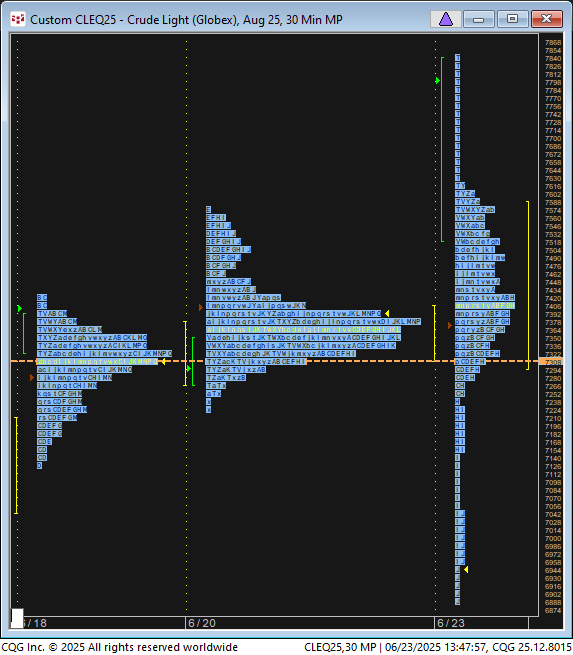
CL - market profile follow-up: Party over when price took out low of Friday's value area. Markets do whatever it takes to mess up the most amount of people...
A lot can happen in the next 24 hours, just as in the last 24. If markets were open now, we would likely see a jump in oil prices, lower equities, and higher gold. The outlook for US government bond yields is less clear—a notable shift for longtime market watchers.
#Markets