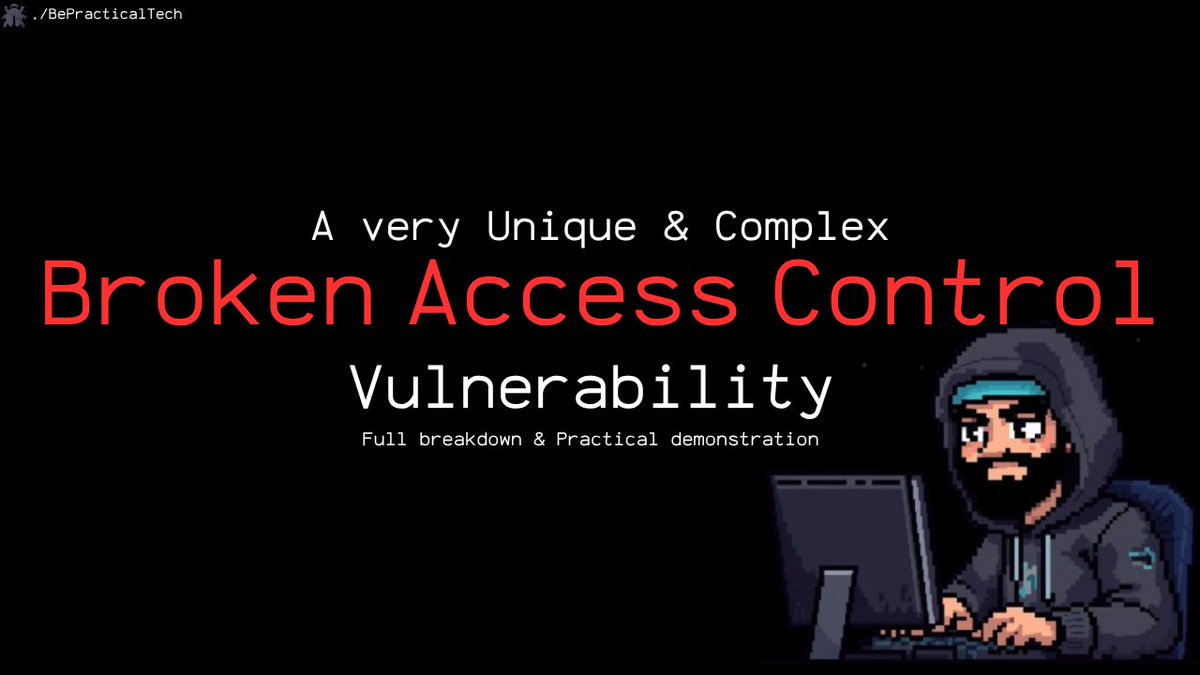
Many bug bounty hunters find an IDOR and stop testing as soon as they see a 403 Forbidden response. But what if that 403 isn't the end of the story?
One of the biggest lessons I've learned over the years is that access control testing is rarely as straightforward as changing an ID and checking the response.
Sometimes the most interesting findings appear when you start asking questions like:
• Is the authorization check happening in the right place?
• Is the application trusting something it shouldn't?
• Are there alternative ways to access the same resource?
• What assumptions did the developer make?
In my latest video, I demonstrate a practical technique that can help uncover authorization weaknesses that many testers overlook. Rather than focusing on theory, I walk through the entire process step-by-step in a controlled lab environment so you can understand the methodology behind it.
If you're interested in bug bounty hunting, penetration testing, or web application security, I think you'll find this one useful.
Watch here: https://t.co/3Q7NIOQPpj
Recently, I discovered something interesting while reconning what looked like a basic Nginx server.
What initially seemed harmless eventually led me to an exposed MCP server hidden behind it, and from there I was able to demonstrate a full exploitation path.
In this video, I’ve covered:
-> Recon & enumeration
-> MCP server discovery
-> Understanding the exposed attack surface
-> Exploitation methodology
As AI infrastructure and MCP deployments continue growing, I think these systems are going to become a very interesting attack surface from a security perspective.
This video was created purely for educational and security research purposes.
Video:
https://t.co/NpGVIriJQc
42,000 people are now part of this journey… and that honestly feels surreal.
I started this channel with a very simple intention: to give back to the cybersecurity community that taught me so much. Most of what I know today came from researchers sharing knowledge openly — through blogs, writeups, talks, tools, and communities. This channel was my way of contributing back, even if in a small way.
I never expected so many people to connect with it.
What makes me happiest isn’t just the number itself, but seeing people grow alongside the content. Messages from beginners saying they found their first vulnerability, understood a complex topic better, or finally got motivated to start learning cybersecurity genuinely mean a lot to me.
Because I know exactly how that phase feels.
I’m truly grateful to everyone who supported the journey — whether you subscribed, watched a video, shared feedback, or simply spent a few minutes learning something from the channel.
And honestly, we’re only getting started.
There’s still so much I want to share: deeper bug bounty research, real-world attack demonstrations, AI + pentesting experiments, cloud security, weird vulnerability chains, and practical content that actually helps people improve.
A lot of people here still don’t know that I document most of this journey on YouTube as well: https://t.co/TPvTr1feWq
If you’ve been following the journey for a while, thank you.
And if you recently discovered the channel, welcome.
Recently came across a pretty interesting XSS payload that managed to slip past some generic WAF rules and basic mitigations.
Could be useful in situations where you already have HTML injection on the target and traditional payloads keep getting blocked.
Payload: <svg><animate onbegin="alert(1)" attributeName=x></svg>
If you want to learn more on cyber security, bug bounty and penetration testing then feel free to check out my youtube channel where i have uploaded 180+ videos on various topics like xss, sql injections, unique/underrated vulns, chaining bugs together etc...all practical!
Link: https://t.co/gavWFZXUqx
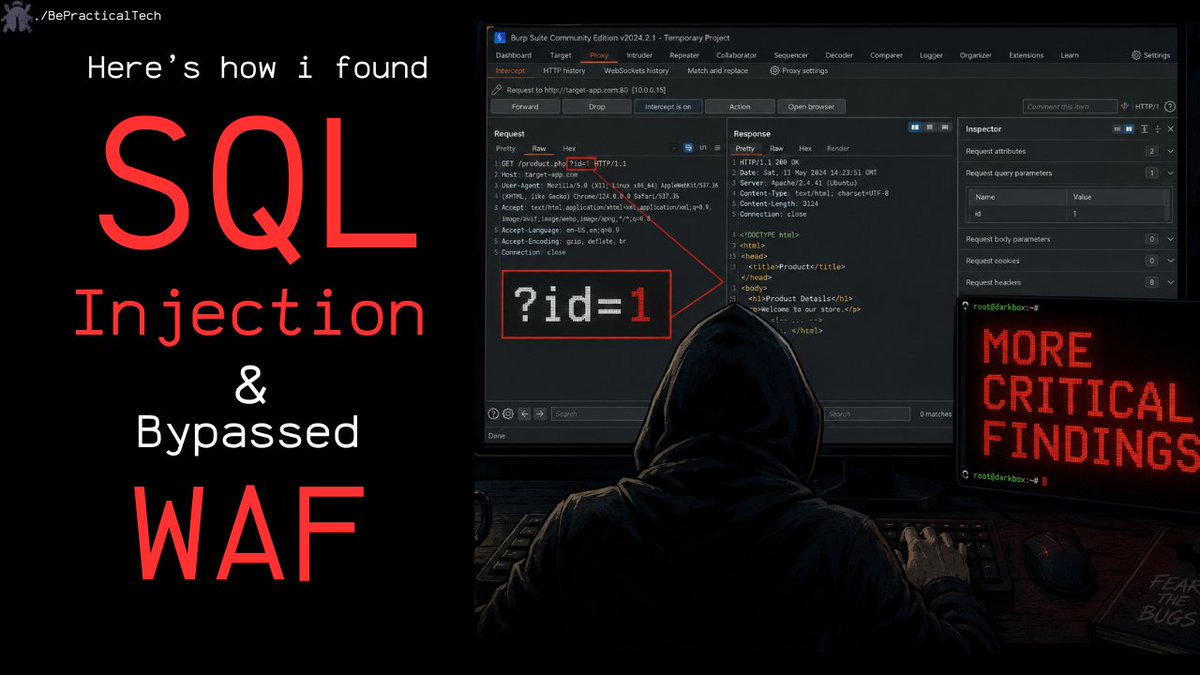
I almost thought there was no SQL injection on this application until this happened...
It was a private engagement. Scope was limited, pressure was high, and I had been staring at this one endpoint for a while. Something felt off about the way it was handling input. Call it instinct, call it stubbornness — I wasn't ready to move on just yet.
Union selects? Blocked instantly. Boolean blind attempts? Blocked. Time based payloads? Blocked. I tried obfuscating, encoding, mixing cases — the WAF caught everything without blinking. I even tried slipping in something as basic as a comment operator --+ just to see how tight the rules were. Blocked. The firewall was aggressive and it was clear someone had put real effort into locking this down.
So I started throwing everything I had.
At this point most people would have moved on. Marked it clean and called it a day.
I tried one more thing. One small, almost stupid simple tweak to my payload. Nothing fancy. No exotic tool. No advanced framework. Just a technique that made the WAF look at my request differently.
The response changed.
I sat up straight. Sent it again. The application was behaving differently now — the WAF had gone completely silent. A few more confirmation attempts and it was official. SQL injection confirmed on a target that looked completely locked down.
The full story, the exact technique, and a complete breakdown of how the bypass worked is all in my latest video.
If you are getting into bug bounty or penetration testing, this one is worth your time.
Check it out here: https://t.co/AX7soYLUjk
Trying to find sql injection but got blocked by the WAF?
Try this payload: ') or 'ab' like 'ab (Worked for me couple of times on real world engagements)
Check out my free sql injection playlist to learn more on how we can find this vulnerability on real world applications!
Link: https://t.co/97oPg1nbqC
Cybersecurity is hard. And the only way to get good at it is to pay for expensive courses? That's the biggest lie in this industry.
You're grinding through theory, watching tutorials, maybe even dropping hundreds on certifications - and still freezing up in front of a real target. Still can't land the job. Still can't find a single bug on a bounty program. That's not on you - that's a content problem.
I built my YouTube channel to fix exactly that.
180+ free videos covering real offensive security skills - the kind you actually need:
- SQL Injection, from the fundamentals to advanced bypass techniques
- Cross-Site Scripting (XSS) in all its forms
- Business Logic Vulnerabilities
- Race Conditions
- Unique, lesser-known vulns that most courses never touch
- And a lot more
Whether you're a complete beginner, prepping for a pentest role, or grinding bug bounty with nothing to show for it - this channel is built for where you are right now.
No paywall. No fluff. Just hands-on, practical content that actually moves the needle.
https://t.co/gavWFZXUqx
And if you feel you liked the channel, you are always welcome to hit the subscribe button.
What if you could learn Cross Site Scripting from scratch, completely FREE — with real exploitation, real scenarios, and zero cost?
XSS is one of the most common vulnerabilities in bug bounty, yet most people either skip it or only understand it on the surface. Knowing how to find it is one thing.
Knowing how to exploit it, chain it, and write an impactful report is a completely different skill.
I've put together a full playlist covering exactly that:
• What XSS actually is and how it works under the hood
• Reflected, Stored, and DOM-based XSS — all three types with practical demos
• How to find XSS in real applications, not just lab environments
• Bypassing filters and WAFs that block basic payloads
• How to escalate XSS into something impactful for your bug bounty reports
Everything is practical, beginner-friendly, and free. No fluff, no paid tools, just hands-on knowledge you can apply while hunting.
If you are getting into bug bounty or want to stop underestimating XSS, this playlist is a solid place to start.
Check it here: https://t.co/3SPHcMIe9G
I am giving away my entire AI hacking playlist — completely free.
This is a full practical series on AI security and pentesting automation, made for anyone getting into this space.
Here is what is covered:
• How AI applications can be hacked and exploited • Prompt injection — and how it can be chained to RCE
• Building a fully local AI agent for security research at zero cost
• Fine-tuning local LLMs on cybersecurity data • Using frontier models to find vulnerabilities faster No fluff. No paid tools.
Everything shown is something you can build and test yourself.
The playlist has 10 videos right now and I am still adding more. If you are serious about understanding AI security or want to use AI to level up your bug bounty workflow, this is worth your time.
Check it here: https://t.co/utRzFeaoRy
Ever thought a simple XSS could let you read files hidden deep inside a server?
Most bug bounty hunters find an XSS, see the alert box pop up, take a screenshot and call it a day. But here's the thing — that alert box is just the beginning. XSS is one of the most underestimated vulnerabilities out there, and most people never bother to see how far it can actually go.
In this video, I took a simple Cross-Site Scripting vulnerability and chained it all the way into Internal File Disclosure — meaning I could literally browse and read sensitive files sitting inside the server that were never meant to be seen by anyone. No guessing, no brute forcing, just a clean exploit chain that anyone can follow.
I've broken it down step by step in the simplest way possible — no heavy jargon, no skipping steps — so whether you're a complete beginner or someone who's been doing bug bounty for a while, you'll walk away understanding exactly how this works and how to look for it yourself.
This is the kind of technique that completely changes how you think about XSS forever.
Watch the full exploit chain here: https://t.co/6dtSFU0Qg5
Just added one more video to my free AI hacking playlist!
This one is based on what I’ve actually seen during real pentests—how AI features introduce new attack paths, and how you can use AI itself to uncover bugs faster.
No theory, just practical techniques that lead to real findings.
Watch here:
https://t.co/utRzFeaoRy
Here’s how you can build an absolutely free AI bug hunting agent that was able to find a real XSS on a live website, without spending a single rupee on front-tier models.
I recently built a fully local AI setup that can assist in recon, analyze responses, and actively look for vulnerabilities as part of a real bug bounty workflow. This is not just theory — the agent was able to identify an actual XSS during testing, which shows the kind of practical impact this approach can have.
The problem with most AI-driven workflows today is the heavy reliance on front-tier models. They become expensive very quickly when you start processing large datasets during recon. More importantly, there is a privacy concern. You are often sending sensitive data such as endpoints, request/response details, and findings to third-party services, which is not ideal in a security context.
By running everything locally, you eliminate both of these issues. You keep full control over your data, avoid recurring costs, and build a system that you can trust and customize based on your workflow. It becomes a practical advantage rather than just an experiment.
I have shared a complete walkthrough where I build this from scratch and show how it fits into a real bug bounty process.
Watch here: https://t.co/21omotUGBv
Here are 170+ cybersecurity videos with full practical demonstrations that you can watch for free.
When I started, I was overwhelmed — too many resources, too much theory, and not enough real-world clarity.
So I built a YouTube channel focused on one thing: learning by actually doing.
Every video I create is based on real-world scenarios — not just slides or definitions. I try to break down how vulnerabilities actually appear in live applications, how attackers think, and how you can identify and exploit them step by step.
On the channel, I’ve covered:
Broken Access Control (one of the most common real-world issues)
Cross-Site Scripting (XSS) with real bypass techniques
SQL Injection with practical exploitation
Chaining multiple vulnerabilities to increase impact
Bug bounty methodologies used on real targets
AI vulnerabilities and how automation is changing security
The goal is simple:
Start from scratch → build strong fundamentals → move towards advanced, real-world exploitation.
No fluff. No paid courses. No unnecessary theory.
Just practical cybersecurity, explained in a way beginners can actually follow.
If you're serious about learning cybersecurity the right way, you might find this useful:
Check it out here: https://t.co/gavWFZXUqx
Added one more video to my FREE playlist on underrated vulnerabilities.
When I started with bug bounty, I used to test the same things everyone talks about — IDOR, basic BAC, XSS…
And honestly, I kept missing the more interesting bugs.
Not because they were hard…
But because I didn’t know where to look.
This new video is a perfect example of that.
It started with a “protected” endpoint — something most beginners (including past me) would normally skip.
But digging a little deeper exposed a complex broken access control flaw, which eventually led to a full compromise.
That’s exactly what this playlist is about:
• Bugs that don’t look obvious at first
• Real-world exploitation, not theory
• Step-by-step thinking process
• How small observations turn into impactful findings
If you're just getting started, or even if you're stuck at finding only low/medium bugs — this might change how you approach testing.
Playlist link: https://t.co/vVKte9j9MJ
This endpoint was looked very well secured… so I almost ignored it.
But something felt off.
What looked like proper access control turned out to be a complex broken access control flaw — and with the right approach, it escalated into a full compromise.
This isn’t a basic BAC. It’s the kind of bug that hides behind “secure” logic and only shows up when you start thinking differently.
In this video, I break down the full exploit chain step by step:
* How the protection was implemented
* Where the logic failed
* How I bypassed it
And how a small gap turned into full access
If you’re relying only on standard BAC/IDOR testing patterns, you’re probably missing bugs like this.
This is a practical walkthrough — no fluff, just real methodology you can apply while hunting.
Check it out here: https://t.co/oKg8R6ONvQ
Think GPT is the best at generating XSS payloads? I just proved it wrong with a local model.
I built and fine‑tuned a small language model on XSS examples. The local AI beats GPT on speed and relevance. I’ll walk you through the exact steps so you can replicate it.
The demo covers:
• Selecting the right training data
• Crafting prompts that target XSS patterns
• Running inference on a single laptop
• Comparing outputs side‑by‑side with GPT
All the code and data are in the Colab link above. If you hunt XSS, this gives you a reusable, faster tool that outperforms the big models.
Video link: https://t.co/xLWYptLGZQ
Generate unlimited XSS payloads for free using your own local LLM — even finding cases that models like GPT sometimes miss…
Most people are relying on paid AI tools and still missing real vulnerabilities.
But in this video, I show how to:
Run your own local LLM (zero API cost)
Fine-tune it specifically for XSS hunting
Train it on real payloads, bypasses, and edge cases
Generate unlimited, context-aware payloads anytime
So instead of asking AI for payloads…
you’re building an AI that actually understands how XSS works.
This is especially useful if:
You don’t want to spend money on APIs
You care about privacy and full control
You want to build something that gives you a real edge in bug bounty
The difference is simple:
Most people use AI.
A few people train it.
If you're serious about leveling up your hunting game, this is something you should not ignore.
Watch it here: https://t.co/OQ5xmPU83N