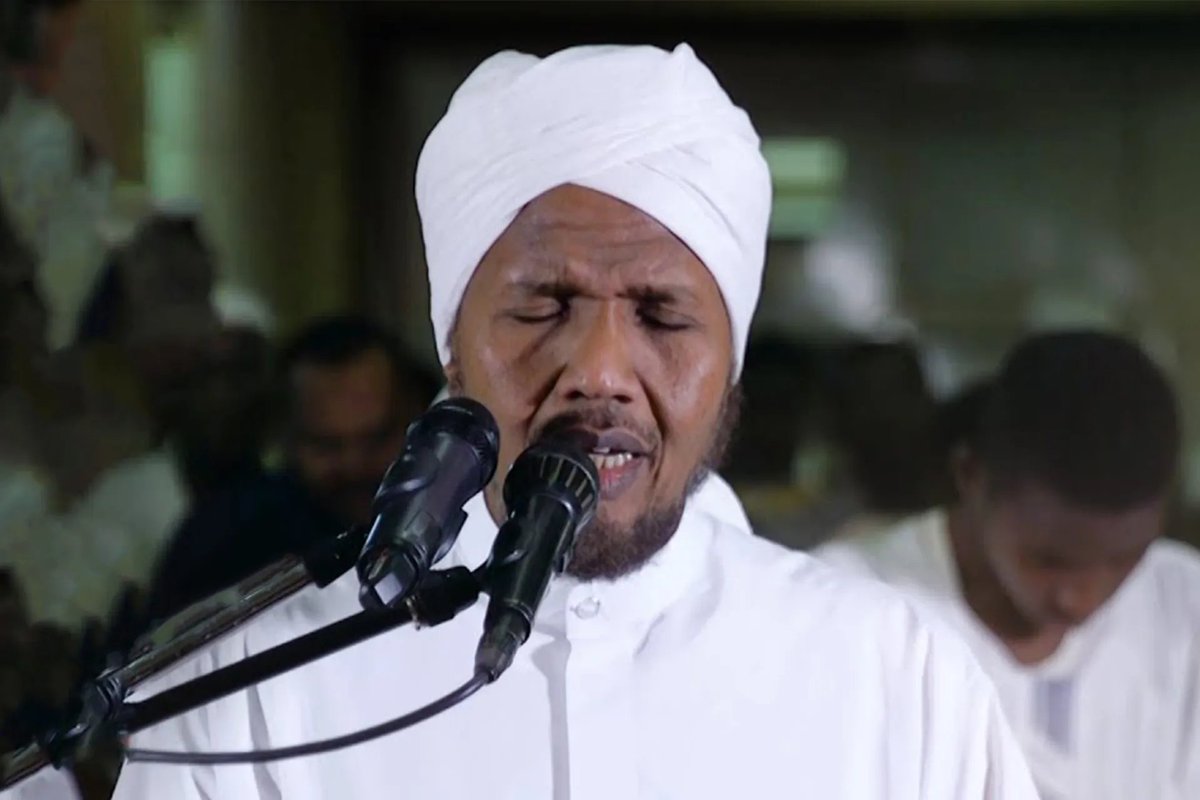
Sheikh Abdul Rashid Sufi is 62 years old.
He stands as imam for the people from the first day of Ramadan, about 5 hours each night.
He leads the Taraweeh prayers with 20 rak'ahs after the Isha prayer. In them, he recites one juz', that is, two hizbs, over approximately two and a half hours.
Then he rests for about two and a half hours to begin the Tahajjud from 12:30 to 3:30. In it, he recites 3 juz' every night-that is, 6 hizbs.
And thus, he completes the Quran in the Taraweeh once every month,
and in the Tahajjud once every 10 days.
And it is well-known about him that at the beginning of the khatm, he recites Surah Al-Baqarah in one rak'ah and Surah Aal-E-Imran in one rak'ah.
But tonight, he recited the entire Surah Al-Baqarah in the first rak'ah... then he recited only 12 pages from Surah Aal-E-Imran in the second rak'ah: up to the beginning of the quarter "All food ..."
And after giving the salam, he apologized to those present for not being able to complete Surah Aal-E-Imran in the second rak'ah... because he was extremely exhausted after the first khatm yesterday, then the Friday sermon, then the Taraweeh.
May Allah preserve him. Aameen
This is the most important post I can make.
When I converted to Islam, it was challenging. I didn't know where to start and I was overwhelmed by the lack of organized resources to learn the basics of the faith.
I started @relayislam with a mission to make things easier for new Muslims when they accept Islam. We're incredibly excited to announce the launch of the Relay app, available on the iOS App Store now! It is the best app to learn how to pray.
Chances are, someone in your circle could really use these resources. Make sure it gets to them and you'll have the reward for it, inshaAllah!
@sanjays9712 Probably crippled by the meaninglessness of existence
الحمد لله الذي هدىٰنا لهذا وما كنا لنهتدي لولا أن هدىٰنا الله
“Praise and thanks belong to Allah, who has guided us to this; and we would never have been guided if Allah had not guided us”
This was difficult to post, but I hope you read it.
As most of you know, I accepted Islam nearly seven years ago. It remains the greatest decision I’ve made in my life. One of the biggest difficulties for converts is losing non-Muslim family members. Recently, my maternal grandmother passed away. It’s difficult to speak about and especially challenging to navigate, knowing that I can no longer pray for her, nor do I know where she will go. I write this with hopes that born Muslims can appreciate the blessing of Islam bestowed to their family, and those who accepted Islam can relate and find peace in this reflection.
I was my grandmother’s eldest grandchild. I know her for always having a face that glowed and a radiant smile. When I was sick as a child, she’d walk me back and forth the hallways of her house in the night so that my parents could get their rest. It’s painful to process that the person who was in my duas every single day for the last seven years can no longer be. Life is fragile, and the harsh reality of death is due upon all of us. Undoubtedly, patience is at the first strike of calamity, so I will practice patience hoping for ease from my Lord.
I find solace in knowing that my Prophet ﷺ went through similar trials. He lost his beloved uncle Abu Talib and was visibly hurt by it. It is only a further proof that we should allow ourselves grace when losing loved ones. It’s okay to feel. The Prophet ﷺ, in the most difficult of moments, only drew closer to his Lord. The most perfect of examples is when he lost his beloved son Ibrahim, and while tears flowed from his eyes ﷺ , he uttered “Verily the eyes shed tears and the heart grieves, and we are saddened over your departure. But we will not say except that which is pleasing to our Lord.”
So how then do I reconcile this loss? There’s so much uncertainty that comes with losing a non-Muslim loved one. The simple answer is I focus on what I know. I know my Lord is Ar Rahman, the Most Merciful. My Lord is Al Wadud, the Most Loving. And it is He who gives life and it is He who takes it. I seek ease from Al Wali, the Protecting Friend, for surely He is Ar Rauf, the Most Kind. My love for Allah has only grown, and my desire to worship Him has only increased. Allah is more merciful than a mother is to her child. That is what I know of who my Lord is. I allow this to be my comfort without letting myself think about what I don’t know.
I want to reaffirm that Islam is the best thing to ever happen to me. I was lost before I found my faith. I was in the darkness before I found the light of this deen. The calamities of this life have only made me love my faith, my Lord, and my Prophet ﷺ more.
To my convert brothers and sisters, may Allah strengthen you and guide your family to this beautiful deen. To my born Muslim brothers and sisters, I hope this helps you appreciate the blessing that Allah has bestowed upon you a little more. I hope you are appreciative of being able to make dua for your loved ones that passed. I hope that you take a moment to say “Alhamdulillah” for what Allah has given you.
All praise is to Allah who guided me to worship Him alone. May our Lord send peace and blessings upon our beloved Prophet Muhammad ﷺ
With love,
Your brother Sanjay
As someone who can easily be mistaken as either Arab or Pakistani for either my appearance or ability to speak both Arabic and Urdu with some fluency - I am occasionally witness to racism within otherwise very religious & practicing Muslims.
There have been a few embarrassing moments where folks l thought I was Arab and made rude comments about the way Indo-Pak people pronounce English or Arabic or the food they eat. They apologized once I revealed I was not Arab, but I had to very gently and politely reprimand them for only apologizing when being exposed.
Similarly, as someone who speaks Arabic, has lived most of my life in Arab countries, and has access to Arab media and scholarship I’ve had to defend Arabs & Arab culture too.
This is not even mentioning the comments you hear about Black or East Asian Muslims from both Arab and Indo-Pak Muslims. Converts are also subject to unbecoming commentary. Then you have inter-race ethnic racism, like Pakistanis and Bangladeshis or Khaleeji and non-Khaleeji Arabs, all mocking each other in their circles as if it’s normal Friday night entertainment. Keep in mind these are ‘religious’ or ‘conservative’ Muslims I’m talking about. I have heard these comments or had these conversations mostly inside the masjid or in the parking lot after the prayer.
Imam Al-Suyuti wrote a book purely on biographies of black Ethiopian/Sudanese scholars. He wrote in the introduction of the book that he did so because he saw that these scholars were heartbroken - because others saw them as lesser and thus made them feel that way - so he wanted them to feel proud of their legacy. So this can happen even in the ‘highest’ circles of Muslims.
Racism is an intellectual & spiritual problem. It’s firstly intellectual because you don’t realize that race and skin color make little to no difference on the worth or value of a person. Especially when it comes to Islam, Muslims of all races and colours have brought tremendous honour and prestige to the ummah. Historically, you will find great heroes and scholars in our history all the way from Morocco and Senegal in the West to Indonesia and Bangladesh in the East.
Spiritually, having mercy in our hearts for our fellow Muslims is wājib according to our scholars. You should never want to think degrading or cruel thoughts about your fellow believers, and even worse never say thing that will likely be hurtful to them. Worse of all, you should never mock Allah’s creation or look at it with contempt.
@sanjaysubhag Also true for more historical colonizers such as the Roman Empire where sure you get plugged into the grid of a massive civilization, but is it worth all the suffering required on the part of the colonized to get there
@sanjaysubhag Agreed, it’s like South Asia or Africa being held solely responsible for all of their post colonial problems, entirely ignoring the amount of wealth and resources that were stolen. Also the Brain Drain.
Al-Hasan al-Basri رح heard some people arguing and he said,
❝By Allah! These are not but people who are bored with worship and they found speaking easier upon them than acting. Their piety diminished and thus they speak.❞
[al-Zuhd li-Aḥmad ibn Ḥanbal 1546]
@ifti_thinks As for the personality thing…not sure man…however, personality in diff languages is influenced by the interactions you have in that language including content consumption. For example the use of honorifics being integral to some languages and honorifics not existing in English
@ifti_thinks I’d like to think it would improve cognitive function significantly because according to the research, bilingual people already tend to do better in that regard. This is like being bilingual++ because you’re more fluent in each language compared to other bilingual people
@ifti_thinks Parent1 - Lang A ques
Child - Lang A response
Parent2 - Lang B comment
Child - Lang B response + Lang B ques
Parent2 - Lang B response
Obviously tough to get used to, but you do have years to work in it and it feels worthwhile given the numerous benefits
@ifti_thinks So for example, if it’s just one parent alone with the child they would communicate solely in that language. If it’s both parents then the child would still communicate with each parent in their respective languages–assuming the parents know each other’s language