🌱 PlantNexus update!
Built the backend, connected Supabase, developed a factory simulator, and implemented analytics with AI-powered explanations.
The dashboard is built too. Now working on frontend integration and end-to-end testing.
One step closer to working demo! 🚀
Today was about getting the foundation right:
🐳 Local Supabase + Docker setup
🗄️ Database foundation
🔄 Local-first development workflow
🚀 Planned local → production migration
🧠 Mapped the remaining MVP phases
Building PlantNexus 🌱 for Environmental Hacks, Event 02 of the Bharat Builds Tour with AWS.
PlantNexus is an environmental data platform focused on helping industries track waste & energy, understand their impact, and turn data into actionable insights.
@imethanchoi Interested! I build React-based websites and would love the opportunity to contribute and learn more about startup-tech design. DMing you my portfolio.
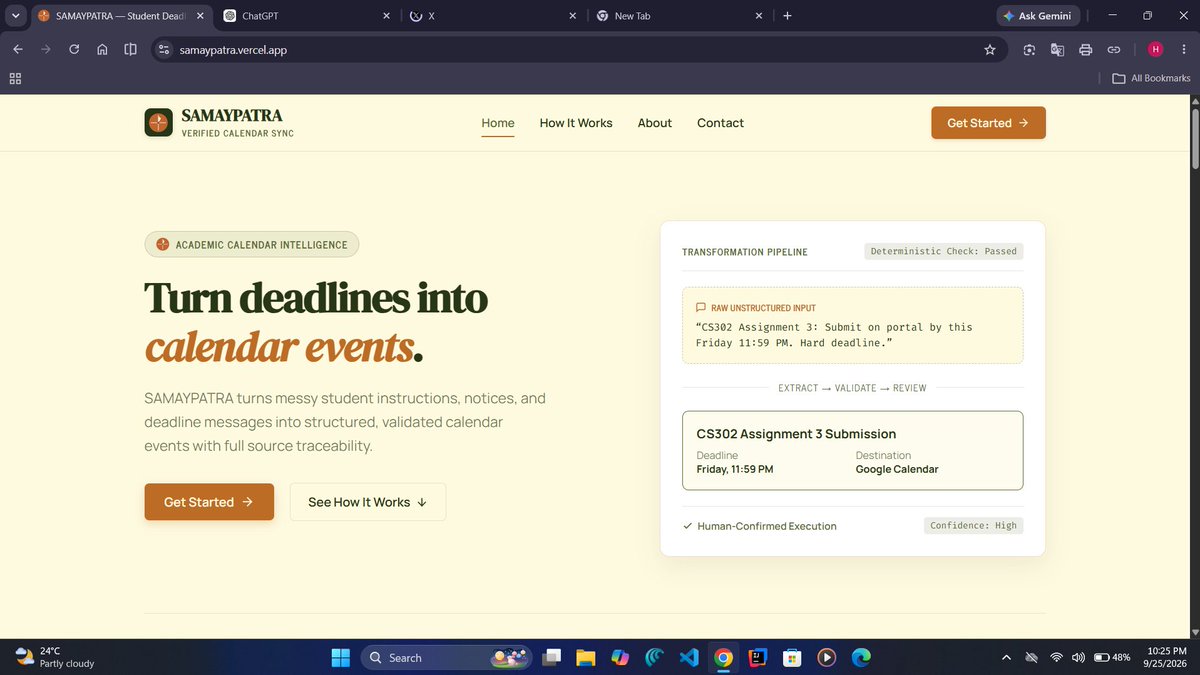
The hackathon is over, but SAMAYPATRA isn't.
I'll come back to this project, finish what I couldn't, and make it actually work.
Grateful to @WeMakeDevs and @awscloud for the opportunity and the experience. 🚀
On to the next build.
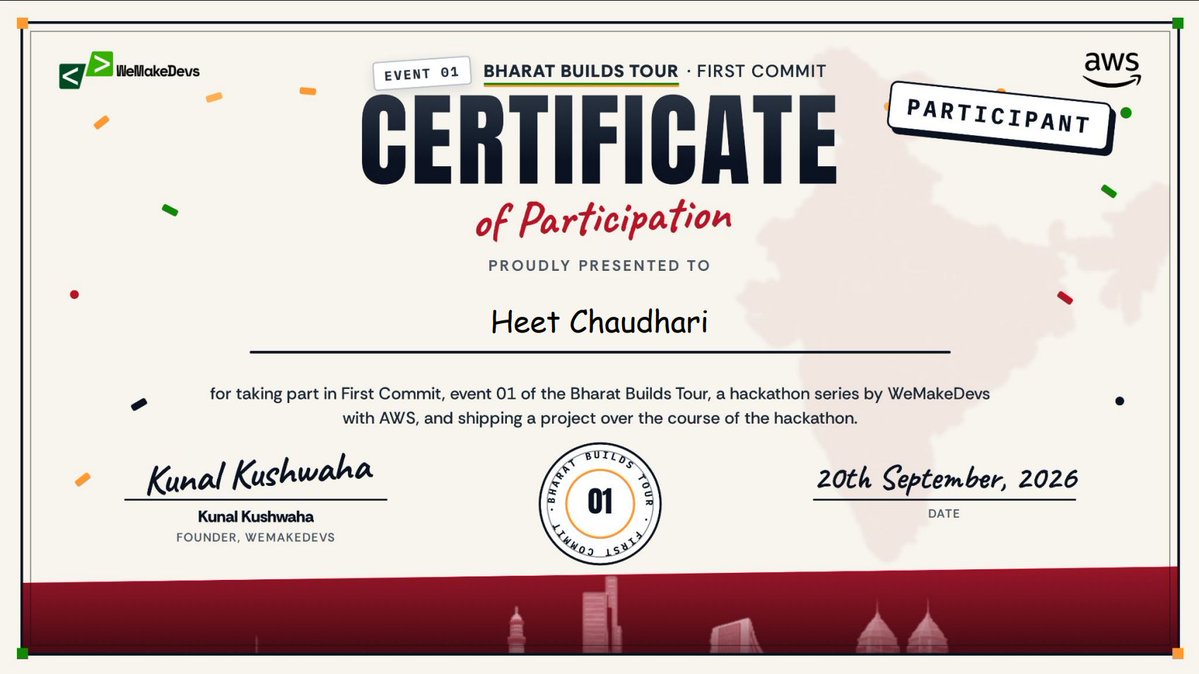
Today I received my participation certificate for the AWS hackathon.
My project, SAMAYPATRA, didn’t work out the way I planned. I couldn't complete it within the hackathon.
But honestly, this experience taught me a lot. 🧵
The biggest takeaway wasn't just learning AWS.
I learned how difficult it is to connect different pieces of a real application — AI extraction, validation, authentication and APIs — into something that actually works.
A lot went wrong, but I learned from it.
SAMAYPATRA was my attempt to convert real-world student deadlines and instructions into validated Google Calendar events.
While building it, I got hands-on with AWS services like Lambda, API Gateway, Bedrock, S3 and Textract, along with OAuth and backend development.
So I’m genuinely curious:
Does AI assistance reduce your ownership of a project?
Or does ownership come from understanding, designing, validating, debugging, maintaining and being able to explain what you built?
I’m still figuring out where that line is.
There’s a stigma around AI-assisted development in beginners :
“If AI helped build it, is it really yours?”
I’ve been thinking about this while building a real production project with AI.
Where do we draw the line between using AI and actually understanding what we build? 🧵
That’s why I’m building an engineering notebook for my project - not just documenting the code, but learning the fundamentals, architecture, database, auth, RLS, security, debugging and why each decision was made.
I’ll also rebuild important parts from scratch.
There’s a difference between:
1. Copying AI-generated code without understanding it.
2. Using AI to implement, debug and learn while understanding the architecture and decisions.
3. Eventually being able to rebuild important parts yourself.
I’m trying to move from #2 toward #3.
After clarifying the requirement, ChatGPT corrected the path.
No custom domain was needed. I kept my Vercel deployment and implemented Google OAuth through Supabase’s default Auth domain.
Implemented & working. 🚀
Implementing Google OAuth for my production app, I hit a roadblock.
I asked ChatGPT and was directed toward a custom-domain approach. I asked about using Supabase’s default domain instead, but was told it wasn’t possible.
That made me dig deeper. 🧵
#LearnInPublic
I dug deeper and realized the confusion: there were actually two approaches.
→ Supabase’s standard hosted Auth (https://t.co/UqhctvWz1y)
→ Custom Auth Domain using your own domain
I only needed the first one. 🧵