pgvector applies your WHERE after the HNSW scan. Per its README, a filter matching 10% of rows returns ~4 results at the default ef_search of 40.
I checked our notebook search: one HNSW index over every team's chunks, team and notebook in the WHERE, iterative scan never enabled.
@DvirDu Thanks, we're sorted. It was our own change, we'd lowered NODE_CREATION_BUFFER below what the graph was built with. Only thing worth an issue: it failed silently. A startup warning for that would have caught it.
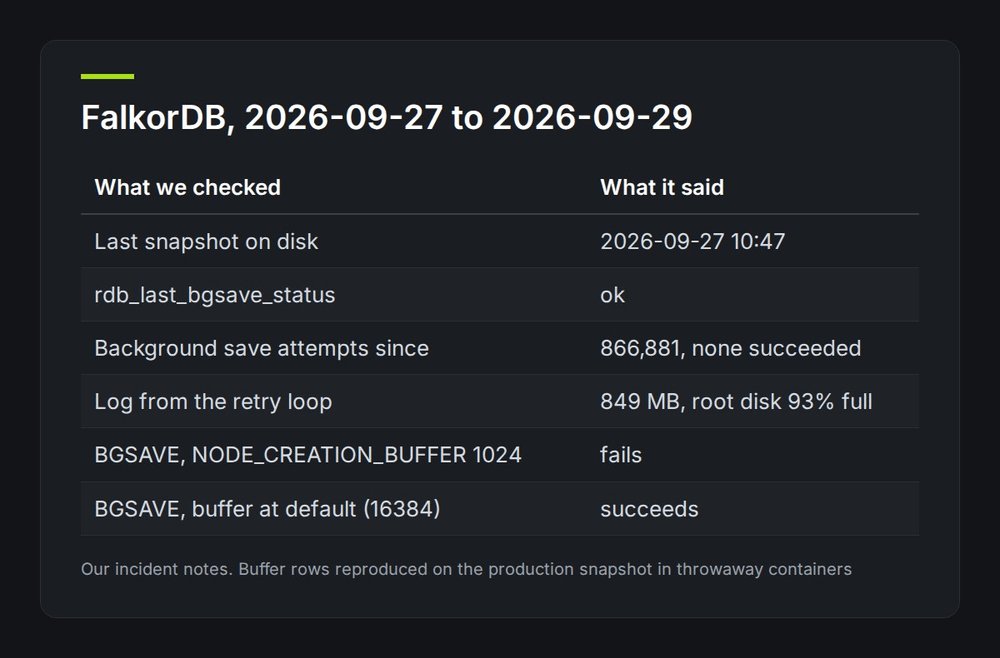
Our graph database went two days without writing a snapshot, and Redis said the last save was ok the whole time.
We had dropped FalkorDB NODE_CREATION_BUFFER from 16384 to 1024. Every background save failed, 866,881 of them.
Alert on rdb_last_save_time age, not the status.
@loudchirper You drew the line at residency, per-task cost caps, outbound limits and multi-model audits. Nothing about a cheaper tier implies those, so downmarket closes the window for consumer wrappers, not the plumbing. Unless the bet is staff bringing it in on the cheap tier.
@ThorCommerce Fair. A fresh rdb_last_save_time only proves the write finished, not that the file loads. A throwaway restore plus a check on a recent node is going on the list.
Gemini 4 Argon's output limit went from 64K to 1M tokens. At Google's post-intro price ($20 per 1M output), one call that uses all of it is $20.
One of our pipelines sends no output cap on purpose and takes the model's max. That was fine at 64K. I wouldn't leave it unset at 1M.
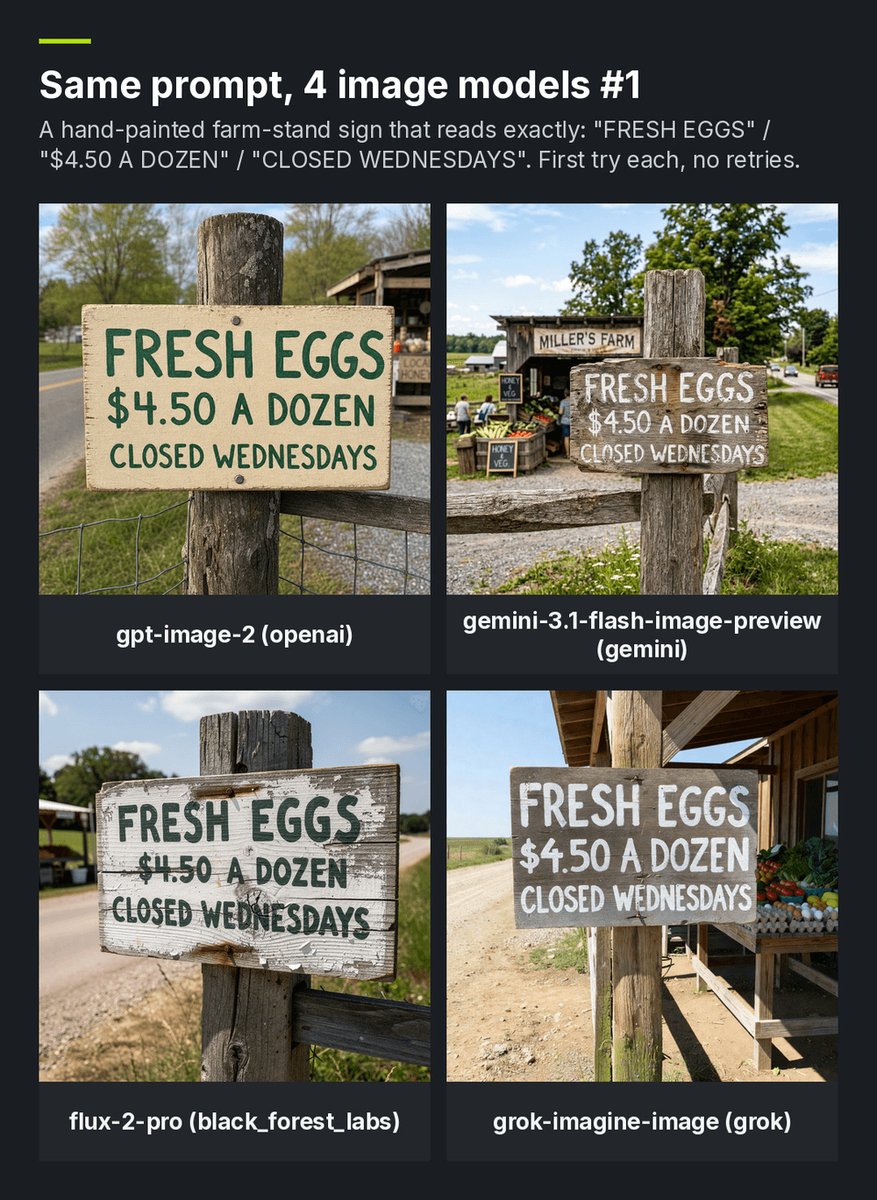
Same prompt, 4 models #1: all four spelled my 3-line sign right on the first try. Two also painted signs I never asked for.
Nano Banana 2 added a farm banner and two produce boards, GPT Image 2 a LOCAL HONEY sign. Grok Imagine and FLUX.2 Pro didn't. One run each.
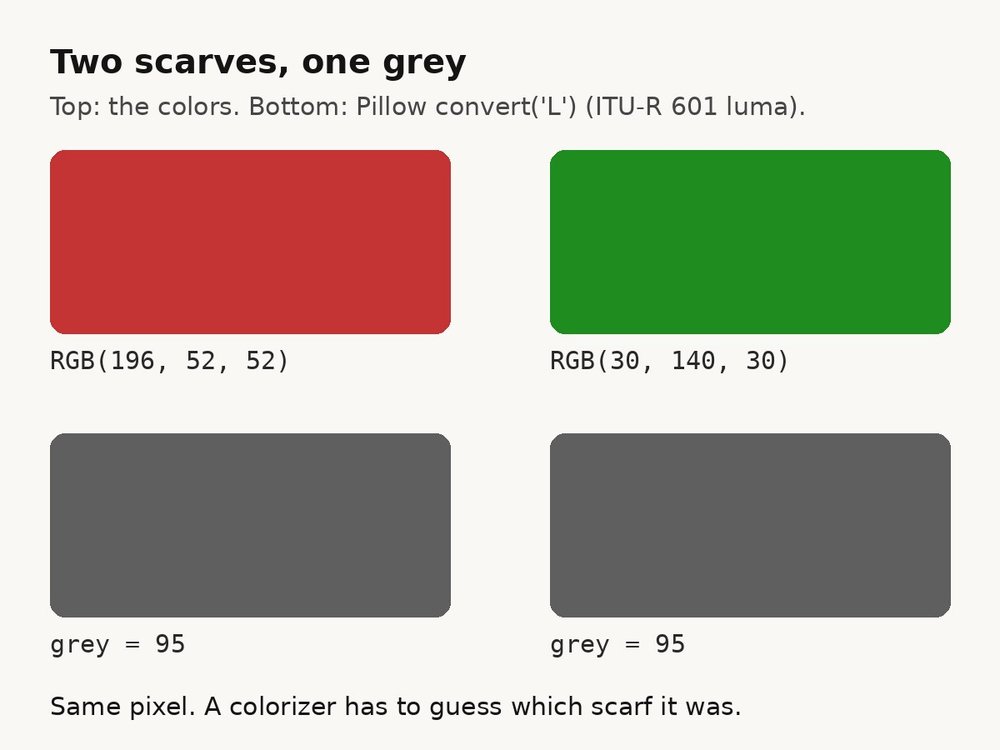
A red scarf and a green scarf can turn into the exact same grey pixel: RGB(196,52,52) and RGB(30,140,30) both convert to 95.
So a colorizer picks a color that fits. It can't get the real one back. In our colorize guide I wrote "plausible, not documented" instead of "accurate".
Opus 5.5 is 20% cheaper per token than Opus 5, $4/$20 per million in/out vs $5/$25.
The part I'd read twice: thinking can't be turned off. thinking: disabled is a 400, and thinking tokens bill as output. A job that ran with thinking off can end up costing more per request.
@oldstackjournal The loud breakages are the fun ones, you get your Saturday and your three lessons. What got me was a quiet one: my self-hosted scheduler failed a post and left it out of its own API listing, so my monitoring said all clear.
@nutlope@ollama What I'd want in the benchmarks is calibration against Jev. My cutoffs were tuned on Jev's scores, so swapping in a local model only works if 0.5 still means roughly the same thing on Tev1. Accuracy alone won't tell you that.
An image model drew garbled bullet text into an infographic, the exact thing my prompt said not to draw. Re-ran that prompt 3 times, all clean. Rewrote it, 4 more renders, also clean.
I'm not calling that fixed. A failure that rare barely shows up in a handful of runs.
@JayaGup10 I used Jev to replace a keyword filter, which never called a model at all. On 71 posts it kept 41 of the 45 on-topic ones, the keywords kept 10. So some of this demand is brand-new calls that don't come out of anyone's flagship bill.
An IP kept topping our weekly security review as an anonymous /api/user caller. It was our own prod server.
Pricing page server-renders, finds no user, falls back to fetching /api/user at the public origin. The call leaves the box, crosses Cloudflare, comes back. ~376/week.
@Hartdrawss The one I'd push back on is the checklist only ever getting longer. Aviation and surgical checklists are short on purpose, because a list nobody finishes protects nothing. Something has to age out, usually the failures the stack now makes impossible.
Asked an image model for "preserve fine edges (hair), transparent PNG" and got the transparency checkerboard painted into the pixels.
Gemini's image models and gpt-image-2 can't emit alpha. What stuck was skipping generation and matting the original photo with BiRefNet.