Introducing Poseidon: a state of the art cybersecurity specific model, designed for vulnerability research, finding, prove, and fix vulnerabilities in real software.
Poseidon preforms:
- 17.6% higher than GPT-6 Astra
- 2.9% higher than Claude Fable 5.2
(CWE-Bench)
NEW BLOG: I reviewed ARTEX in an isolated lab to see what the panic was about. The scary part isn’t the AI. It attacks exactly like we’ve taught for 20 years. Just without the coffee breaks. Blog: https://t.co/qEI3sDaDb1
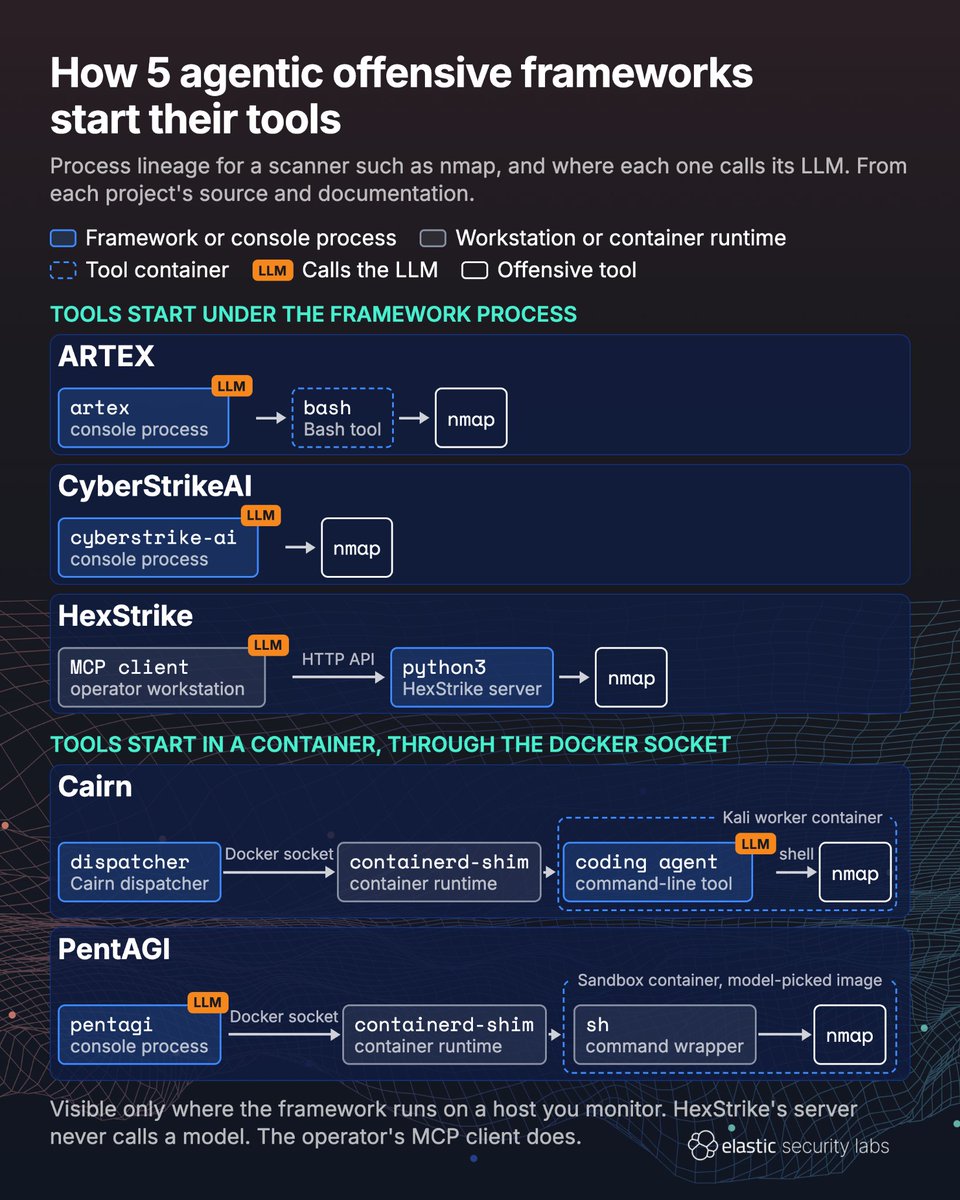
5 agentic offensive frameworks skip in-code authorization by default.
ARTEX, CyberStrikeAI, Cairn, PentAGI, and HexStrike put an LLM in the planning loop around familiar scanners, shells, and cloud CLIs, and GTIG observed ARTEX acting in bursts of roughly 2 to 25 seconds.
All 5 have already turned up in real intrusions, across reporting from GTIG, Mandiant, Microsoft, and our own research.
We read their source and the public incident reporting to work out what reaches defender telemetry. Research by @stryker0x: https://t.co/PPBzAI94hF
• Why IOC and User-Agent detections go stale while behavior-based rules hold up
• Tempo and sequence signals per identity for short bursts and long campaigns
• An ES|QL hunt for tool-family bursts across web, proxy, and cloud audit logs
• Why blocking a source IP must be paired with credential/session revocation
Every action these frameworks take still has to land in telemetry you already collect.