@birch_js Why pick Electron with all the AI?
This made IDEs a distribution layer.
Developers adopt what fits.
Once in the workflow — vertical integration dries Cursor's moat.
Once you own distribution, models become a commodity.
Distribution.
The interesting bit here is not model fandom. It is portability inside the harness: context preserved, evaluation attached, logs intact. When switching models does not reset the work, performance becomes an operating choice.
It's official: for the first time ever I moved my Hermes agent to ChatGPT. That's how good 5.6 is
I was on Opus since day 1, even paying the API pricing (thousands a month), but I still thought the performance benefit was worth it
No longer. For the first time ever ChatGPT caught up.
Plus they are consumer friendly and let you use your subscription in the harness.
Now I'm getting better performance for a fraction of the price.
Never thought this day would come but it happened
Seen a lot of people asking the best way to do it. Here you go:
1. In your terminal type 'hermes dashboard'
2. This will pop open a dashboard in your browser
3. Go to 'Profiles'
4. In the default profile, click the 3 dots and click 'Change Model'
5. Make sure to choose codex/gpt-5.6-sol. Not the openrouter one if you have a chatgpt subscription
Boom you're good to go.
@MollySOShea@marcboroditsky@nebiusai Actually — do enterprises adopt for architecture or action?
GTM gaps ground the go-to-market — motion before models.
Goals, gaps, and good enablers — not compute.
CapEx covers compute — GTM covers the gap.
Companies covering compute — skipping the signal.
Decompose.
Finance agents get interesting when the work has a boundary: known start, known end, reviewer in the loop. Pitchbooks, KYC, earnings reviews — useful if the harness carries context, evaluation, and logs.
The Claude for Financial Services with key details :
Core Offering:
10 Pre-built AI Agents for finance tasks like pitchbook building, KYC screening, financial modeling, earnings reviews, general ledger reconciliation, and month-end close . These are available as plugins in Claude Cowork/Code or as Managed Agents .
Claude Opus 4.7 powers these agents and leads the industry on Vals AI's Finance Agent benchmark at 64.37% .
Microsoft 365 Integration:
Claude now works across Excel, PowerPoint, Word, and Outlook with context carrying automatically between apps . You can start a model in Excel and move it to a deck without re-explaining .
Data & Ecosystem:
Institutional Data Partners:
FactSet, PitchBook, S&P Capital IQ, Morningstar, MSCI, LSEG, Moody's, Dun & Bradstreet, and more .
New Connectors & Plugins: Anthropic-built finance plugins (financial analysis, investment banking, equity research, private equity, wealth management) plus partner plugins from LSEG and S&P Global .
Key Capabilities:
End-to-end workflows: research → model updates → deck building in a single session .
Transparent outputs with source hyperlinks for verification .
Human-in-the-loop: analysts review and approve all work before client delivery .
Adoption & Impact
Customers include Goldman Sachs, Citi, Visa, AIG, Carlyle, and Moody's .
PwC reports underwriting cycles compressed from 10 weeks to 10 days and delivery improvements up to 70% .
Finance is now Anthropic's second-largest vertical after technology .
@Vtrivedy10 Isn't the real trap calling the default harness strategy?
Harness heft helps when context, checks, and logs travel together.
Heavy defaults hurt when personas pile up.
Teams need loops that fit their codebase and risk.
Taste is knowing what to keep out.
Scope?
@billzh The interesting shift isn’t “more people can code.” It’s that software starts as a personal workflow before it hardens into a product category. The durable winners will be the tools that own the harness: context, evals, feedback loops, and a path from toy to team.
Agent harnesses are the real product surface. The moat is less 'my model writes code' and more: can you package repo context, evals, model switching, logs, and outcomes into the workflow developers already use?
deepagents is our newest open source project - an open source, model agnostic agent harness
this is maybe the most important academy course we've launched
@amasad The loop is the product here, imo. Models will keep compressing toward parity; the useful moat is the harness that notices what failed, feeds it back, and improves the next run. Outcomes, not speed, become the thing to measure.
@emollick The “yes, this is just management” bit is doing a lot of work. AI makes execution feel easy, but the leverage is still in judgement: goals that matter, what good/bad looks like, feedback loops, and measuring outcomes instead of admiring a polished output.
@lilianweng This is the bit I keep coming back to with harnesses: the model is only one layer. The harder work is defining the start/end state, what context gets packaged in, how outputs are evaluated, and what gets logged. That is where the system gets real leverage.
@davidfowl Yes. The team-of-agents framing skips the boring part: who owns the harness? Future teams still need codebase context packaged in, evals/tests/logs around outputs, and outcome metrics beyond speed. Otherwise software factories just ship faster uncertainty.
RLI's useful move is the unit of judgment: accepted work. That shifts the agent question from 'how smart is the model?' to 'can the harness reliably finish and evaluate the work?' Outcomes, not speed or lines of code.
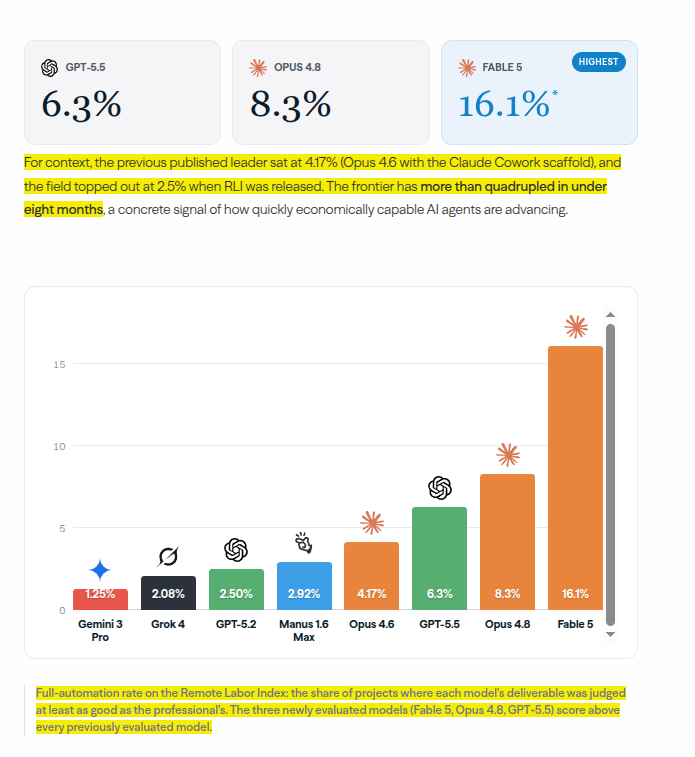
CAIS and Scale (AI safety research group) say Fable 5 now automates 16.1% of real remote-work projects, about 2x Opus 4.8.
Remote Labor Index tests whether an AI can finish paid freelance work well enough for a client to accept it.
Each task comes with briefs, files, and a professional deliverable used as the human baseline.
Fable 5 led the new results, while Opus 4.8 reached 8.3% and GPT-5.5 reached 6.3%.
That 16.1% number still means failure on most tasks, but the direction of improvement is massive. For the context of how large this jump is, the best model scored only 2.5% when RLI launched.
The work is not toy prompting, since tasks include CAD, architecture, animation, audio, data analysis, and web apps. This means the benchmark is testing computer work across messy tools, not narrow text answers.
Fable 5 looked strongest on examples like ring modeling, animation, and bathroom design.
The automated judge ranked models well, but overstated GPT-5.5 by about 2.9x and Opus 4.8 by about 2.3x. The result says AI agents are improving fast, but quality control remains the hard wall.
Another key point is that the model alone is not the whole product anymore. The gains are coming from stronger agent setups: better tool use, full desktop environments, professional software, longer runtimes, and worker-critic loops where 1 agent does the task and another reviews it like a demanding client.
@omarsar0 This is the part I'd underline: audit + rollback. Durable state is only useful if the harness can tell when yesterday's context is now poison. Otherwise you don't have an always-on agent; you have a very confident cache.
@Technerd_9 The underrated part is not the 130k lines. It's that you picked a real thing, stayed inside the discomfort, and got feedback from the work itself.
AI makes execution look easy. Taste still comes from reps + perception, not another tutorial.
@banglani Painfully PMM-coded. The feedback form became the metric, not the signal. PMM's job in market work is almost the reverse: keep the messy customer voice in the room long enough that the team can't optimise around only the pleasant answers.
@jlongster https://t.co/8gazH18aXc is a nice version of the loop. For acute tasks, the useful thing is often a known start/end point plus a harness that lets you inspect the artifact.
Static page, live thought, tiny app: something to react to.
@fatih@PlanetScale The doc refresher + Slack-complaint loop is the bit. Context, eval, logs, human checkpoint, and then the next run is less confused than the last one.
That's the harness doing the real work.
@gokulr The hard section isn't ACCEPTANCE CRITERIA — it's SUCCESS METRICS. That's where 'built what we said' meets 'market responded.' PRDs blurred them. The Product Spec forces the split: PM owns the build contract, PMM owns the market contract. Evals cover one. The other needs humans.
@leerob The coding/writing split maps to feedback more than prompts imo. Code gets a harness: compile, test, log, judge. Nonfiction gets delayed/conflicting feedback and polish that looks like substance. The missing eval is often: did this reveal a sharper thought?
@lennysan Yes. The cargo shorts line strips taste of prettiness. The hard part is the 'where are we going' bit: engaging with the work, taking messy feedback, and knowing which tradeoffs hurt the outcome months later. Aesthetic taste is just the visible artifact.