I built Concrete Cup: The Moai Edition 🗿⚽
48 nations. Live World Cup updates. Moai Badges. Moai Feed. Build your Moai Eleven with Messi, Neymar… or Bean.
Football culture carved in stone.
The Moai are watching. 🗿
https://t.co/EQZ8a8NhdP
@ConcreteXYZ
Blockchain adoption only becomes meaningful when it solves real problems beyond the crypto ecosystem.
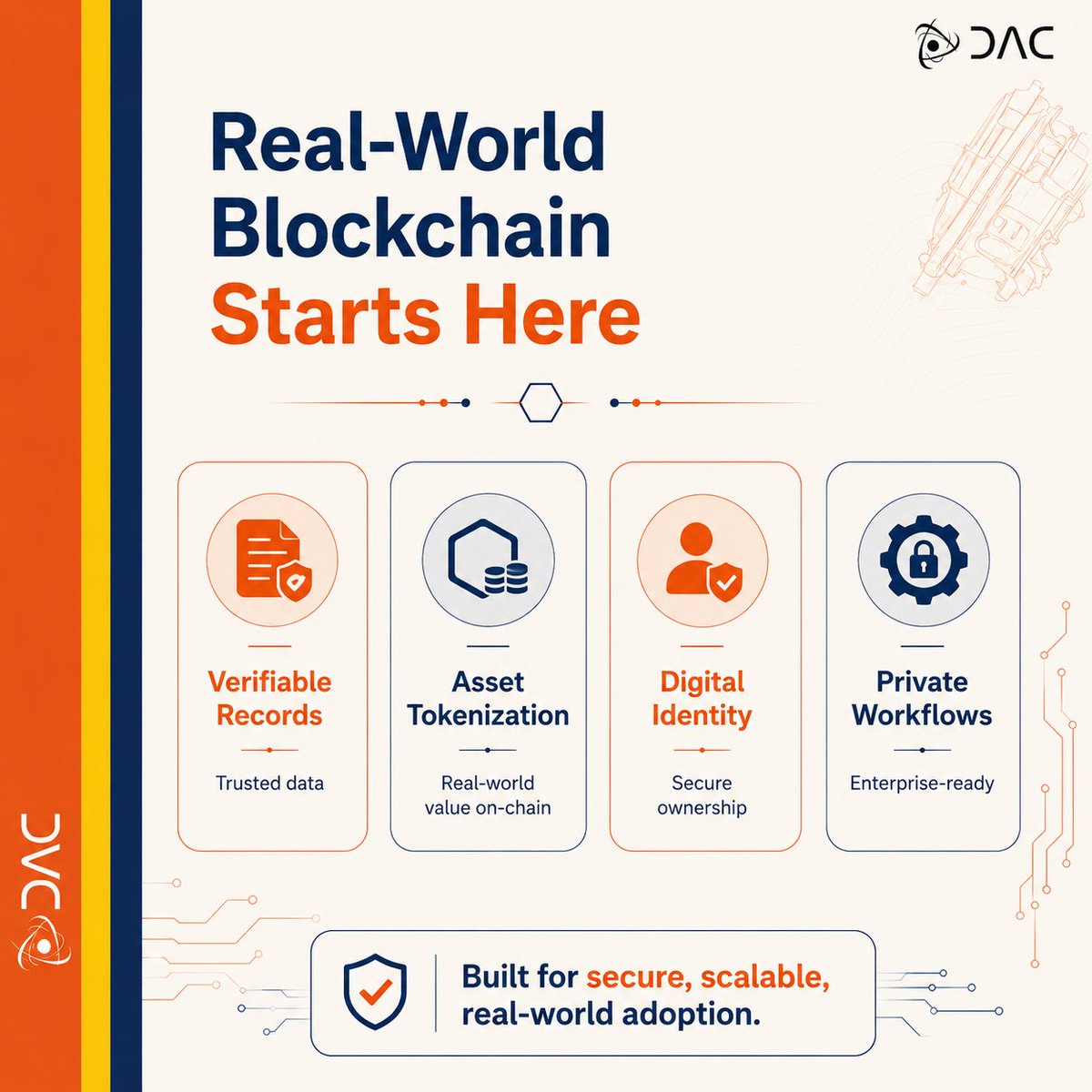
That's why I find DAC's approach interesting. Instead of focusing only on speed or hype, @dac_chain is building infrastructure for practical, real-world applications. From verifiable records and asset tokenization to digital identity, workflow automation, and private enterprise systems, the goal is to make blockchain useful where trust, transparency, and security matter most.
Long-term adoption also depends on long-term protection. As technology evolves and new security challenges emerge, future-proof infrastructure becomes essential. Security shouldn't be an upgrade added later, it should be part of the foundation from the very beginning.
By combining practical utility with a security-first architecture, DAC is creating an ecosystem designed to support businesses, developers, and institutions for years to come.
Real-world blockchain needs more than innovation. It needs reliability, scalability, and infrastructure built for the future.
@dac_chain
Foundations aren't built for today's weight. They're built for the weight that's still coming.
Quantum computers already exist, and every breakthrough brings us closer to a future where the cryptography securing today's blockchains may no longer be enough. The exact timeline is still uncertain, but waiting until the threat becomes immediate isn't much of a strategy.
That's why @dac_chain caught my attention.
Instead of treating post-quantum security as something to bolt on later, DAC made it part of the protocol from day one. Security isn't an optional upgrade or a roadmap item—it's the foundation the network is built on.
The vision goes beyond protecting digital assets. It's about creating infrastructure that can support RWAs, DeFi, AI applications, and enterprise adoption without forcing developers and users to worry about tomorrow's security challenges.
Building for the future means preparing before the pressure arrives, not after.
The strongest infrastructure is rarely the one that reacts the fastest. It's the one that anticipated the challenge long before everyone else realized it was coming.
As quantum computing continues to evolve, networks designed with long-term resilience in mind will have a significant advantage.
That's why I'm watching DAC early.
@dac_chain
The energy from @ETHGlobal Lisbon 2026 is a reminder that Web3 moves forward because builders keep showing up, experimenting, and shipping.
In just 48 hours, teams turn ideas into real products. That only happens when the underlying infrastructure is reliable, scalable, and built for developers.
That's why infrastructure matters just as much as innovation.
@dac_chain is taking a long-term approach by building a blockchain designed for performance, scalability, and quantum-ready security—giving developers the foundation to create applications that can stand the test of time.
Great builders create the future.
Great infrastructure makes that future possible.
@dac_chain
The DAC team just wrapped @ETHGlobal Lisbon 2026, 48 hours of builders shipping at full speed on EVM.
That pace is a good reminder of who we're building a lasting infrastructure for.
Full recap ↓
Stablecoins have already proven they can move value at internet speed.
The next challenge isn't adoption. It's privacy.
Without confidential transactions, stablecoins struggle to become true everyday financial infrastructure. The future belongs to systems that balance privacy, compliance, and user control instead of forcing trade-offs.
That's where the next wave of innovation begins.
@0xMiden
Stablecoins will only become everyday financial infrastructure when privacy is solved.
The industry increasingly agrees on that. The real debate is which privacy model becomes the standard, who controls access, and how compliance is enforced.
https://t.co/qNRGf1Hn9W
Tokenization shouldn't mean rebuilding your entire tech stack.
If developers already know Solidity and the EVM ecosystem, they shouldn't have to learn an entirely new framework just to tokenize assets.
That's one of the things I find interesting about @dac_chain.
DAC supports native EVM compatibility, allowing developers to deploy fungible and non-fungible assets using familiar Solidity tools and established smart contract standards. Less time adapting, more time building.
The use cases go far beyond crypto.
• Financial assets like bonds, equities, and structured products.
• Real estate and infrastructure ownership.
• Digital certificates and verifiable credentials.
• Memberships, subscriptions, and enterprise access control.
• Carbon credits, supply chain assets, and other real-world applications.
What also stands out is the infrastructure behind it.
Assets on DAC benefit from Entropy-Padded Transactions (EPT), designed to provide an additional layer of protection against future quantum threats.
On top of that, the dual-token model separates governance from transaction fees, helping make operational costs more predictable instead of being driven entirely by token price volatility.
Real-world adoption doesn't just depend on innovation.
It depends on making blockchain easier for developers and practical for businesses.
That's the direction DAC appears to be building toward.
@dac_chain
Every QE you earn today could matter more than you think.
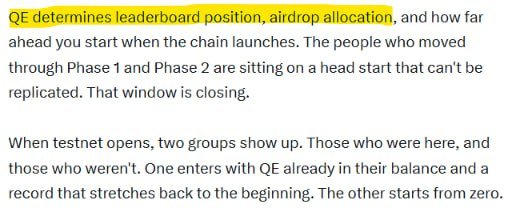
The latest reminder from @dac_chain makes it clear that QE isn't just a progress counter. It's a reflection of your consistency and could play a major role in your journey ahead.
Your QE helps shape:
• Leaderboard ranking
• Potential airdrop allocation
• Your starting position when the network goes live
Early participants from Phase 1 and Phase 2 have already built a strong foundation, but there's still time to keep improving.
Here's what I'm focusing on:
• Earn more QE every day
• Unlock every available Badge
• Open Quantum Crates
• Stay active through Mainnet & TGE
Small actions add up over time. Stay consistent, keep building, and don't miss the opportunity to strengthen your position.
@dac_chain
One of the biggest challenges facing blockchain isn't speed or scalability anymore, it's preparing for the quantum era.
Bitcoin wasn't designed with quantum-resistant cryptography in mind. Upgrading its security requires broad consensus across the entire network, making meaningful changes slow and difficult.
That's why building quantum security into the protocol from the very beginning matters.
@dac_chain takes a different approach.
Instead of relying on future upgrades, DAC is designed with quantum resilience at its core. Every transaction is protected through a security-first architecture from the moment it's created.
With Post-Quantum Cryptography (PQC) securing wallets and digital signatures, and Quantum Key Distribution (QKD) protecting network communication, DAC is preparing for a future where quantum computing becomes a reality.
Real innovation isn't just about making blockchains faster.
It's about making sure they remain secure for decades to come.
The future won't wait for outdated cryptography to catch up.
That's why @dac_chain is building quantum-ready infrastructure from day one.
The latest benchmark from dac_chain is a reminder that consistency always matters.
100K+ QE and 60+ Badges is not just a
number, it shows the effort and dedication of active community members.
With TGE getting closer, every action inside the ecosystem feels more valuable. If you are still participating, now is the perfect time to check your progress:
• Keep increasing your QE
• Collect every badge you can
• Stay active across Inception
• Don’t miss any official updates
The final reward model is still unknown, but one thing is becoming clear: active participation is being recognized.
Curious to know where everyone stands 👀
My Progress:
QE: 67K
Badges: 45
How close are you to reaching the 100K QE & 60+ Badge milestone?
@dac_chain
Real-world adoption of blockchain will not happen because of hype. It will happen when businesses and users can trust the infrastructure behind it.
From important records to tokenized assets, digital identity, automated workflows, and private enterprise systems, the next generation of applications needs more than just decentralization.
It needs security, reliability, and data integrity that can stand the test of time.
This is where @dac_chain focuses on building real-world utility through a secure, enterprise-ready blockchain environment.
By enabling verifiable records, asset tokenization, identity solutions, workflow automation, and private systems, DAC creates a foundation where real-world applications can operate with confidence.
But as more valuable assets and sensitive data move on-chain, long-term security becomes more important than ever.
The future is not only about bringing the real world onto blockchain.
It is about building infrastructure that can protect that value for decades ahead.
DAC is building for real-world utility, sustainable growth, and the next era of blockchain adoption.
@dac_chain
Scalability isn't just about processing more transactions. It's about doing it without sacrificing security or decentralization.
One thing that stood out to me while learning about @dac_chain is its layered architecture.
Instead of relying on a single execution layer, DAC distributes responsibilities across three specialized components:
• ShardChains → Execute smart contracts and process transactions in parallel
• MasterChain → Coordinates the entire network
• SyncroChain → Handles consensus finality and synchronization
This separation prevents network congestion, balances workloads, and keeps performance consistent even as activity grows.
Rather than forcing every node to do everything, each layer has a clear role. That's a smarter approach to scaling blockchain infrastructure.
For developers, it means building high-performance dApps without constantly worrying about bottlenecks, high fees, or declining throughput.
Strong architecture creates strong performance.
That's the kind of design philosophy that makes @dac_chain worth paying attention to.
Most blockchains were built for the threats of today.
But what happens when quantum computers become powerful enough to break the cryptography protecting wallets, treasuries, and governance systems?
That's the challenge @dac_chain is preparing for.
Instead of relying on a single layer of protection, DAC combines two complementary technologies to strengthen long-term security.
🔹 Post-Quantum Cryptography (PQC)
PQC upgrades traditional cryptography with quantum-resistant mathematical algorithms, including lattice-based cryptography. These algorithms are integrated into DAC's digital signatures and wallet infrastructure, helping protect private keys and transactions against both classical and future quantum attacks.
🔹 Quantum Key Distribution (QKD)
While PQC secures the cryptography itself, QKD protects the communication layer. Using the principles of quantum physics, encryption keys are exchanged through photons. If anyone attempts to intercept the transmission, the quantum state changes immediately, allowing the network to detect the intrusion before sensitive data is exposed.
Together, PQC and QKD create a defense-in-depth approach:
• PQC protects wallets and digital signatures.
• QKD protects data while it's being transmitted.
• Both work together to prepare the network for the post-quantum era.
Preparing for quantum threats isn't just about stronger encryption.
It's about building a blockchain that can continue protecting digital assets, governance, and network security long after today's cryptography reaches its limits.
@dac_chain