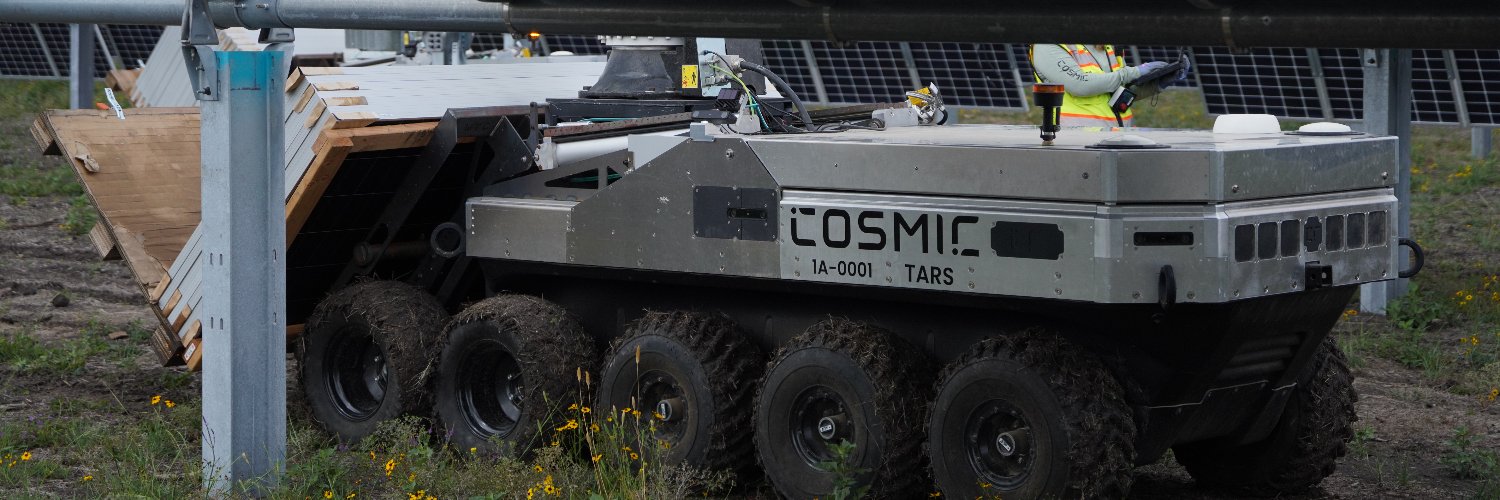
The fundamental bottleneck for robotics has been data, but now Claude can be your teleoperator, data curator, and model trainer. This completes the feedback loop to automate robotics research. Robotics is about to start scaling like frontier labs. The mad lads did it
Introducing Waddle Labs: Claude Code for robots.
Connect our API to your robot and enter a prompt, then our agents write code to achieve the task in 20 minutes.
@yiding_song@theWaddleLabs
@YuXiang_IRVL Claude can now teleoperate and build robotics applications quickly, I think we’re about to decouple expensive human demonstrators from data collection
Introducing Waddle Labs: Claude Code for robots.
Connect our API to your robot and enter a prompt, then our agents write code to achieve the task in 20 minutes.
@yiding_song@theWaddleLabs
If I was a VC in today’s market, I’d be betting on hardware companies. No one knows which frontier lab will win out, and open weight is consistently only a few months behind the SOTA. Margins will fall and I don’t see network effects or other natural moats for intelligence except maybe economies of scale.
a pre-seed team with an API key can now replicate what billion dollar robotics labs spent years and hundreds of millions building. 20 minutes to get a robot doing real tasks. the entire physical AI moat just got cooked and most VCs haven't priced it in yet.
Just went to The Coffeeshop in Dogpatch and ran into four robotics founder acquaintances while grabbing coffee with a robotics operator. SF is THE place to build
Those colours indicate steel temperatures around 750° C. That seems too hot for my taste. Gut feeling only. RD-180 apparently got up to 800° C. But that's single fluid staged combustion. There are steel types that can deal with such temperatures. But isn't the whole idea of full flow staged combustion to bring temperature of and stress on the powerhead down?
And in the very end, is this sunlight or a burn-through on the centre right engine?
SpaceX culture is built on a unique extreme humanism mindset. There’s this belief that a very determined person with good ideas can single-handedly shift the course of the company and maybe humanity. Extreme ownership taken to the limit. Turns out that kind of exercise of free will can lead to glory or paranoia.
I’m showing funny tweets to gf and she can’t grok the words and she’s showing me funny insta posts and I can’t comprehend the social context it’s like Babel
The biggest one I’ve seen is when people seek validation through promotion. A lot of people early in the career think they get promoted as a reward for doing well, when in reality you get promoted because a role needs to be filled and you’re best positioned for it. Jobs are not created for you, you are recruited for the job.
The world is deeply unfair.
Some of the most talented people I know are stuck in dead end desk jobs while some of the snarkiest narcissistic tyrannical workhorses are in positions of great power.
This has always greatly saddened me.
After a lot of analysis, I think there are 5 reasons this happens:
1. Refusal to believe / fear of failure. Loss of belief that where there is a will (to enact change), there is a way e.g. “I am just a cog in the wheel. If I say something, no one will listen.” or “if I do this, I will upset somebody”
2. Lack of purpose. You don’t really understand what you’re fighting for and what you believe in. You fight for inconsequential, often selfish, goals. e.g “Will doing this get me a promotion? Should I completely change everything to do this other project cause it will get me a promotion?”
3. Lack of self awareness. I will stand up to this thing I believe in and they will listen to me. e.g intern saying: “why doesn’t the ceo like my view on company strategy?”
4. Refusal to play. The failure to acknowledge that your worldview is only as powerful as your ability to influence others of your worldview OR a complete repudiation of the will to interact with those who don’t share your worldview e.g. “these guys just do what they want. They won’t listen to me. what will happen if I do this?”
5. Refusal to strategize or concede. The unwillingness to play and win a side quest that will ostensibly further your vote because you find the interim goal pointless. Or the inability to concede a battle to fight the war. e.g. “this direction is wrong. I need to fight it (even though it’s a small issue)”
Almost everyone who is bitter or feels stuck in their career boils down to one of these 5 failure modes 1, 2 and 3 are the most common. Many suffer consequences of 2-5 and end up in 1. I’ve personally seen some of my sharpest friends land up in 1 because they just don’t believe they can win.
One privileged part of my job is getting to interact with people who are willing to, against all odds, believe in something heretical, know why it’s important, know what needs to be done to make it real, do it, and make side quests to get it done. I think it applies to everyone doing anything.
They make good chips but 1) the OS and software on top sucks 2) the chips need to be integrated with a motherboard and peripherals and packaged in rugged boxes and 3) sometimes the Jetsons just aren’t powerful enough. Just had lunch with a founder who’s building a fix and I’m stoked
STOP BUILDING SOFTWARE. I’ve talked to so many startups trying to do some kind of software tool for robotics and it’s very hard for me to believe in any of them. If you want to sell picks and shovels to robotics, build a hardware company instead. Better edge compute, better sensors, better actuators, better manufacturing equipment, even just operating better machine shops. We will happily onboard new hardware vendors and take a bet on you because that is the bottleneck right now for all robotics companies.
Yeah, you're totally right that companies come in different types of embodiments and biz models. That makes it hard to build software products.
For our software specifically, that means we need to take pride in forward-deploying and not making our flow too opinionated while still being valuable.
I think middleware is an example of a tarpit in robotics products. But I also think it illuminates the not-invented-here syndrome in robotics. Because in the past, things like middleware haven't been great, so robotics companies think they need to build literally everything themselves.
That might be currently true about middleware and some existing software, but that doesn't necessarily have to be true!
Great, thoughtful software means that you can focus on building robots and not all the other tools you need to make your company work. Imagine having to build Rippling from scratch to run your payroll.
The answer is that you need software that actually helps you, not that you should just build everything yourself.
(and obviously, I'm biased as someone who builds software for robotics)
I think there’s def room for better software tools in robotics (existing solutions all suck) and I’d happily buy software that moves the needle. But I think robotics companies come in such different shapes and sizes that a lot of software tools have trouble supporting all applications, kind of like how ROS continues to fall into the trap of being okay but not good for most customers. If every company gives up on ROS and homebrews their own middleware, they probably have the expertise to build most other tooling and other software on top of that.