Yesterday we're talking about getting leads through referral system. Today we'll talk about Meta ads.
Many B2B leaders think Meta only drives low-quality, consumer-level noise. But if you shift your mindset from "lead bait" to "intent filters," Meta can actually become your highest-ROI channel for finding qualified enterprise buyers.
How to do it for high quality now that algorithmic targeting relies heavily on broad signals? The answer is to let your creative do the targeting.
1.Un-gate the Value, Gate the Utility: Stop forcing people off the app for simple reading material. Give away your best insights right in the text or via a mobile-first, 45-second Reels video. Only gate a high-utility asset—like a product walkthrough. If you use native Lead Forms, use the "Higher Intent" option to add a mandatory review step that weeds out accidental clicks.
2. Fix the B2B Email Match Gap: The biggest mistake in B2B Meta ads is uploading a CSV of target corporate emails. Most people link their Facebook and Instagram accounts to personal emails (@gmail.com), leading to terrible match rates. Enrich your target company lists first using data-matching tools to find those personal handles, then upload them to build an airtight Custom Audience seed list.
3. Optimize for Revenue, Not CPL: Instruct your growth team to stop celebrating a low Cost Per Lead (CPL). Because Meta is highly efficient, it can generate cheap $15 leads that completely ghost your sales team. Instead, optimize your Meta pixel using Conversions API (CAPI) to feed deep CRM signals back into Ads Manager. Train Meta’s algorithm to optimize for the Lead-to-Opportunity conversion rate, not raw form submissions.
On Meta, your ad creative is your primary filter. When your hook states a precise, painful operational bottleneck, only the qualified, high-intent buyers will stop scrolling their feed to raise their hand.
#MetaAds #B2BMarketing #DemandGeneration #LeadGeneration
There are many ways to get leads and this week we will focus on that.
First method of getting high quality leads is referral.
Most B2B referral programs fail because they ask at the wrong time. "Who else do you know?" at the end of your first wrap-up call usually gets you a low-quality lead just to be polite.
If you want referrals that actually close, you need a system, not a favor.
How to do it? Don't ask broad questions. Do the homework first.
1. Target the Ecosystem: Look at your client’s LinkedIn connections before you speak. Find 2–3 specific companies that perfectly fit your Ideal Customer Profile (ICP).
2. Anchor to an Inflection Point: Ask for the referral right after a Value Milestone (e.g., right after your software automates their first 1,000 hours, or saves them 15% on a line item).
Here's the script you can use: "We just hit [Milestone] for you, and I notice you're connected to [Name] at [Target Company]. Their operations look identical to yours before we started. Would you be open to a 2-sentence email introduction framing how we solved [Specific Pain Point] for you?"
This specific requests yield high-quality leads. They're the leads you KNOW are likely to convert and you have already proved that your product works for them with the milestone you have for their network.
Stop asking for "anyone who needs help." Ask for the exact match you’ve already researched.
#B2BMarketing #LeadGeneration #SalesStrategy #ReferralMarketing
Quick demo of how legion use AI to do outbound calling and automate everything in the CRM. From create contact, move leads to different stages in pipeline, create appointment, send SMS/ email/ call follow up, everything can be done without you having to lift a finger.
We're offering 15 minutes consultant to diagnose your current marketing and sales workflow.
Don't be shy and DM us for the free session!
#smallbusiness #smallbusinesssupportingsmallbusiness #smallbusinessbigdreams #CRM
The brutal truth about outbound sales in 2026
If you are forcing your sales reps to spend 4 hours a day staring at a CRM, dialing cold lists, hitting voicemails, and getting hung up on, you aren't just burning budget—you are burning out your team.
-The Speed-to-Lead problem: If you don't respond to a hot lead or signal within 5 minutes, conversion rates plummet by nearly 80%.
-The Volume trap: Humans can only make so many dials a day before fatigue sets in and tone drops.
Outbound nowadays is simply too tough, too slow, and too soul-crushing for brilliant sales reps to waste their energy on the first dial.
At Legion AI, we built an autonomous AI voice agent designed specifically to handle the "heavy lifting" of outbound calling for you. It doesn't read from a robotic, frozen script—it listens, handles objections dynamically, qualifies the lead, and books the meeting directly into your closer’s calendar in real-time.
Instead of replacing your sales team, it gives them superpower scale. The AI handles the 90% friction of cold outreach, so your humans can focus 100% of their energy on closing high-value deals.
Want to see it in action? Watch the quick demo below to hear exactly how human it sounds. 👇
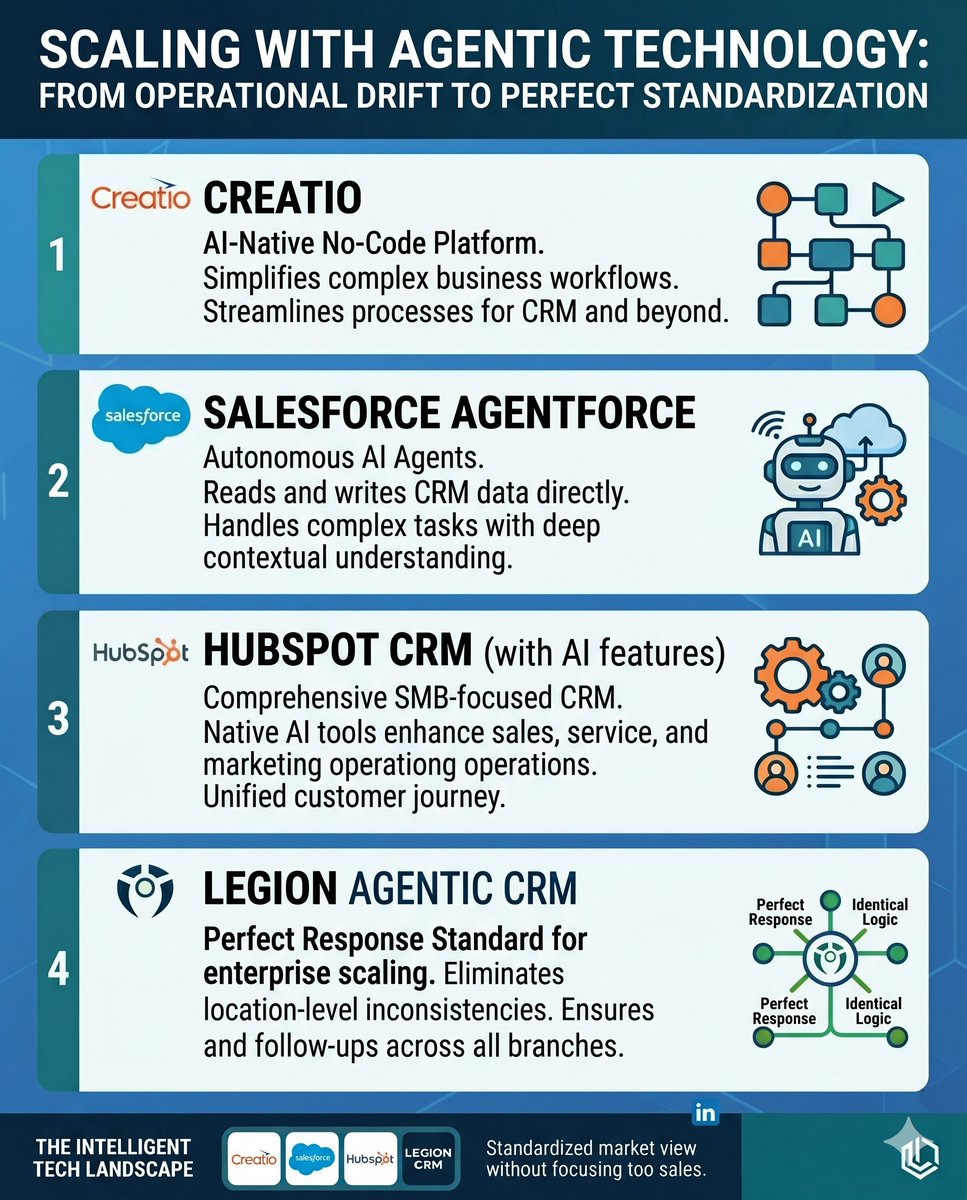
The Silent Brand Killer of Scaling a Business: Inconsistent Customer Experiences.
When you manage one location, maintaining service is easy—you or your core team are there to oversee every lead, call, and follow-up. But the moment you expand to Location B, C, or D, things fracture. Location B handles inquiries differently. Following up becomes lagging, booking logic gets sloppy, and response quality drops. This operational drift dilutes your brand, leaks revenue, and leaves customers confused.
Scaling successfully requires decoupling your brand experience from local human variance. You need an automated Response Standard. The operational goal is simple: ensure that the very first touchpoint, the immediate follow-up, and the appointment booking logic are executed identically across your entire enterprise, regardless of geography.
To achieve this at scale without inflating your headcount, companies are moving away from traditional, static CRMs and adopting Agentic AI and intelligent workflow platforms.
Depending on your current tech stack, here is how the landscape looks for standardizing multi-location operations:
-Salesforce Agentforce: Ideal for massive enterprise ecosystems, using autonomous agents to natively read/write CRM objects and manage inbound lead generation under strict corporate guardrails.
-HubSpot CRM (with native AI features): Great for mid-market businesses looking to centralize omni-channel customer journeys and scale standardized email and messaging plays.
-Creatio: An AI-native, no-code platform where automated customer journeys and lead scoring are embedded directly into the architecture rather than patched on top.
-Legion (Agentic CRM): Built specifically to lock in uniform outreach and booking logic across distributed enterprises, ensuring your signature brand experience is executed flawlessly by autonomous agents on day one of a new location launch.
Standardization isn’t about removing the human touch—it’s about using intelligent tech to handle the repetitive logistics perfectly so your local teams can focus on face-to-face relationship building.
How are you keeping your operations consistent as you scale this year? Let's discuss in the comments.
#BusinessScaling #Operations #AgenticAI #CRM #CustomerExperience
Ever run a big holiday promo… and then watch your ops fall apart?
A local business ran a “Memorial Day Special” that crushed it on clicks and calls—but managers hadn’t staffed up.
Result:
-Phone lines jammed
-Long wait times in-store
-Great offer, terrible experience
-A wave of bad reviews
This isn’t a marketing problem. It’s a coordination problem.
The real issue
-Marketing runs on one calendar.
-Staff scheduling runs on another.
-No one is connecting “promo day” to “we need more people on shift.”
How to solve it
Step 1: One shared promo calendar
Use a simple shared calendar like Google Calendar or Microsoft Outlook Calendar as your “Revenue Calendar” for all promos, mailers, ads, and events.
Give access to whoever creates staff schedules and treat it as the single source of truth.
Step 2: Turn promos into staffing rules
Create 2–3 clear rules that your team can actually follow, for example:
“Email blast” → +1 person per shift
“Holiday sale (10–20% off)” → +20–30% staff for 2–3 days
“Major seasonal promo” → max staffing + manager on site
Write these into your scheduling SOP so it’s automatic, not a judgment call.
Step 3: Add a light automation layer
Once that’s working, layer in simple tools instead of a full-blown AI platform:
Calendar → Notification:
Use Zapier or Make to watch your “Promo” calendar.
When a promo event is added, automatically send a Slack/Email/WhatsApp message to managers:
“Promo: Memorial Day Sale (5/25–5/27). Increase staff by 25%.”
Calendar → Scheduling app:
If you use tools like Homebase, When I Work, or Thryv, make sure your promo calendar events are visible when building schedules, or push tasks into those tools so managers can’t miss them.
Use past data to refine:
Every time you run a promo, log:
-Sales vs. a normal day
-Avg. wait time
-Staffing level
After a few cycles, you’ll know “Memorial Day-level promo ≈ 30–40% more volume → +2–3 staff.”
#scaling #marketing #operation #smallbusiness #meduimbusiness
If you manage 3 locations, you can walk the floor. If you manage 30, you’re flying blind.
The real problem with scaling isn’t growth. It’s the visibility gap.
When you run multiple locations, operational issues hide in plain sight:
📍 One site is quietly leaking leads at the front desk.
⏳ Another is racking up unapproved overtime.
📋 A third is completely missing daily execution standards.
By the time the monthly report shows it? The damage is already done. The money is gone.
The answer isn't more alignment meetings. It’s a better system. Multi-location operators need a unified tech stack that gives them a single source of truth across every single zip code.
If you want to close the visibility gap, here is the ultimate multi-location starter stack:
🌐 Local Visibility & SEO: Yext, BrightLocal 🇺🇦, Moz
⭐ Reviews & Reputation: Birdeye, Reputation, Grade
📋 Daily Ops Consistency: OpsAnalitica
⏳ Sales & CRM: Legion AI
💬 Team Communication: Slack, monday
📁 Files & Shared Docs: Google Workspace, Office 365, Dropbox
📍 Field & Fleet Tracking: Linxup, GPS tracking tools
The goal here is simple: fewer surprises, faster decisions, and total real-time visibility across every single location.
Stop managing by fire drill. Scale with data.
#smallbusiness #mediumbusiness #scalingbusiness
One bad schedule can create legal risk, massive burnout, and avoidable fines.
For small and medium business owners, managing a retail floor, restaurant, or service team is tough enough. But if you are still building schedules on a spreadsheet, you are playing a high-stakes game with labor compliance.
It takes just one oversight to trigger major issues:
-Scheduling an employee to close at 11 PM and open at 6 AM the next morning. It destroys morale and violates mandatory rest-period laws in many jurisdictions.
-Forgetting to schedule compliant rest or meal blocks, leading to disgruntled staff and costly wage-and-hour violations.
-Changing a published schedule at the last minute in cities with strict labor laws, resulting in mandatory predictability pay penalties.
Trying to catch these errors after a schedule is published or during a busy shift is too late. Compliance checks must be built directly into the scheduling process, not treated as an afterthought.
The Tech Fix: You don’t need an army of lawyers or expensive enterprise software to protect your business. Affordable, plug-and-play Workforce Management apps (like Deputy, Homebase, or 7shifts) have local labor compliance built right into their core system.
As a manager builds the weekly schedule, the app actively works in the background as a digital compliance guardrail. If you accidentally schedule a "clopen," assign a shift that triggers overtime, or violate local break laws, the software flags it instantly before you hit publish.
Stop relying on memory to stay compliant. Move your scheduling to a compliance-aware system, protect your bottom line, and give your team the predictable rest they deserve.
#staffing #compliance #AI #smb #smallbusiness
A coverage problem quickly becomes a communication problem when you don't have a self-service workflow.
Every small business owner or retail manager knows the sudden dread of the 6:00 AM text: "Hey, I'm sick and can't make it in today."
What happens next is pure operational chaos. The manager spends the next two hours desperately texting down a phone tree, sending panicked messages into a group chat, or begging off-duty staff to come in. It burns out the manager, disrupts the team, and often leaves the shift completely understaffed.
When an employee calls out, the solution shouldn't rely on a manager's frantic manual outreach. It should rely on an automated system.
To stop the group-text chaos, your business needs a structured Call-Out & Coverage Strategy:
An Automated Escalation Path: Establish a clear digital protocol for absences. When a worker marks themselves out, the system should immediately trigger a standardized workflow rather than a random text thread.
Automated Replacement Suggestions: Stop guessing who to call. The system should automatically scan your roster and instantly surface the next best available staff member who is qualified for the specific role.
A Single Source of Truth for Availability: You cannot find a quick replacement if your team's availability is scattered across sticky notes and old text messages. Real-time availability must live in a centralized digital hub.
The Tech Fix:Spreadsheet workflows and SMS groups can’t handle last-minute chaos. You need to transition the burden to an affordable, mobile-first Workforce Management app built for small teams (like Deputy, Homebase, or 7shifts).
Instead of forcing the manager to play middleman, these platforms introduce employee self-service. When someone needs to drop a shift, they post it to the app. The system automatically sends a push notification only to eligible, off-duty coworkers who can claim the open hours in a single tap—instantly patching the coverage gap while automatically blocking anyone from hitting accidental overtime.
Stop fighting fires in the group chat. Shift the burden to a self-service app, and let your operations run smoothly even when life happens.
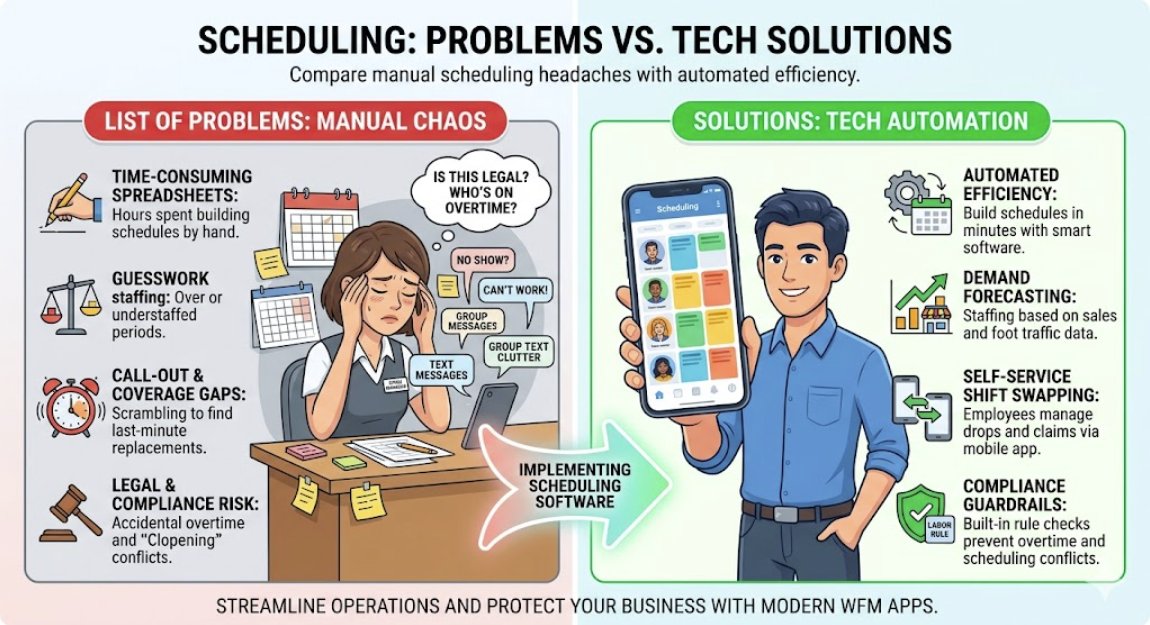
Manual scheduling is expensive, slow, and usually based on guesswork.
If you are an SMB owner or manager still building schedules by hand every week, you aren't just losing your mind—you are losing money. Spending hours on an Excel spreadsheet trying to piece together who can work, who is qualified, and when you’ll actually be busy is a massive operational bottleneck.
If you want to reclaim your time and protect your bottom line, your scheduling workflow needs three things:
1. Hourly Demand Forecasting: Stop scheduling for a generic "day." Look at your historical traffic to map out exactly how many people you need by the hour.
2. Skills-Based Assignment: Ensure every shift has the right mix of skills (e.g., pairing an experienced closer with a new hire) so operations run smoothly without your constant supervision.
3. Centralized Availability: Ban the text messages, sticky notes, and verbal requests. Move all employee availability and time-off requests into a single, master digital system.
The Tech Fix:
You don't need a massive enterprise IT budget. Lightweight, plug-and-play labor scheduling apps built specifically for small teams completely eliminate the spreadsheet headache:
- Deputy (Best for Shift-Swapping & Compliance): Features one-click auto-scheduling based on employee availability and skills. It gives managers real-time warnings if a shift change accidentally triggers overtime, and lets employees claim open shifts right from their mobile phones.
- 7shifts (Best for Restaurants & Cafés): Connects directly to your POS system to analyze historical sales data. It automatically predicts your hourly staffing needs, showing you a live meter of your projected labor costs before you publish the schedule.
- Homebase / When I Work (Best for Tight Budgets): Replaces messy text messages by forcing all availability and time-off requests into one app. When you build a schedule, anyone who is unavailable is automatically blocked out, completely preventing accidental double-bookings.
Stop playing calendar Tetris. Automate the baseline so you can spend your time actually growing the business.
#smb #smallbusiness #mediumbusiness #smbowner #staffing
This week we'll talk about staffing problem.
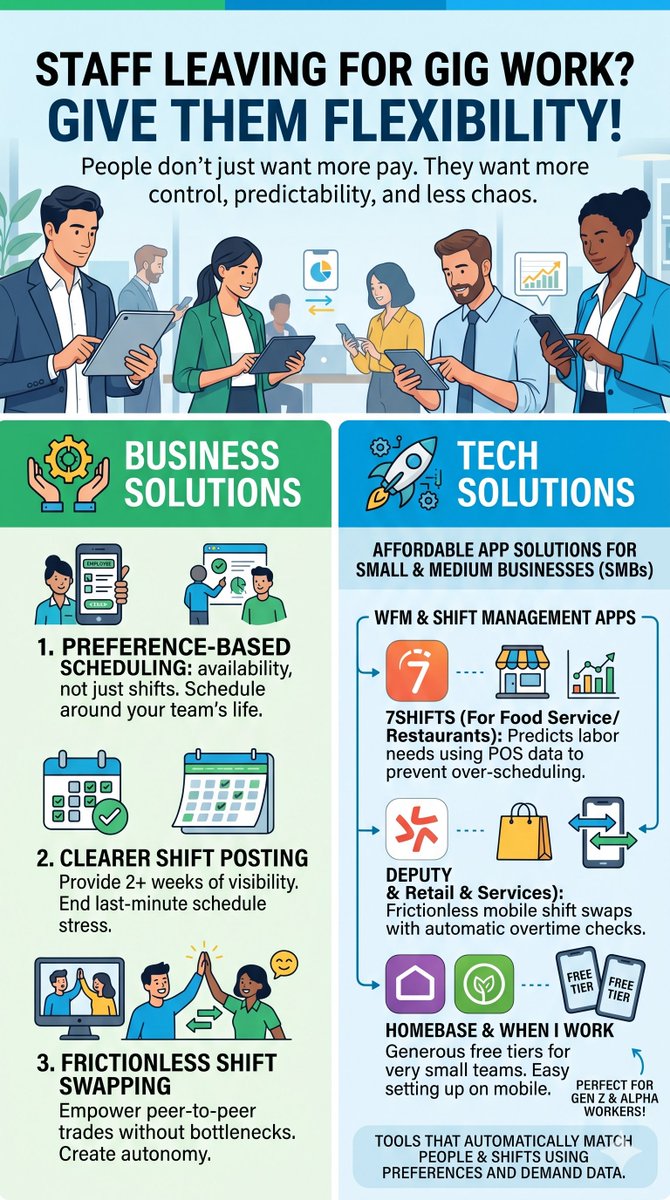
People don’t just want more pay.
They want more control, more predictability, and less chaos.
We are seeing high-quality, experienced staff leave stable roles for gig work.
On paper, it looks risky. In reality, they are trading traditional benefits for the ultimate currency: schedule flexibility.
In this economy, the reality has shifted:
-Parents need rigid predictability to manage childcare or spend time with family.
-Professionals are balancing a second gig just to keep up with the cost of living.
-Gen Z and Gen Alpha are naturally free-spirited—they value autonomy over corporate assimilation and will actively quit jobs that offer zero freedom.
If you are a business owner losing talent to the gig economy, you aren't just competing on wages anymore. You are competing on lifestyle.
Here is how you fix it on the Business Side:
-Preference-Based Scheduling: Don't just assign shifts. Let your team log their ideal windows and build your core schedule around them.
-Clearer Shift Posting: Stop posting schedules 48 hours before Monday. Give people at least 2 weeks of visibility so they can plan their lives.
-Frictionless Shift Swapping: Create a culture where team members can trade shifts easily without jumping through bureaucratic hoops.
Here is how you solve it on the Tech Side:
You don’t need an enterprise IT budget or massive software systems to fix this. There are lightweight, plug-and-play scheduling apps built specifically for small and medium businesses.
-For Easy Swapping & Autonomy (e.g., Deputy or When I Work): These tools put the power on the employee's phone. If someone needs to drop a shift, they post it to the app. Other qualified team members get a push notification and can claim it instantly. The software automatically checks to ensure no one accidentally goes into overtime.
-For Industry-Specific Forecasting (e.g., 7shifts for restaurants, Homebase for retail): These apps connect directly to your existing POS (Point of Sale) system. They look at your historical sales data to predict exactly how many people you need on the floor, helping you build optimized schedules in minutes rather than hours on a spreadsheet.
Give your people control over their time, and they’ll give you their best work.
#smb #smallbusiness #mediumbusiness #staffing #shiftmanagement #WFM
Last post of Medspa Problem Week.
What is your front desk actually optimized for?
Is it answering repetitive questions all day?
Or delivering a high-end, in-person experience that keeps patients coming back?
Because right now, for most medspas, it’s the first one.
The phone rings:
“What’s your filler pricing?”
“Do you take walk-ins?”
“How do I prepare for Botox?”
“Can I reschedule my appointment?”
None of these questions are complex.
But together, they take up hours of your team’s day.
And every minute spent on the phone has a hidden cost:
The patient at the front desk gets a fragmented experience
Staff attention is split instead of focused
New inbound leads (especially from Instagram or web) go cold while waiting
This is where the gap shows up between operational reality and brand promise.
You can’t deliver a luxury experience if your team is constantly pulled away from the person in front of them.
The highest-value role of your front desk isn’t answering FAQs.
It’s creating a seamless, personalized, in-clinic experience.
Everything else should be offloaded.
That’s where Legion fits in.
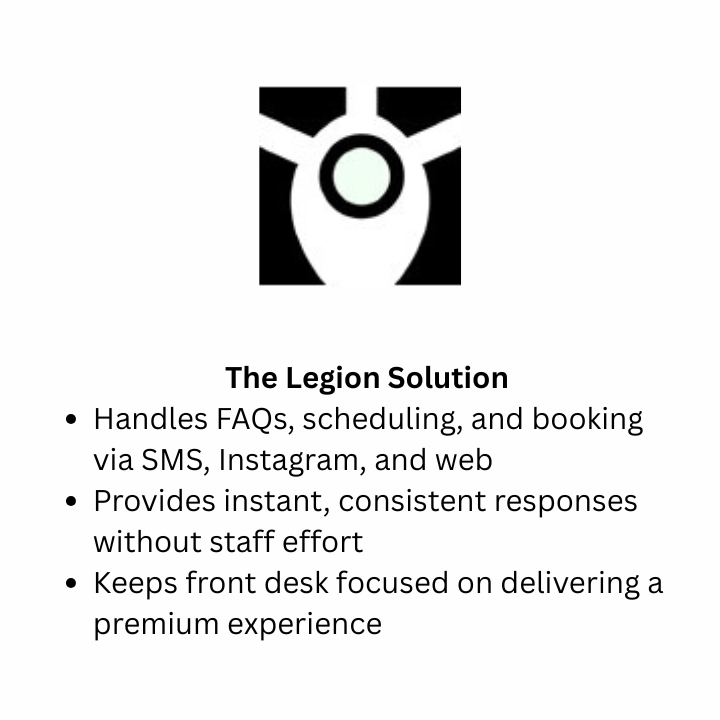
Legion handles the entire FAQ and booking layer across SMS, Instagram, and your website — instantly, consistently, and without staff involvement.
Patients get answers right away.
Appointments get booked without delay.
And your team stays focused where it matters most: the in-person experience.
You’re not replacing your front desk.
You’re elevating it.
Give your front desk their time back. See Legion in action — book a demo.
#Medspa #Medspaowner
For third post od Medspa Problem Week, we're diving into data fragment problem.
Most medspas don’t have a patient data problem.
They have a fragmentation problem.
The treatment history lives in the EMR.
Appointment details sit in the booking system.
Patient conversations are buried in texts, emails, or another platform entirely.
And before every appointment, someone has to piece it all together.
Not because they want to — because they have to.
This is where things start to break down:
-Important context gets missed
-Providers walk in partially informed
-Patients end up repeating themselves
And the experience? It feels transactional instead of personal.
That’s a problem — especially in a space where premium service is the differentiator. Because from the patient’s perspective, it’s simple:
“If I’ve been here five times, why don’t they know me?”
The expectation isn’t just good treatment.
It’s continuity. Recognition. Personalization.
And that only happens when your team has a complete picture — instantly.
A unified system isn’t just an operational upgrade. It’s an experience upgrade.
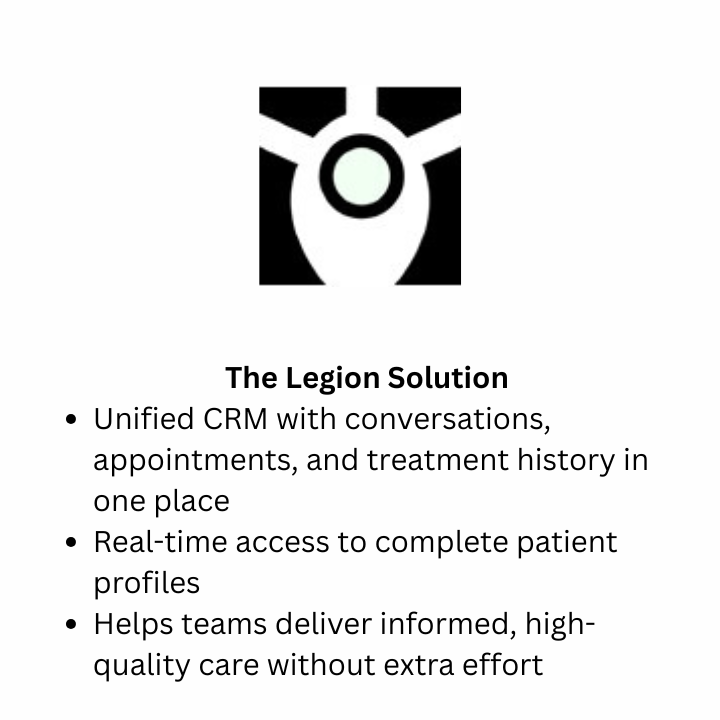
Legion brings everything into one place — conversations, appointments, treatment history, and notes — all connected, all accessible in real time.
So instead of scrambling to prepare, your team walks into every session already informed.
They know who the patient is.
What they’ve done before.
What matters to them.
That’s what turns visits into relationships — and relationships into retention.
One platform. One source of truth. See it live — book a demo.
#Medspa #EMR #CRM
The fourth post of Medspa Problem Week. We're going to talk about pricing.
Pricing in a medspa isn’t static.
It changes based on unit count, provider experience, active promotions, membership status, and service bundles. Two patients asking about “Botox pricing” might legitimately get two different answers.
And yet — most clinics are starting to rely on chatbots to handle these conversations.
Here’s the problem:
Generic AI doesn’t actually know your pricing.
It predicts. It pulls from patterns, assumptions, or incomplete context — and then fills in the gaps.
Sometimes it’s close.
Sometimes it’s wrong.
But in this industry, “close” isn’t good enough.
Because the moment a patient hears one price online and a different one at checkout, trust breaks. Not later. Immediately.
And now your staff has to:
Explain the discrepancy
Rebuild trust
Potentially honor a price that was never supposed to be offered
This isn’t just a communication issue. It’s a revenue and brand problem.
The solution isn’t just a “smarter” chatbot.
It’s a constrained one.
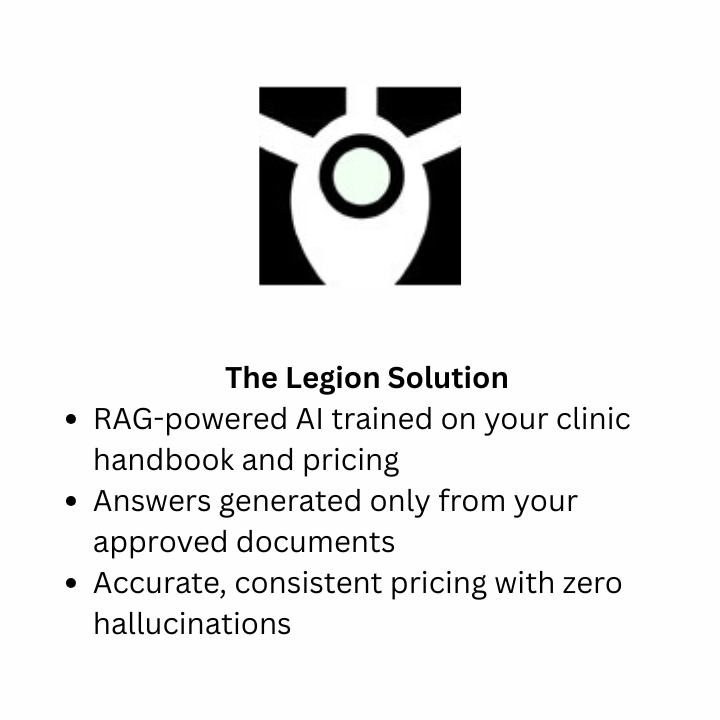
Legion uses knowledge base, which means the AI doesn’t invent answers — it retrieves them directly from your actual clinic materials.
Your pricing sheets.
Your service menus.
Your internal handbook.
If it’s not in your system, it doesn’t get said.
That means:
No hallucinated pricing
No outdated promotions being quoted
No ambiguity in what patients are told
You’re not training a bot to sound confident.
You’re giving it a single source of truth to be accurate.
So every response reflects exactly how your clinic operates — down to the details.
Upload your pricing sheet, and your AI becomes an expert instantly.
See how — book a demo.
#Medspa #Medspaowner
For second post of Medspa Problem Week, let's talk post-treatment churn.
After a treatment, life gets busy.
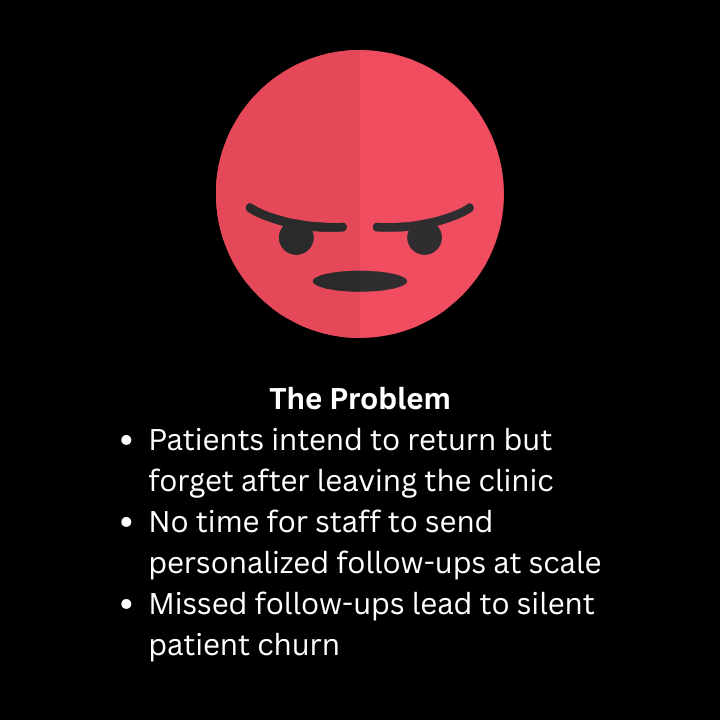
The patient walks out feeling great. Maybe they even intend to rebook. But then work picks up. Notifications pile up. Time passes.
And they just… don’t.
This isn’t a motivation problem — it’s a timing problem.
Research consistently shows that reaching out within the first 24–48 hours after a treatment significantly increases the likelihood of a patient returning. It’s the moment when the experience is still fresh, when satisfaction is highest, and when rebooking feels natural.
But here’s the reality inside most clinics:
-Front desk teams are managing 15–20+ appointments a day
-Providers are focused on delivering care, not sending follow-ups
-Personalized outreach falls to the bottom of the priority list
So what happens? Nothing gets sent.
And that patient, who likely would have come back, quietly disappears.
The gap isn’t intent. It’s execution at scale.
That’s where automation, when done right, changes everything.
Legion sends post-treatment follow-ups that are automatically tailored to the exact service each patient received. A Botox patient gets messaging that reflects their treatment journey. A laser patient gets something different — relevant, timely, and aligned with their experience.
It doesn’t feel like a blast. It feels like someone remembered.
And that’s the difference between a one-time visit and a long-term relationship.
Retention doesn’t require more staff.
It requires better timing — delivered consistently.
If you’re thinking about how to improve retention without adding operational overhead, it might be time to rethink your follow-up strategy.
Book a demo to see what your retention workflow could look like.
#Medspa #Automation
Welcome to the first post of Medspa Problem Week! We're going to talk about something very important...No-show revenue leak.
You paid to acquire that patient.
The ad spend. The follow-ups. The consultation. The time your staff invested to get them through the door.
And then… they cancel.
That empty slot isn’t just a scheduling issue — it’s lost revenue.
Most clinics accept this as part of the business. A no-show here, a late cancellation there. But what’s often overlooked is how recoverable that revenue actually is.
Because when a slot opens up, there’s still demand.
Patients are waiting. They just aren’t being reached fast enough.
Speed is what determines who fills that slot.
The reality? Manual outreach can’t compete:
Front desk teams are juggling calls, check-ins, and in-person patients
By the time they start calling down a waitlist, minutes — sometimes hours — have passed
And that patient? They’ve already booked somewhere else
The opportunity doesn’t disappear. It just goes to whoever acts first.
That’s the shift clinics need to make — from reactive scheduling to real-time recovery.
Legion automatically reaches out to waitlisted patients the moment a cancellation happens. Not later. Not when someone has time. Immediately.
Patients get notified while the slot is still available.
Clinics fill chairs without lifting a finger.
What used to be lost revenue becomes recovered revenue — consistently.
Because empty chairs aren’t inevitable. They’re just unmanaged.
See how Legion handles no-shows. DM/ comment to book a demo with us.
#Revenue #Medspa #Automation
Running a MedSpa isn’t just about providing world-class aesthetic treatments—it’s about managing high-value appointment cycles, complex patient histories, and a front desk that never seems to catch a break.
High-intent leads are ghosting, post-treatment follow-ups are falling through the cracks, and tech debt is eating into profit margins.
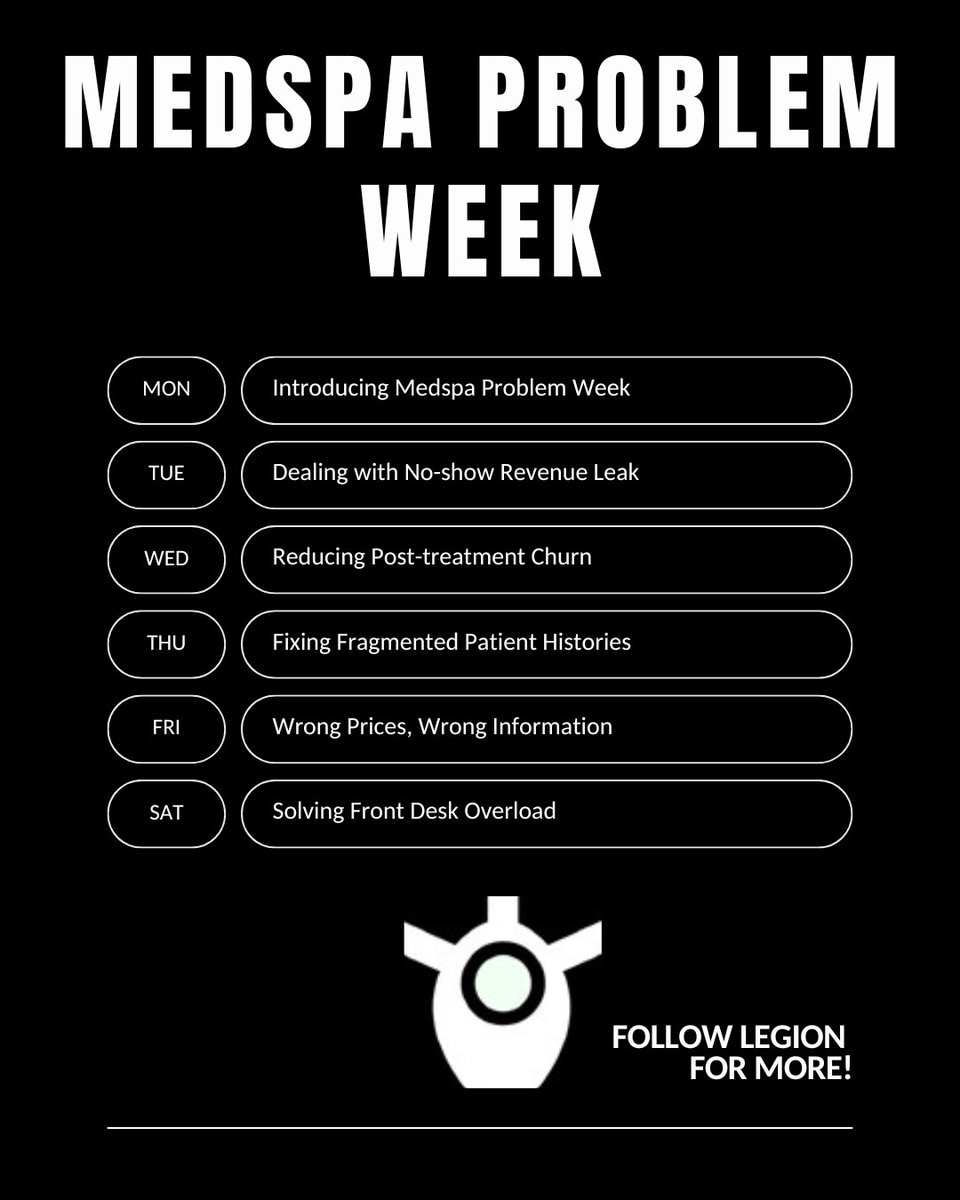
Starting today, we’re doing a deep dive into the 5 biggest hurdles preventing MedSpas from scaling effortlessly:
-TUE: Dealing with the No-show Revenue Leak 📉
-WED: Reducing Post-treatment Churn & Boosting Loyalty 🤝
-THU: Fixing Fragmented Patient Histories (The "Single Source of Truth") 🗂️
-FRI: Solving "Wrong Prices, Wrong Info" with Agentic Knowledge 🧠
-SAT: Ending Front Desk Overload for Good 📞
Which of these is your biggest headache right now? Drop a comment below and follow along all week as we solve them one by one. 🦾
#MedSpa #AestheticMedicine #MedSpaOwner #BusinessAutomation #AgenticAI #PatientRetention
Last post for minority smb owner week. For most minority-owned businesses, the biggest hurdle to opening a second location or expanding a service isn’t a lack of vision—it’s the overhead.
Hiring is slow, expensive, and incredibly risky. If you’re waiting until you can afford a massive new payroll to grow, you might be waiting forever.
The secret to growth in 2026 is Lean Scaling. It’s about increasing your output without immediately exploding your costs. How? By implementing a Digital Concierge.
Think about the repetitive "noise" that eats your team's day:
- Answering the same FAQs
- Sending manual appointment reminders
- Basic intake and lead qualification
The Legion Solution:
At Legion AI, we built AI to be that digital concierge. It allows you to manage multiple locations or a massive surge in lead volume with your current, trusted team.
We handles the repetitive outreach in the background so your staff can stay focused on the high-level, human-centric service that actually builds your brand.
Ready to grow lean? Reach out today for a custom scaling plan and let’s see how Legion can expand your reach.
#MinorityOwnedBusiness #minorityowned #smallbusinessowners #smallbusinessownerlife #smallbusinesses