Unslopping vibecoded websites starts with the basics
give Claude these 13 rules. works wonders ↓
“
1. Use a small, consistent type scale.
2. Make card titles smaller than section headings.
3. Use 400 for body text and 400 or 500 for headings.
4. Keep headings upright. Skip italics.
5. Size card text 1px smaller than similar text outside.
6. Size button text 1px smaller than nearby text.
7. Tighten letter spacing as type gets bigger.
8. Use tight line height for large headings.
9. Leave breathing room between sections.
10. Balance wrapped headings. Avoid lone words on the last line.
11. Cut decorative labels, badges, and redundant buttons.
12. Use one sans serif for body text and one family for all headings.
13. Favor high-quality, real photos.
“
what is agent looping
for the last two years we prompted agents one task at a time. that is starting to change
instead of asking an agent to build the landing page and then driving every step yourself, you set up a loop that handles discovery, planning, the work, checking, and iterating until the goal is met
looping is a setup you build. almost any agent harness can run it, it just depends on how you wire it up
at its simplest, looping is one agent working on itself:
> researches
> drafts
> checks the draft against a goal
> fixes what is weak
> runs that cycle again until the work clears the requirements
you are not prompting each step anymore. the agent repeats the cycle for you
the bigger version is a fleet looping. you give an orchestrator agent a goal, it breaks the goal into pieces, hands each piece to a specialist agent, and those specialists hand smaller jobs to their own subagents
the whole tree keeps looping through discovery, planning, execution, and verification until the goal is met
one agent looping is like a person redoing their own draft. a fleet looping is a whole team running a project end-to-end
you create a goal, and the system runs the loop until it finishes within the reqs you set
open and closed looping:
OPEN LOOPING is exploratory. it still has conditions and a goal, but you give the agent or the fleet a wide space to move in. it can try different paths, discover things, build something you did not fully spec out
this is the exciting end, it is what Peter and others are doing, and tbh it is where I want to spend more time
the catch is cost, an open loop with real room to explore burns an insane amount of tokens. for the 90 percent of people without an unlimited budget it is not runnable yet, and pointed at projects with a loose standard it turns into a slop machine
CLOSED LOOPING is bounded. a human designs the end-to-end path first:
> clear goal
> defined steps
> an eval at each step
> a point where it stops or hands back to you (and feeds back performance data)
the agents still loop, but inside framework you built. it gets better every run because each pass feeds the next, and it runs on a normal budget because the path is tight.
for most marketing work, closed is the one that pays off today.
> the orchestrator owns the goal
> the specialists own the steps
> the subagents do the narrow work
> an eval gate make sure its not slop
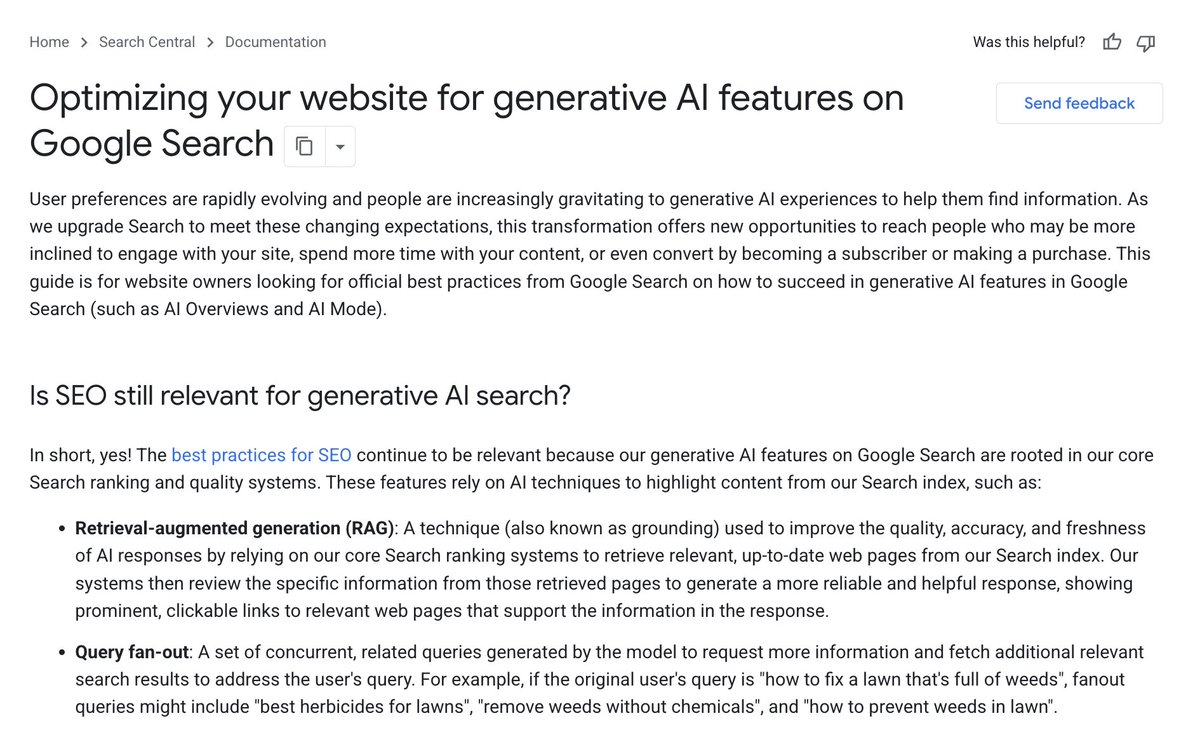
🚨 JUST IN - Google published a long piece about "Optimizing your website for generative AI features on Google Search" 👀
A lot in it https://t.co/22t75EtwUH
🧵
The Warp team uses a lot of Skills to speed up our workflow, so we open-sourced them.
> npx skills add warpdotdev/oz-skills
Includes Skills for SEO and accessibility auditing, documentation writing, DevOps tasks like terraform configuration, and more.