A right-footed centre-back belongs on the right. Under pressure on the left, he is forced onto his weaker foot—blocking forward passes, slowing the build-up and increasing the risk of losing possession, control and dominance.
Virgil van Dijk’s first game at RCB for the Netherlands.
These are some of his most interesting touches against Serbia. You can immediately see how natural he looks on this side.
The passing angles are better, he can accelerate the game more easily and find passes between the lines. He is also able to hold the ball until the very last moment, drawing pressure before releasing it and creating better conditions for the next action.
It was also clear that he still had to adjust slightly. That is understandable after spending years almost exclusively at LCB.
But even in his first game on the right, he immediately showed a very high level. The build-up looked more natural, more progressive and more threatening.
This clip shows exactly why playing with inverted wingers creates far more attacking threat.
Summerville is right-footed and playing on the right. Because of that, he struggles to create any real threat here, even though there is plenty of space and he is basically 1v1 with the defender.
Now imagine he is left-footed.
There are already two moments in this clip where a left-footed inverted winger could immediately attack the defender. He can drive inside onto his stronger foot, which forces the defender to make a decision: step out and risk being beaten 1v1, or stay off and open up the possibility of a through ball.
That is the key difference. An inverted winger can threaten both the inside pass and the individual action at the same time.
With a right-footer on the right, the situation becomes much more predictable. His natural movement takes him towards the touchline, and it is harder to attack the space inside with the ball on his stronger foot.
The space is there. The 1v1 is there. But because of the winger’s strong foot and positioning, the attacking threat is much smaller than it could be.
A right-footed centre-back belongs on the right. Under pressure on the left, he is forced onto his weaker foot—blocking forward passes, slowing the build-up and increasing the risk of losing possession, control and dominance.
This is why having a left-footed left-back matters. Under this kind of pressure, De Cuyper can receive naturally, open the pitch and play through the press. A right-footed left-back simply doesn’t have the same angles.
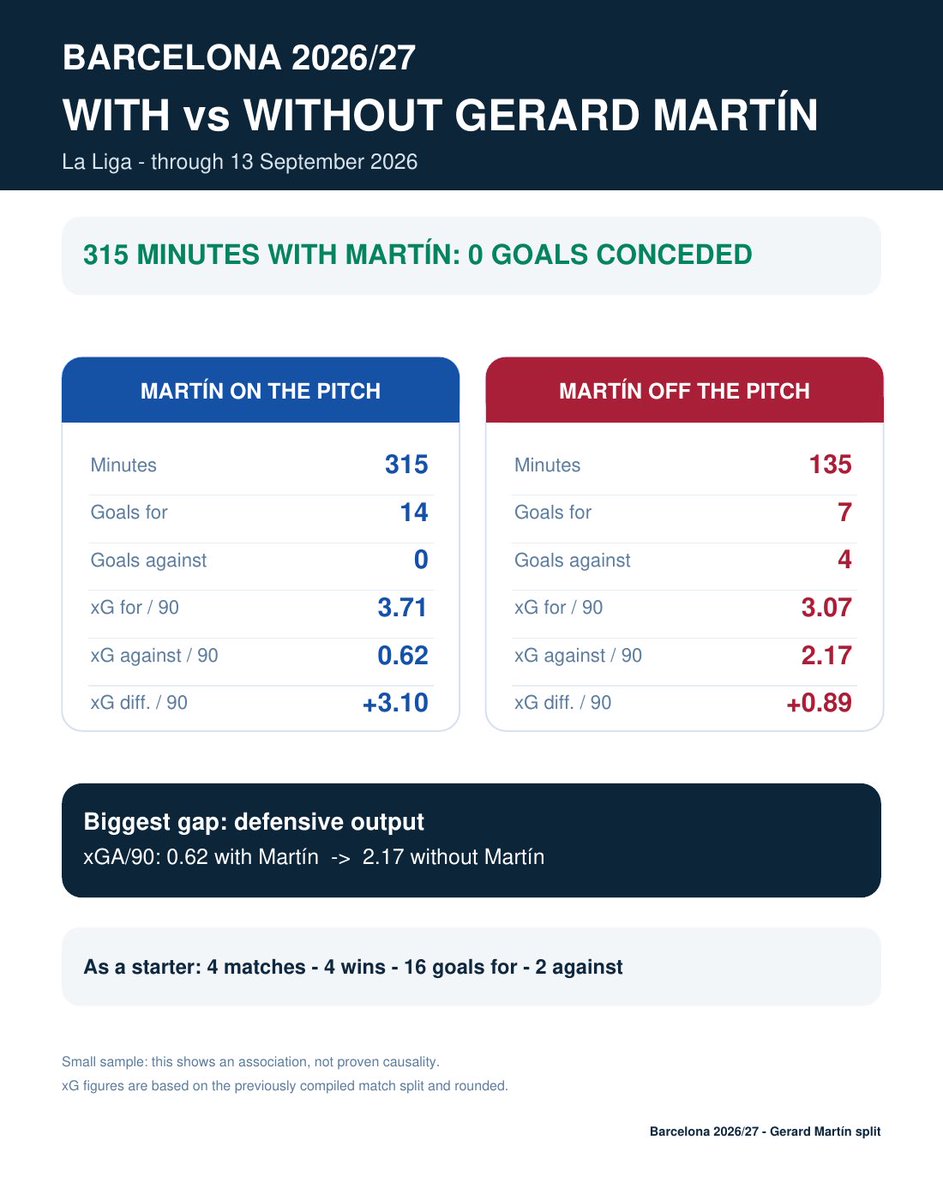
Gerard Martín is Barça’s only natural left-footed centre-back.
315 minutes this season: 14 goals scored, 0 conceded.
His profile gives Barça better balance and cleaner build-up from the left.
3/3 — In the second clip, the high full-backs leave Schouten short of options. His pass puts Gasiorowski under pressure, forcing him back to Kovář. One mistake, another goal. PSV’s positioning makes the press easier.
1/3 — These two clips against Newcastle show the risks of PSV’s build-up structure. With the full-backs high, the centre-backs lack short passing options. The ball goes back to Kovář, who is forced to go long.
2/3 — Kovář’s long ball is poor, but Schouten and the Sidilia don’t drop in time to offer an alternative. They’re also too far from the centre to protect against a turnover. Newcastle win possession and score.
Barcelona’s xG with Gerard Martín starting at left centre-back:
vs Athletic: 4.23
vs Valencia: 4.05
With Christensen there against Feyenoord today:
1.88 xG, despite winning 5–1.
These were last season’s results with and without Gerard Martín at LCB 👇
At the same time, the No. 10 drops deep and wide. If the opposition centre-back does not step out, one of Barcelona’s midfielders is always free. With the right pass, at the right moment and onto the correct foot, Barça can play through the press.
As mentioned in an earlier post, Barcelona’s full-backs should start on the same horizontal line as the centre-backs. This maximises the distance the pressing winger must cover, giving the full-back more time to receive and play the ideal pass.
Higher up the pitch, Balde can break lines without slowing the move down. By providing maximum width as a left-footer, he stretches the opposition, creates more space inside and keeps Barça’s possession fluid and dynamic.
These clips show why Barcelona need a left-footed left-back like Alejandro Balde. In the first phase, he can receive with an open body on his first touch, buying himself more time and helping Barça play through pressure with ease.
With a natural left-footer at LCB, these passes can be played earlier and more directly.
That creates more chances to find players between the lines or play through the block before the space closes.
These were Christensen’s highlights against Rayo Vallecano in Barcelona’s last match.
He often needs an extra touch or carries the ball first. That gives the opponent time to close the space and makes progressive play down the left much harder.
Even a world-class passer like Van Dijk can look far less effective when forced to play line-breaking passes with his weaker foot. Structure determines whether quality can be expressed.
A right-footed centre-back belongs on the right. Under pressure on the left, he is forced onto his weaker foot—blocking forward passes, slowing the build-up and increasing the risk of losing possession, control and dominance.
Also notice the positioning of the midfielders and striker.
Their movement constantly creates passing options. The ball is played at the right moment, at the right speed and onto the right foot.
That’s how you play through pressure without taking unnecessary risks.
This is what Flick’s build-up looks like.
Watch Barcelona’s full-back:
• Same line as the CBs — sometimes even deeper
• Maximum distance from the winger = maximum time
• Receives completely open and can play both ways
Now watch the movements of the midfielders and striker.