Watch hydrogen wavefunctions evolve through quantum states (n, l, m).
These aren't fixed orbitals, but the electron's probability density reshaping as it transitions between energy levels.
Stokes' Theorem in pure visual glory:
The circulation of F around any closed curve C ∮_C F · dr
equals the flux of its curl through any surface S bounded by C:
∬_S (∇ × F) · dS
Harvard SEAS prismatic architected metamaterial: extruded cubic cells (24 faces, 36 edges) tessellated via snapology origami.
Reconfigures volume, shape, and effective stiffness on demand through hinge folding; scale-independent from nano to meter.
Harmonious Geometry: The Hirajoshi Wave
Gravity-defying spheres trace the haunting paths of the C Hirajoshi scale (C, D, Eb, G, Ab), forming a mesmerizing polyrhythmic pendulum.
Credit: project.jdm
This is the single most beautiful moment in all of calculus.
The limit as h → 0... Watch the secant line collapse into the exact tangent at that point.
The Clay Institute offered $1 million for solutions to 7 of the hardest problems in math. Only one has fallen.
Here are the ones that still remain unsolved:
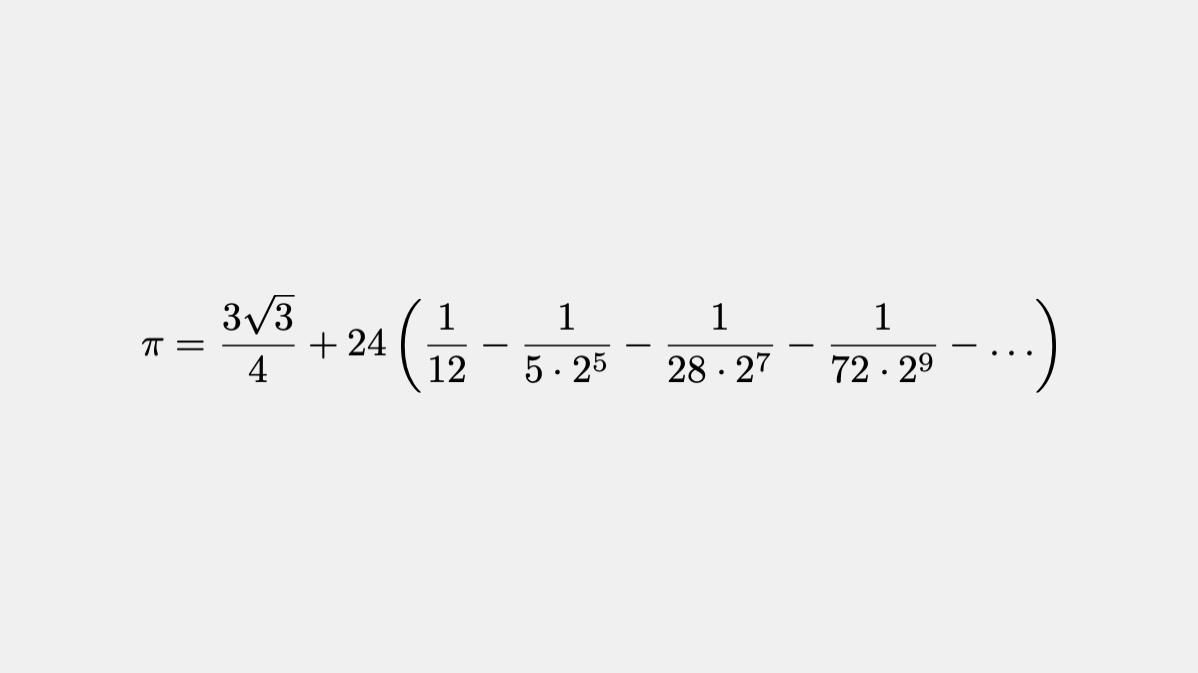
In 1666, Newton used just 22 terms of this series to calculate π to 16 decimal places. He later admitted, “I’m ashamed to say how many digits I worked out, since I had nothing better to do at the time.”
The largest known prime, discovered in Oct 2024, is 2¹³⁶²⁷⁹⁸⁴¹−1. It’s a Mersenne prime (2ᵖ−1), a special type that’s easier to search for. GIMPS took nearly 6 years to find it after the last record, and it’s the first Mersenne prime discovered using GPUs.
When you square a number made up of n consecutive ones, the result forms a perfect palindrome that increases from 1 up to n and then decreases back to 1.