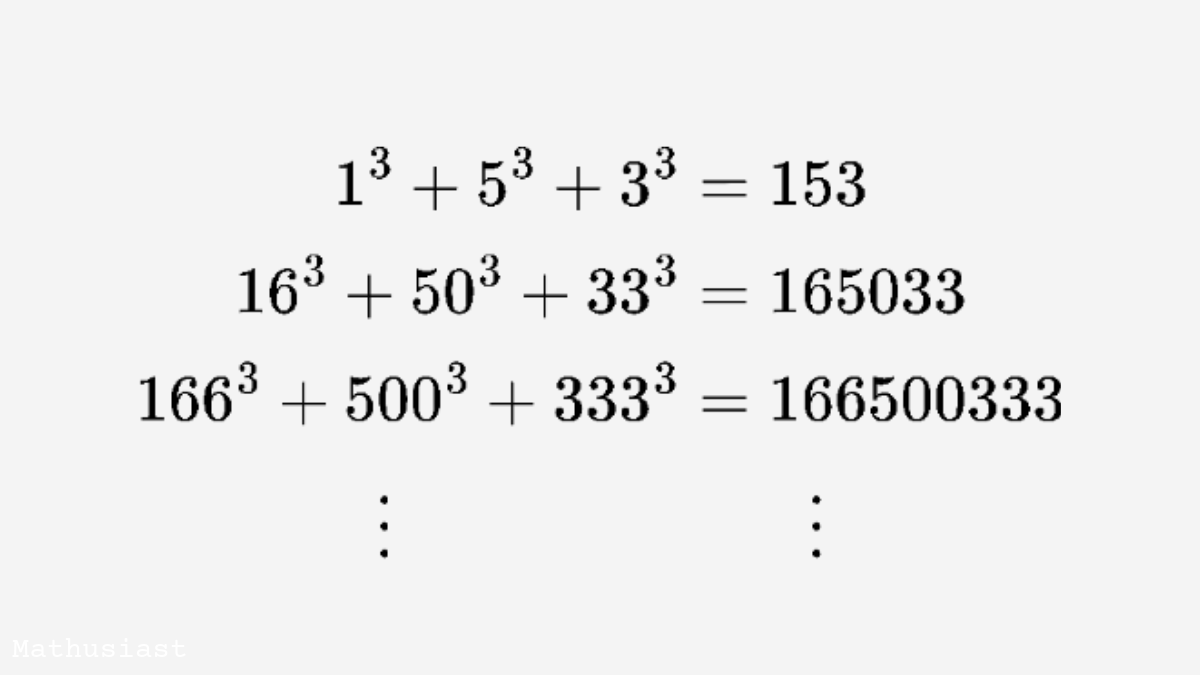
This amazing pattern is called a second-kind Armstrong number. The interesting thing about this particular number is that the pattern holds true for infinity.
#math#number
In 1706, William Jones introduced the symbol π for the circle ratio in his book “Synopsis Palmariorum Matheseos” (1706).
Euler later helped make it universally known.
#MathHistory#Pi#Mathusiast
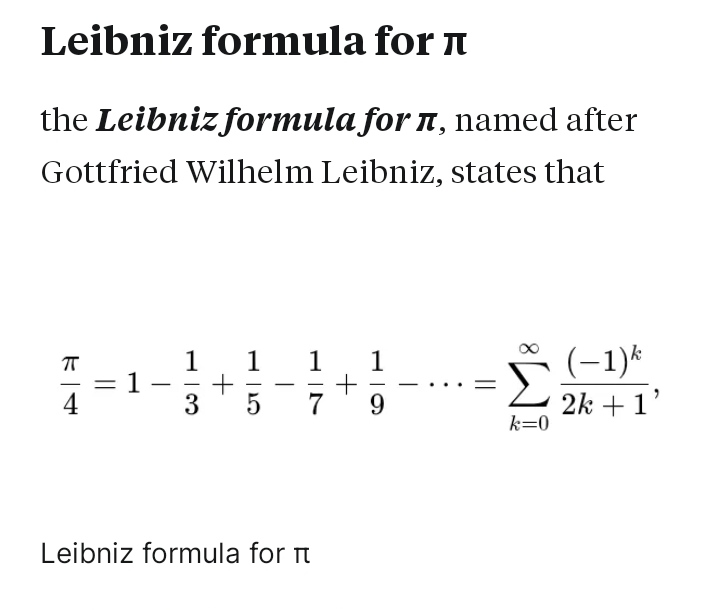
Centuries later, in 1671, James Gregory found the same series in Europe (without corrections).
Then in 1676, Leibniz also rediscovered it and made it famous. But it was very slow — around 100 terms give just 2–3 digits of π.
But it all started with #Madhavan#Leibniz#Ramanujan
Over 600 years ago, Madhava from Kerala discovered this beautiful infinite series.
He even added clever correction terms to make it more accurate — getting up to 11 digits of π!
Centuries later, in 1671, James Gregory found the same series in Europe (without correction).
#Pi
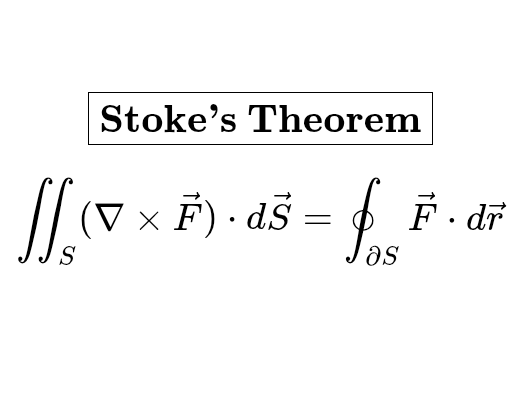
Exactly 175 years ago today, on July 2, 1850, Stokes' Theorem first appeared in a letter from Sir William Thomson (later Lord Kelvin) to George Gabriel Stokes.
#math#mathematics
Exactly 175 years ago today, on July 2, 1850, Stokes' Theorem first appeared in a letter from Sir William Thomson (later Lord Kelvin) to George Gabriel Stokes.
#math#mathematics
Exactly 175 years ago today, on July 2, 1850, Stokes' Theorem first appeared in a letter from Sir William Thomson (later Lord Kelvin) to George Gabriel Stokes.
#math#mathematics
2025 is a Semiperfect Number:
A Semiperfect Number is a number that is equal to the sum of some or all of its proper divisors.
2025 = 1 + 3 + 5 + 9 + 15 + 25 + 45 + 75 + 135 + 225 + 375 + 675
Mathematical Patterns in 2025
2025 is a perfect square:
2025 = 45²
This means that 2025 can be expressed as the product of a number multiplied by itself.