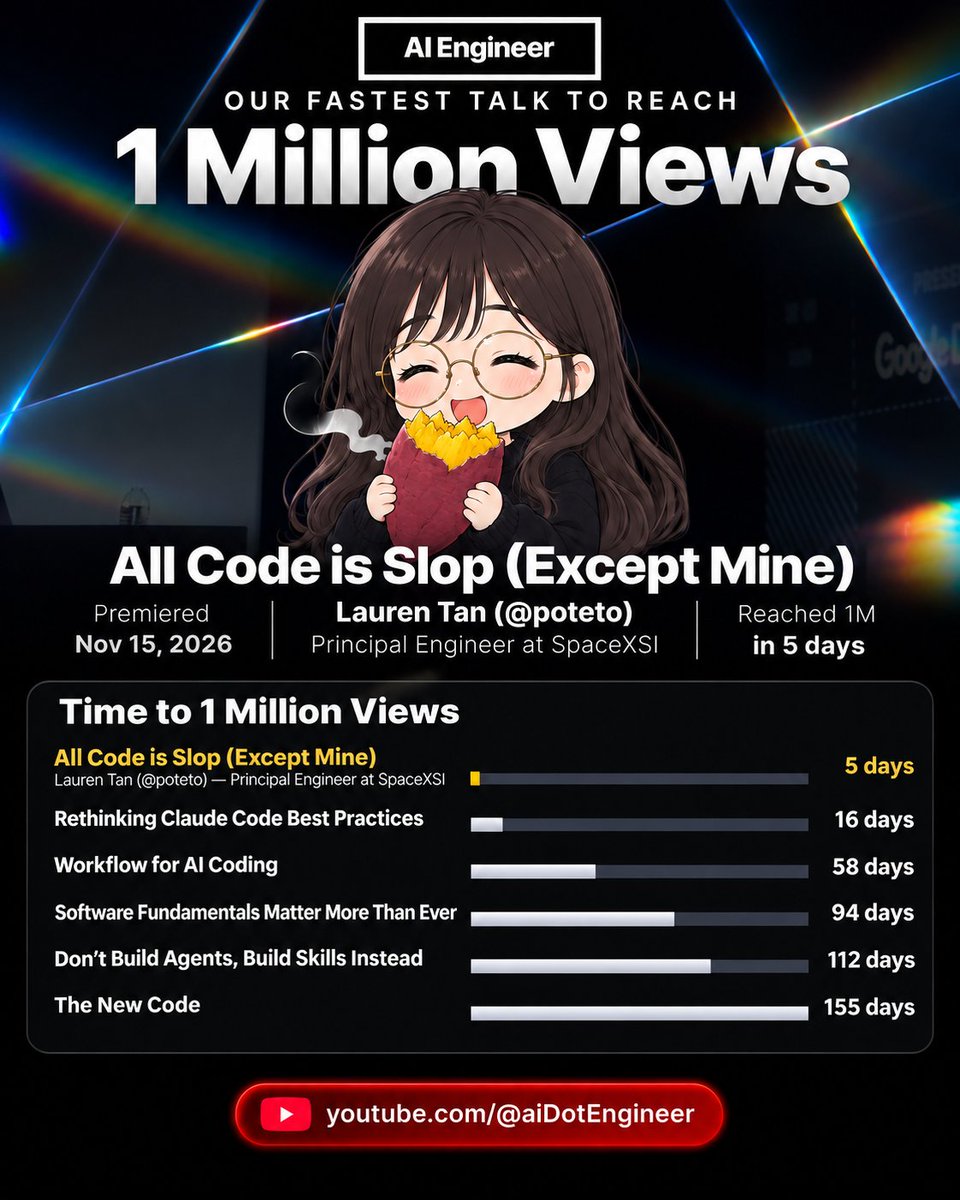
1 million views. Our fastest talk to get there.
@poteto of @spacexai on the engineering behind 11,000 production PRs in one month.
All Code Is Slop (Except Mine).
Watch: https://t.co/iYjSpi3Xwg
A brief history of AI Coding since Nov 2025:
Nov 2025: Opus 4.5 releases, OpenClaw gets built
Dec 2025: community agrees that models get good enough to handle 95% of coding tasks
Jan 2026: Ralph loops get popular, early efforts on loops/orchestration
Feb: Everyone feels knackered, too much strategic decision-making, fears around cognitive debt begin
Mar: Skills explosion as community converges around easy-to-share processes (superpowers already ahead of the game here)
Apr: most SOTA devs haven't written a line of code in months
May: "The unreasonable effectiveness of HTML" - more interest in richer review surfaces
Jun: "Loop Engineering" wins vaguepost of the year, signals more hype around process
Jul: Every talk in every conference becomes "here is my software factory"
Aug: Opus 5 speaks incomprehensibly, interest in ASD-STE100 peaks
Sep: Grok Bot gets popular, more interest in long-running "manager" threads which retain context and delegate work
Oct: The promised speed gains haven't materialised, "dark factory" feels a long way off still
Nov: No-slop manifesto releases, reading the code still appears essential
TL;DR: no-one is writing code anymore, and we are still figuring out what that means
i learnt this lesson this year. it's helped me follow through on my ideas and not get stuck overthinking it
don't ask if you should do the thing. do it, then come back with a demo or something tangible
you can just do things
@Wv3EcACHtizRjZK@GoogleCloudTech@mattpocockuk@poteto For now, I am passing the outputs of each to the next. So the the design doc made by egm becomes the input for my wayfinder session.
The wayfinder session finishes with specs and implementation tickets, which are then picked by the pstack skills to complete.
My development workflow now:
Step 1 - do a elephant goldfish model (by @GoogleCloudTech) preliminary design session
Step 2 - do wayfinder (by @mattpocockuk ) charting
Step 3 - use pstack (by @poteto ) to develop
What's yours ?
Has anyone done a comparison between the elephant-goldfish model by @GoogleCloudTech and the wayfinder skills by @mattpocockuk ?
From my preliminary usage, I feel like adding a light egm session before the wayfinder charting helps give wayfinder enough context for charting questions. What are your thoughts?
Check out Google's Elephant-Goldfish Model, our new open-source plugin → https://t.co/eIWb2HAeDt
Draft specs with deep-context agents and stress-test them with zero-context subagents before writing code. You make the architectural decisions and approve the spec before implementation. Works with Antigravity, Claude, Codex and ChatGPT.
This looks like a big step for businesses to adopt AI. But that means you will need create your own personal agents which would then talk to their agent
Now in beta: Businesses in ChatGPT.
Claim your business, manage your information, and get insights on how people engage with you.
Eligible businesses can also build a Business Agent to answer customers’ questions and help them explore what you offer.
https://t.co/N2GEZX0mFT
@poteto is it possible to add some visualization to show context usage in grokbot similar to how it's in @cursor_ai ?
That way we might able to anticipate issues that might come with compaction like the issue I faced here
So in my Code Builder grok bot, I noticed the below message:
"Builder: Two review notifications overlapped; one run holds the fix slot, and the other started nothing. No action needed"
So I asked the "dr eggbot" bot to analyse what went wrong with its instructions and skills
The review actually discovered a seperate bug in my Project Manager bot - although it checks for duplicate alerts when finding new work from GitHub issues, if a compaction happens it can resend an alert it sent before compaction