FIFA publishes a 52-page data report for every World Cup match. Almost nobody reads them.
I parsed all 102 past matches into one explorable site. Line breaks, ball recovery, pressing phases. Every team, every player, every number linked to its FIFA source.
Free, no ads: https://t.co/xQ5fbSeWHk
Statement on behalf of UEFA and its 55 National AssociationStatement on behalf of UEFA and its 55 National AssociationStatement on behalf of UEFA and its 55 National AssociationStatement on behalf of UEFA and its 55 National Associations
Spain 1 - 0 Argentina | World Cup 2026 Final Review.
I'll try to explain what were the main differences between both teams and take some conclusions.
You can explain Spain's dominance through five key game aspects.
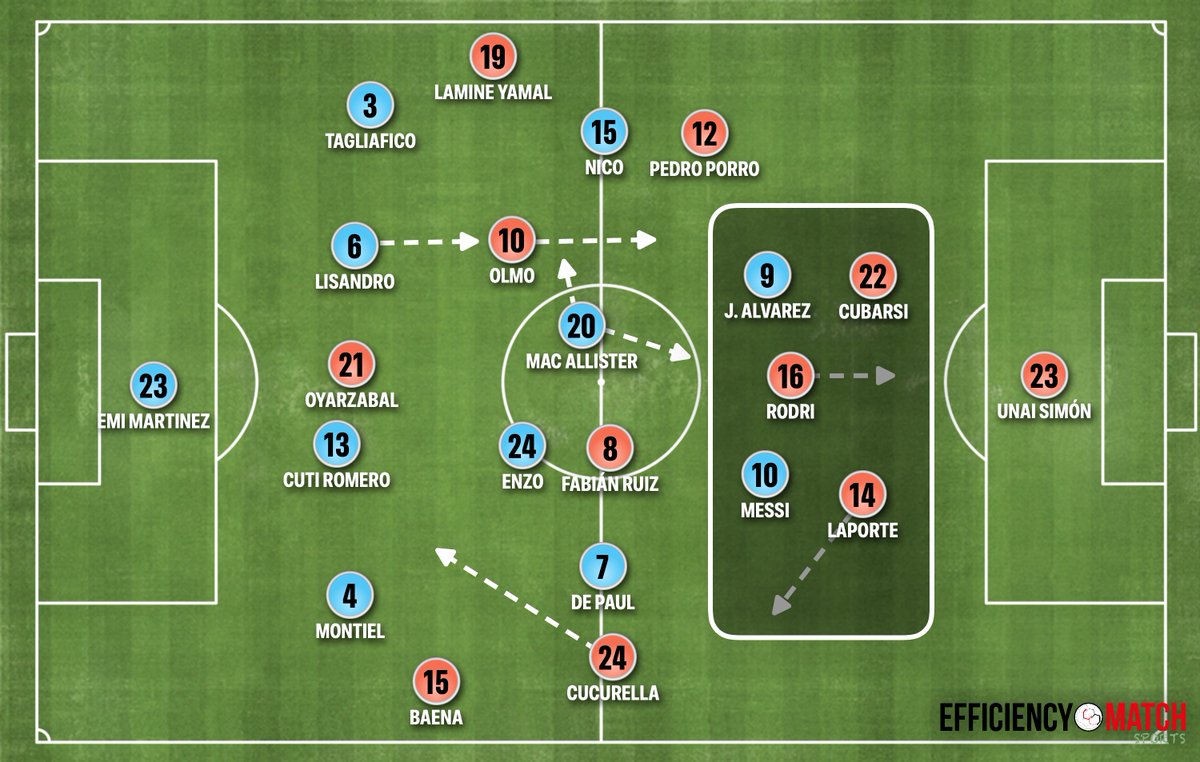
1. Rodri's positioning outside Argentina's defensive block and Spain's ability to find always the free player.
I wrote this in the final preview:
"Argentina usually defend in a 4-4-2 that easily transforms into a 4-4-2 diamond, with one of the midfielders stepping out to press the #6. They defend in a very man-oriented way inside their block, often not worrying about leaving space in front of the defensive line because both centre-backs are comfortable stepping out to challenge opponents. However, if one of Spain's midfielders drops outside Argentina's block to dictate play, Argentina's midfielders will probably not follow. That could allow Spain to control possession."
That's what happened. Rodri dropped alongside the centre-backs countless times, and Argentina didn't know how to deal with him. Whenever they didn't follow him, Spain created a 3v2 with Rodri and the two centre-backs against Messi and Julián Álvarez. In reality, it was even easier than a normal 3v2 because Messi wasn't really involved in the press. Spain consistently found the free player and progressed comfortably. That's why we saw Aymeric Laporte driving forward with the ball so often. Messi stayed with Rodri, Julián pressed Cubarsí, and Laporte was left completely free.
Spain are too good at finding the free player through third-man combinations, positioning and decision-making.
2. Argentina not pressing man-to-man often enough.
Argentina were too reluctant to press Rodri aggressively. The alternative was clear: allow one of the midfielders to jump onto Rodri and accept that Dani Olmo would have to be taken by Cuti Romero or Lisandro Martínez, which is not necessarily a problem because both centre-backs are great at stepping out aggressively to win individual duels. In those situations, you sacrifice the spare man at the back and essentially defend man-to-man across the pitch.
Interestingly, Argentina looked at their best whenever they pressed this way. One midfielder would jump onto Rodri, Lisandro would step into Olmo, Spain were forced to play long, and Argentina recovered the ball almost every time. If Spain had one weakness, it was their deep build-up against an aggressive man-to-man press. They lacked a true reference for direct balls and didn't really have specialists attacking in behind.
The problem for Argentina was that this approach depended heavily on their centre-backs stepping out. Once both defenders got injured, they could no longer defend this way. From that point onwards, Spanish players started receiving freely between the lines far more often, allowing Spain to dominate the second half.
3. Argentina's long distances in deep build-up.
Argentina are usually characterised by having many players comfortable progressing through short combinations in very close distances. We barely saw that in the final, especially during the deep build-up phase. Too often, players moved away from the ball. Nico González constantly threatened in behind, Tagliafico stayed very high, and the midfielders rarely dropped close enough to offer support. As a result, Lisandro Martínez was frequently isolated and forced to play long. I understand why playing Nico changes some of these dynamics. A player like Thiago Almada naturally comes short much more often. However, you can still play Nico and progress through short combinations while always keeping at least one option threatening in behind.
Strangely, Argentina played in much shorter distances once they reached the final third, with some occasional very good combinations, but they played in very large distances in deep build-up.
4. Spain's press and the work rate of Olmo and Oyarzabal.
It was a fantastic defensive plan from Luis de la Fuente. Spain pressed in a 4-4-2, with Dani Olmo and Mikel Oyarzabal consistently guiding Argentina towards their left side. The reason was simple. Whenever Spain shifted into a 4-4-2 diamond, it was usually Fabián Ruiz who had to step out to press Enzo Fernández. Doing so would leave the space where Messi likes to receive. By forcing Argentina towards the opposite side, Spain reduced those situations considerably. Even better, Spain often didn't need Fabián to jump at all because the work rate of Olmo and Oyarzabal was exceptional. Olmo repeatedly used his cover shadow to block the passing lane into Enzo before stepping forward to press Lisandro. He executed that action countless times throughout the match. Argentina aren't as efficient as Spain at finding the free player through third-man combinations, so they struggled to exploit the numerical advantage.
Simply put, Olmo and Oyarzabal managed that 3v2 much better than Argentina's front two managed theirs. You could even describe it as a 4v2 because whenever Argentina recycled possession back to the goalkeeper, Oyarzabal immediately jumped to press. Whenever Fabián needed to step forward, he did. The conclusion is clear. Spain could defend in a more conservative structure while still keeping the spare man at the back because of the incredible work rate of their two forwards.
Argentina, on the other hand, only looked effective when pressing man-to-man. Whenever they tried to keep the spare man behind the press, Spain played through them with relative ease.
Spain also never became passive in the press. Every backward pass immediately triggered another aggressive press from Olmo and Oyarzabal, while they continued using their cover shadows to block the #6.
5. Spain's counter-press and rest defence.
Spain suffocated Argentina with their counter-press. Every time they lost possession, the reaction was immediate. Every player committed to it, including Lamine Yamal. The difference between both teams in this phase was enormous. Argentina forced Spain to play long on several occasions and often won the initial duel. However, by the time they tried to secure the second ball, Spain already had multiple players surrounding the area and quickly regained possession.
The same applies to Spain's rest defence. For years, Spain have consistently used a 2+3 rest-defence structure. The two concepts are closely connected. Spain can counter-press so aggressively because they are already well organised against defensive transitions. The two centre-backs stay behind the ball, with Rodri positioned in front of them. Alongside Rodri, you will almost always find Fabián Ruiz or Cucurella on the left and Pedro Porro on the right. A very clear 2+3 rest defense. That organisation provides constant protection while also allowing Spain to immediately attack the ball after losing possession.
You can't explain Spain's remarkably low number of goals conceded or chances allowed without acknowledging the quality of both their rest defence and their counter-press.
Spain won the World Cup and half of me has been celebrating all week. The other half still hasn't gotten over what happened to Türkiye in the group stage.
"EXPECTED GOALS."
Every Turkish father, son, daughter, barber, butcher, pundit and cab driver has had a go at this stat over the past month, so I figured I'd earn my seat at the table too.
I computed xG for all 104 matches of WC2026 from FIFA's own tracking reports. In 11 of them, the team that created the better chances still lost.
The single biggest gap of the entire tournament: Türkiye 2.13 xG, Paraguay 0.36. We lost 0-1. That Saturday morning was horrendous. Two of the three worst "injustices" of the whole tournament are ours. (And before anyone calls me biased: by that exact same logic we also beat the USA while creating less than they did. xG cuts both ways. This month it cut us open.)
Here is what I actually took from it. Generating xG has nothing to do with winning a football match. xG measures the "quality" of your chances, nothing more. It cannot see the keeper, the pressure on the shot, or the touch before it. And "more chances" isn't "better chances": a shot with four defenders in front of you scores the same on paper as the same shot with nobody there. They are not the same thing.
So I am digging into what was actually missing for us. Same players, same coach, same conditions, what could we have done differently in front of goal, when it mattered most, to turn 2.13 xG into even one?
What do you think we were missing most?
Data: FIFA Post-Match Summary Reports (Enhanced Football Intelligence), https://t.co/ZdvWysQQ0r
My explorer: https://t.co/xQ5fbSeWHk
Verilere bakınca bu istatistik çok şey anlatıyor.
Bir de topu geri kazanma süresi:
• Turnuva ortalaması: 11,5 sn
• Final: 10,5 sn
*Genel ortalama: 16,9sn
Bu arada turnuva lideri Türkiye.
Ama İspanya’nın bunu sekiz maç boyunca sürdürüp şampiyon olması, bu metriğin oyun hakimiyeti açısından ne kadar değerli olduğunu gösteriyor.
👋🏼💫 Hola, estrella.
Has estado 16 años sola, pero ya es hora de que tengas compañía encima de nuestro escudo.
¿Te parece?
#VamosEspaña | #CopaMundialFIFA
No prediction, just numbers I could check. All of it is explorable here, every figure one click from its FIFA report: https://t.co/q2kvMbGYrm
What am I missing?
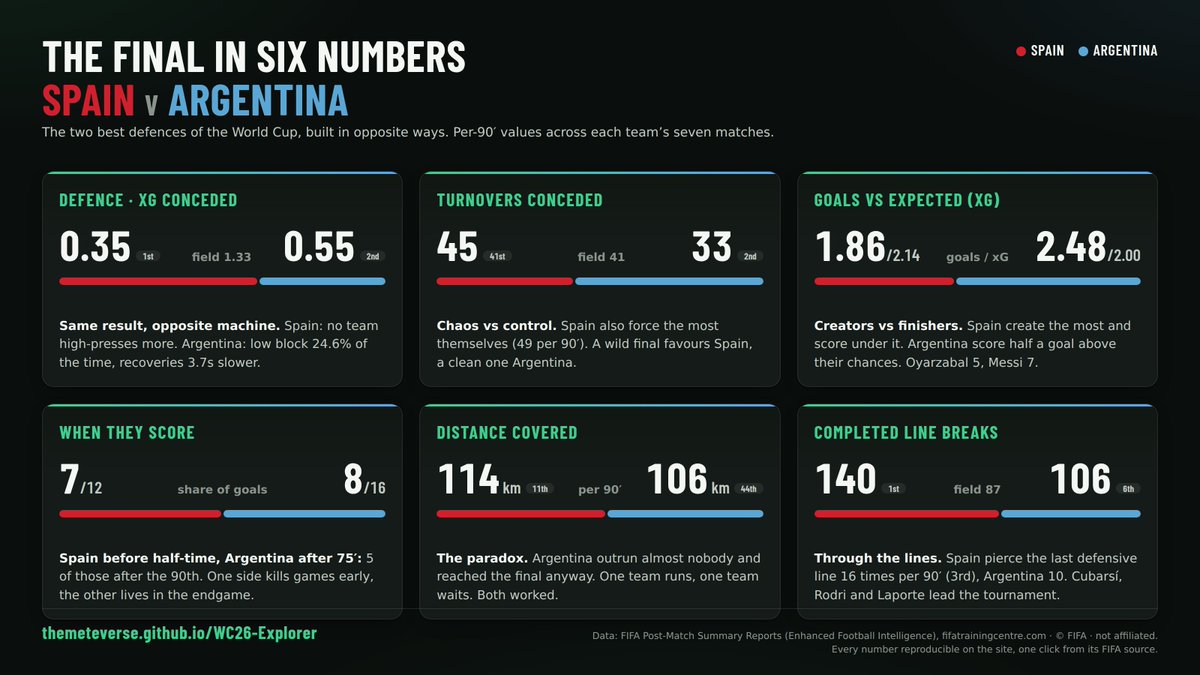
Spain and Argentina reached the final with the two best defences of the World Cup. They could not be more different. What FIFA's own tracking data says about the final, in six numbers. A thread.
Argentina rank 44th of 48 in distance covered per 90. They are in the final. Spain rank 11th and lead the tournament with 140 completed line breaks per 90. One team runs, one team waits. Both worked.
For over 60 years, @Pele’s legendary "lost goal" at Rua Javari lived in the memories of those who were there.
In close collaboration with historians, experts and Pelé’s family, we used @GoogleDeepMind technology to bring this iconic moment to life. ⚽️ See the film ↓
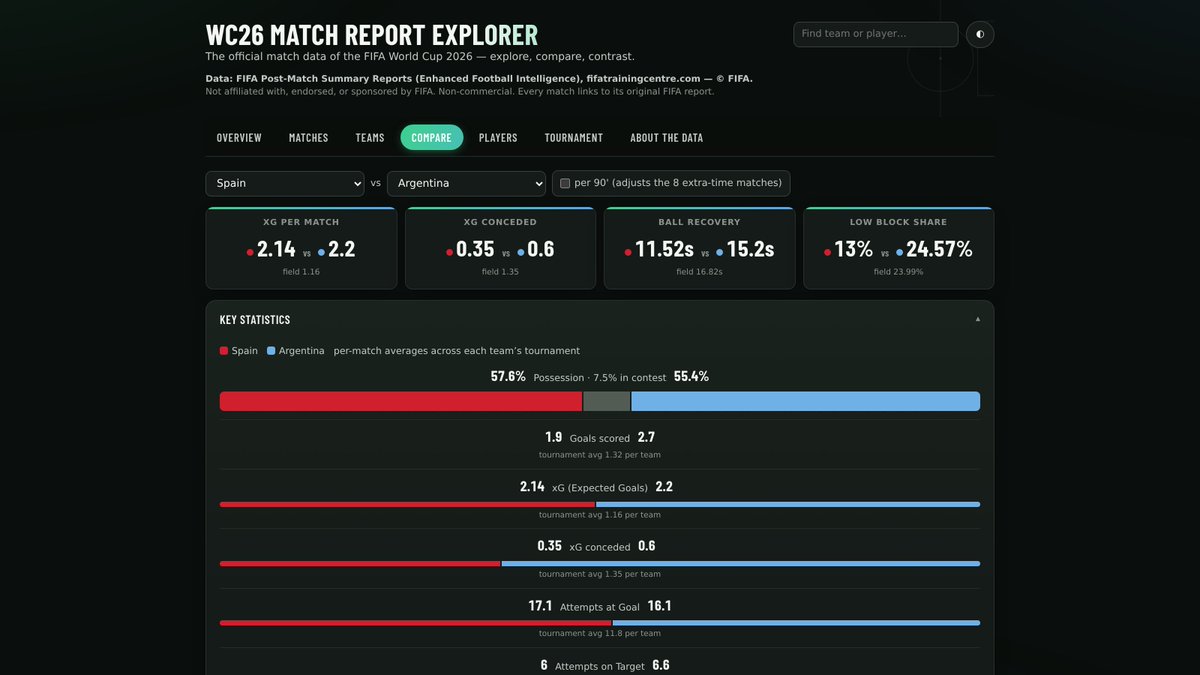
Tomorrow's final in one view. Identical attacks (2.14 vs 2.20 xG per match), opposite defensive machines. Spain recover the ball in 11.5s and low-block 13% of the time. Argentina: 15.2s and 24.6%.
https://t.co/q2kvMbGYrm
FIFA publishes a 52-page data report for every World Cup match. Almost nobody reads them.
I parsed all 102 past matches into one explorable site. Line breaks, ball recovery, pressing phases. Every team, every player, every number linked to its FIFA source.
Free, no ads: https://t.co/xQ5fbSeWHk