@adamhuras Who else is looking forward to Trump losing the midterms so Canada's housing crisis, unemployment, inflation and collapsing productivity can all magically disappear?
It's been a tough 10 years under President Trump...
@Hershel_Lives@RealAlbanianPat You need to be a member of their online rewards group. They give points redeemable for gift cards when you complete their surveys.
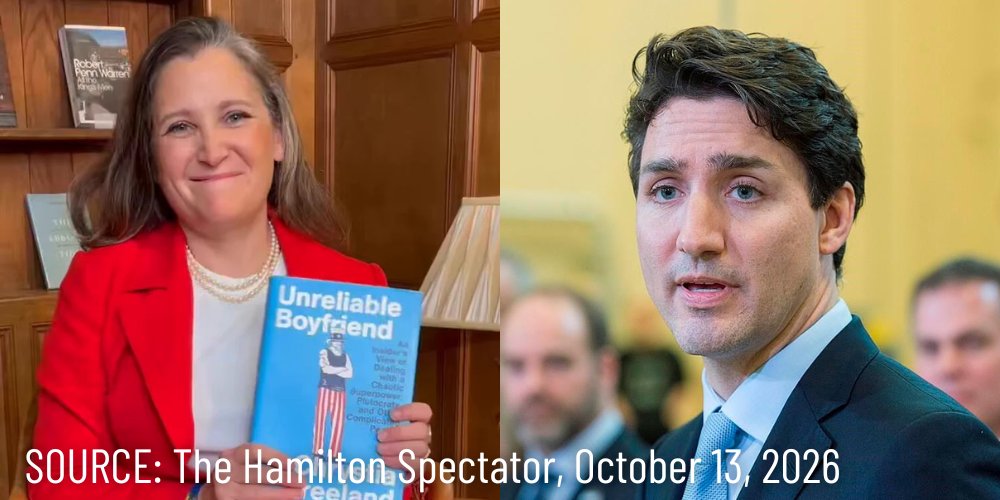
Freeland's new book claims that "crying was routine at cabinet meetings" under Justin Trudeau's leadership, and that the former prime minister would be driven into fits of rage when colleagues would use non-woke words like "crazy" instead of "bananas."
CBC does a midterms piece on Americans in Canada and somehow only finds the ones who think this might be “the last free election.” They pad it with a one-line statement from Republicans Overseas about taxes, then cut back to a Democrats Abroad volunteer. Balanced as a Canadian public broadcaster gets. Elbows up
David Cochrane is completely out of control!
Kyle Seeback lays out a consistent, evidence-based critique of the Carney government’s trade strategy, secrecy, and industrial policy
David Cochrane’s response, for the bulk of the nearly 11.5-minute exchange, is a running series of Liberal talking points, caveats, and excuses that reframe every failure as either inevitable, someone else’s fault, or already being handled
Seeback’s core auto-pact argument is straightforward: the industry is deeply integrated, a tariff-free arrangement that reshores production on both sides of the border is what automakers and workers actually want, and the White House is the outlier
Cochran’s counters are:
* Trump “sees, in spite of all of the evidence, tariffs as the key to American prosperity.”
* Howard Lutnick already said Canada will not make cars.
* The administration’s explicit goal is “deindustrializing southwestern Ontario.”
* This is “pure self interest” (illustrated by a Putin diesel deal).
These are descriptions of the other side’s position, not rebuttals of the plan’s logic or of Canada’s leverage (critical minerals, diesel capacity if expanded, etc.)
When Seeback notes the give-and-take nature of any negotiation, Cochrane immediately pivots to “the nature of this presidency” and Carney’s broken campaign promise, then concedes the premise: “Getting to zero tariffs on steel, aluminum, auto. Seems like it will not happen as long as Trump is in the White House.” The Liberal line becomes the ceiling
On the secrecy point Seeback makes a concrete, checkable claim: the Canadian ambassador refused to say when the last substantive offer exchange occurred; industry contacts were giving contradictory answers on auto tariffs even as a deal appeared close; Mexico’s process has been more visible. Cochrane’s reply is that “we know broadly the timeline,” that Dominic LeBlanc and Janice Charrette were in Washington in a certain week, that Mexico is also being squeezed, and that “Donald Trump’s trying to exert leverage everywhere.” That is not a defense of the government’s opacity; it is an acknowledgment that the Americans are doing what the Americans do, plus a claim that the process is normal. Seeback’s observation that no industry knows where things stand is left standing.
The Stelco segment is the clearest example of the pattern. Seeback notes that the minister previously promised to sue Stellantis and did not, that the current deadline has passed, and that the government controls the industrial carbon tax and the dumping problem that raise costs for Canadian steel. Cochrane’s interventions are:
* The NDP has argued for nationalization.
* A seven-page letter from the Cleveland CEO should be considered.
*Governments should build the Pacific Link pipeline if no private proponent appears
Seeback’s reply that governments do not run commercial operations well (the pipeline example of cost overruns and delays) is met with the distinction that “Nationalization of the steel industry is very different” and a restatement that the pipeline should still be built by the government if necessary. The specific, controllable domestic costs Seeback identified—the carbon tax and dumping—are not engaged; the conversation stays on Cochrane process, lawsuits, and the pipeline exception
Throughout, Cochrane’s questions and counters function less as cross-examination of Seeback’s plan and more as a real-time restatement of the government’s constraints, the other side’s bad faith, and the difficulty of the file. The result is that every Seeback point is answered with a version of 'the situation is complicated, the Americans are aggressive, and the government is doing what it can under the circumstances.'
That is the job description of a Liberal communications shop, not of a neutral CBC interviewer. If the audition for the Liberal comms job is still open, the tape is perfected @brodiefenlon@kyleseeback
Hi Bruce. Forgive me, I don’t know you. You’re not a subscriber and yet you have an opinion of copy you’ve never read. Why?
I have 43 years in MSM; CBC, CTV, foreign bureau and CPAC with @caj awards. How ‘bout you? Sports guy, no?
@stphnmaher How much value does Canadian legacy media give to the Liberals in what amounts to advertising? It must be well into the millions of dollars.