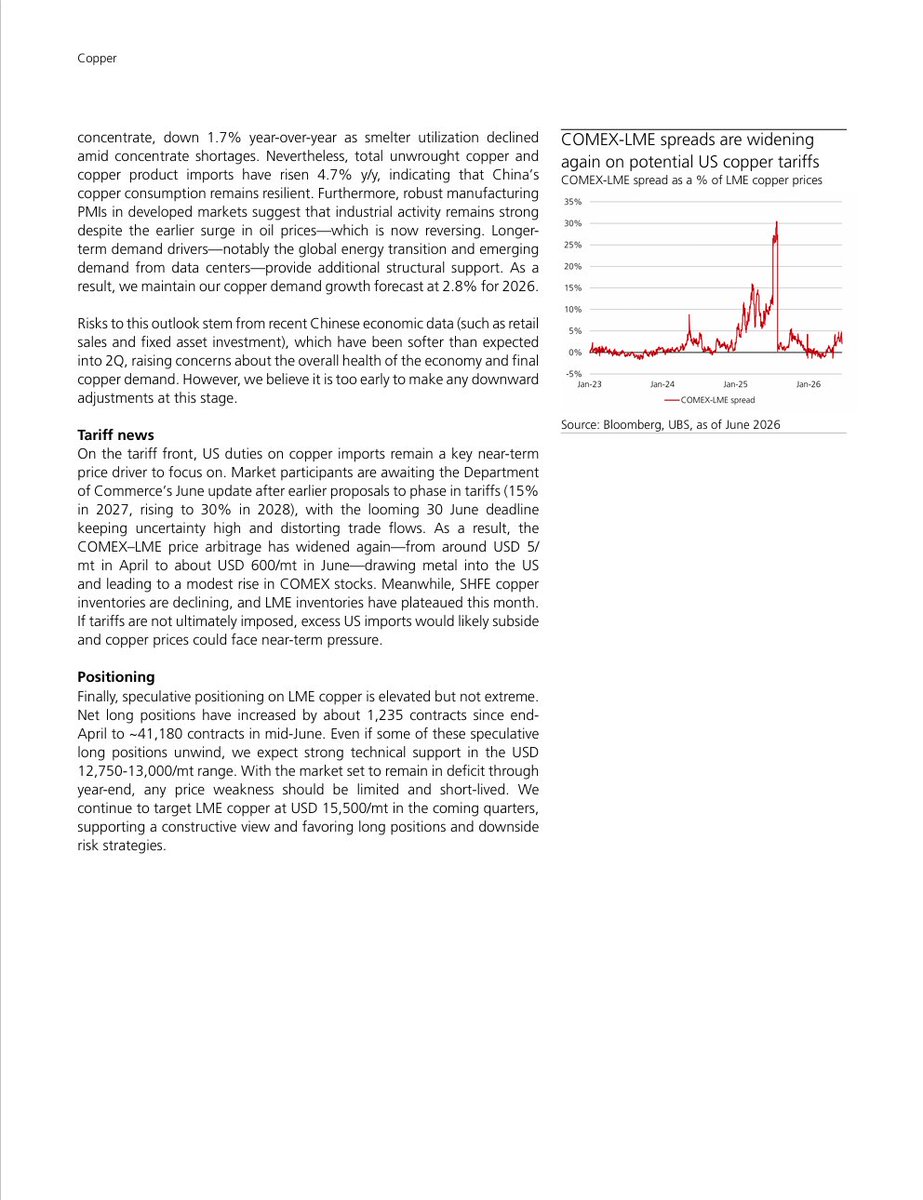
AI is a significant copper demand driver. Data centers need copper for power distribution, cooling, and connectivity, and analysts see AI infrastructure adding to the same structural trend as EVs and grid upgrades.
The copper demand story keeps getting stronger and Kamoa-Kakula, the world's highest-grade major copper complex, is set to ramp up to over 500,000 tonnes from 2028.
$IVN
A Nobel Prize winner spent 40 years learning why smart people lose money.
It fits in one book. And the con it exposes is the one your own brain runs on you every single day. 🧵
👀 Kodiak Copper #TSXV $KDK is drilling for growth at its MPD Project in British Columbia:
⛏️ Resource expansion at Ketchan
🎯 Tau target set for drilling
🤖 AI-assisted exploration targeting
🔄 Kay Copper transaction progressing
🎥 Watch now: https://t.co/sxV3oKUbzD
#MiningNews #Copper #Exploration #KodiakCopper
@KodiakCopperCo
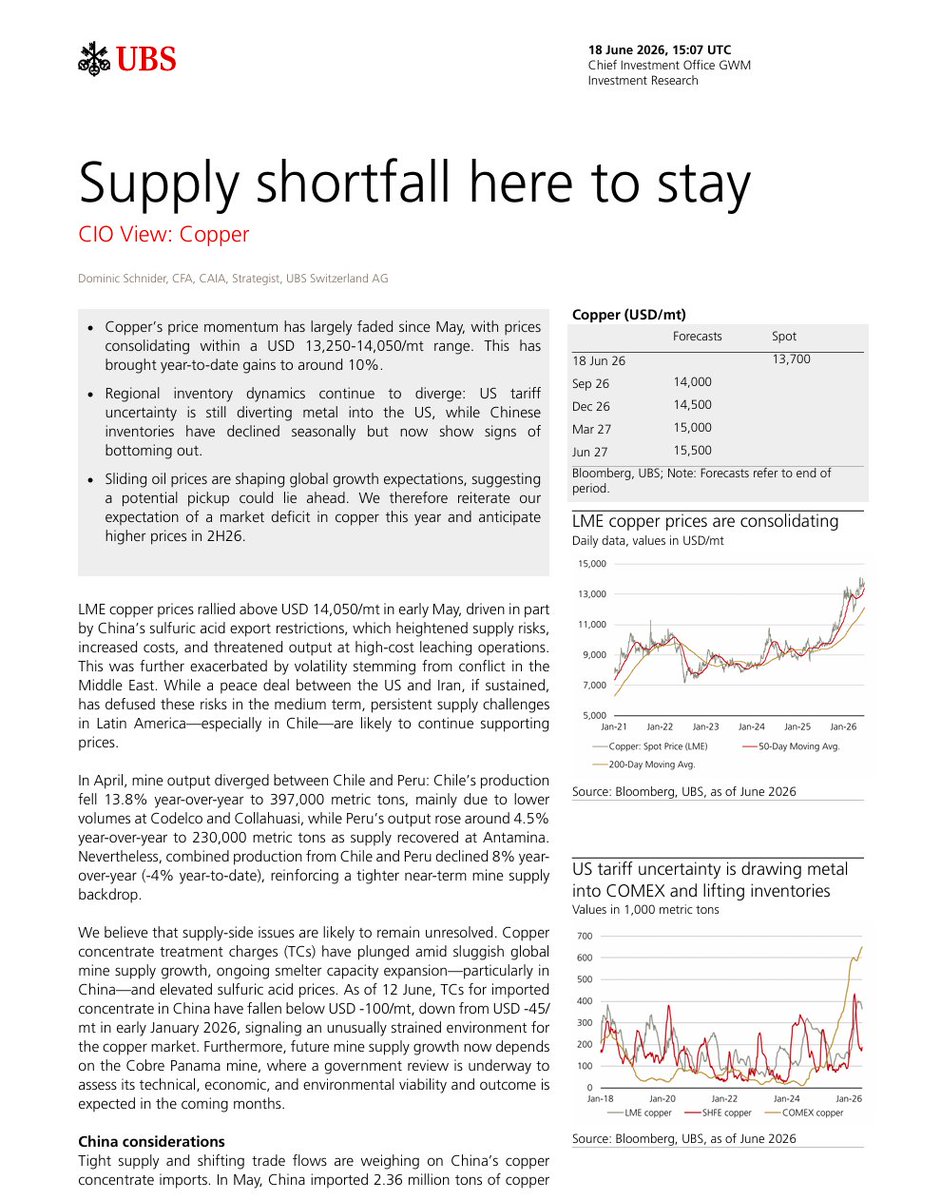
Everyone's arguing about the copper deficit, but here's the quiet part: Chile — the world's #1 producer — is going backwards. Cochilco sees its 2026 output down ~2% on tired ore grades and maintenance. When the biggest player shrinks, price barely needs help. $SCCO
https://t.co/6qgSmqYtZO
[𝗠𝗜𝗡𝗜𝗡𝗚 𝗜𝗡 𝗦𝗢𝗨𝗧𝗛 𝗔𝗠𝗘𝗥𝗜𝗖𝗔] @Dentons reports that across lithium and copper corridors, water has become a permitting constraint, a trigger for social conflict and a source of legal exposure. 𝗥𝗲𝗮𝗱 𝗺𝗼𝗿𝗲: https://t.co/hFBeUrnzc4
#ESG#WaterManagement
and finding more copper for AI, electrication, space economay etc. is increasingly on the shoulders of explorers like for example @AlgoGrande_ or @brixtonmetals and many others
$AXO.NE $ALGR $BBB $PRIZ
[Inside the AI Build-Out - by Nutty]
I turned the essays I’ve written so far into a single map.
Over the past few months, I’ve written more than twenty essays on AI infrastructure. Power, memory, servers, optics, neoclouds… the topics may look scattered, but they are all really about one question:
How is AI infrastructure actually being built?
A simple list of posts does not show that structure very well. It just stacks the essays in publishing order. So I built something separate.
This is not just a list of essays. It is a structural map of the work.
The path of power from hundreds of thousands of volts at the grid level down to 0.7V inside the transistor.
The way memory is layered across HBM, LPDDR, NAND, and base die.
Who actually assembles the AI server, and where the margin sits.
Where neoclouds and optical interconnect fit inside the larger system.
Each essay is placed by where it belongs in that broader picture.
Not by time. By layer.
A simple way to use it:
1. Read by layer
Power, Memory, Servers, Neoclouds, and other areas are grouped separately. You can follow only the part you care about.
2. Filter by company
Click a company name at the top, and the essays that discuss that company are highlighted. You can quickly see where NVIDIA appears, or which pieces go deeper on Bloom Energy.
3. Start with free essays
Each piece is marked as free or paid. If you are new, the free essays are a good entry point.
4. Switch between light and dark mode
There is a theme toggle in the upper right.
If you are visiting for the first time, I would start with Part 1 of the power series, or a few of the free essays.
After reading one essay, the map shows what sits next to it.
As the work grows, this map will grow with it.
Link in the first reply.
Colombia’s elections are officially over, and the shift away from the far left continues to gain momentum across South America.
South America is moving toward a region-wide pro-business agenda unlike anything in recent history.
Investors are still underestimating what could become one of the defining investment themes of the next decade.
https://t.co/548wwzjKfC
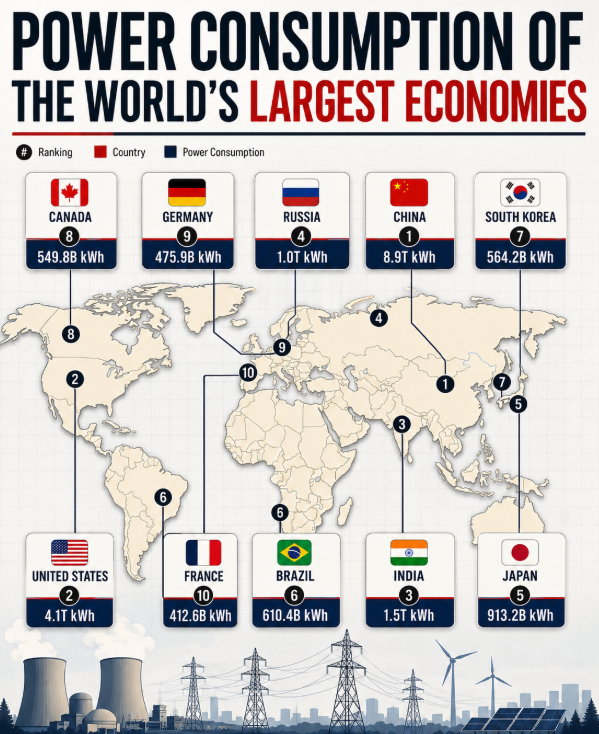
🇨🇳China burns more electricity than the next 2 economies combined.
China consumes 8.9 trillion kWh a year, 2.2x 🇺🇸 the US at 4.1T
🇮🇳India is a distant 3rd at 1.5T, then 🇷🇺Russia at 1.0T.
Add up the US, India and Russia and you still trail China.
Electricity is the new hard ceiling on AI and industrial scale.
Compute, EVs, and data centers all cash out as kilowatt-hours, and China already has the biggest grid feeding them.
The AI race and the energy race are the same race.
Whoever can add terawatt-hours fastest sets the pace, and right now that's not the US.
France at 412.6B kWh, the most nuclear-heavy grid on the board.
Who closes the gap with China first, and on what fuel?
(subscribe to my newsletter link in my bio)
Indeed he’s defintely in talks. His network is another reason to be bullish about $glxy. They Will have a lot of investment opportunities in AI on the next hot sectors
Copper and energy 🔥
"..In China specifically, our team forecasts data center demand to grow at a 20% compound annual growth rate (CAGR) from 2025 to 2028, driven by structural developments in AI and stepped-up investments by hyperscalers and large language model (LLM) companies..."
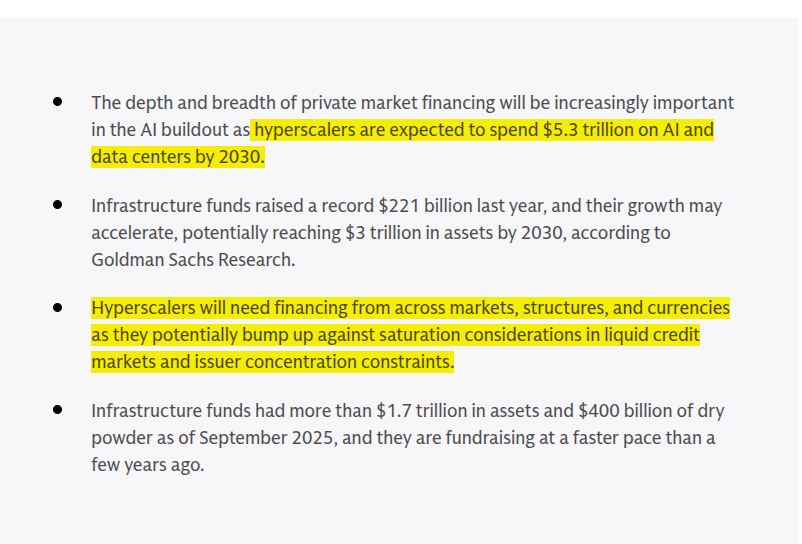
Goldman Sachs is now saying the AI race has become a $5.3T capital-spending cycle.
with that figure covering expected hyperscaler spending on AI and data centers from 2025 through 2030.
AI infrastructure is starting to strain normal financing channels, because the same few hyperscalers cannot endlessly push debt into public bond markets without investors worrying about issuer concentration.
A data center is not one asset, because it combines land, power access, network links, buildings, cooling, and AI servers, so the financing naturally spills across infrastructure funds, real estate funds, private credit, and corporate bonds.
Goldman signals that AI capex estimates are rising faster than actual data center construction, which means the bottleneck may shift from model demand to financing capacity, power availability, and project execution.
‘It represents a structural repricing of copper's role in the global economy, driven by the convergence of two of the most capital-intensive megatrends in modern history: the electrification of everything and the explosive buildout of artificial intelligence’
Understanding the Lassonde Curve ⛏️📈
The junior #mining sector often follows a general lifecycle pattern:
🔍 Exploration → Early-stage work and initial results
📉 Development → Increased technical and funding requirements
🏗️ Construction → Advancing project definition and permitting
🚀 Production → Potential cash flow and re-rating phase
💡 The key takeaway:
Market perception can shift significantly between early exploration and later-stage development, creating periods of both optimism and caution.
The Lassonde Curve serves as a conceptual framework in our corporate presentation to illustrate the typical stages of resource project development.
👉 https://t.co/lG0D801MqU
$JUGR.v $JUGRF #GoldMining #PreciousMetals
The next 25 years could require as much copper as humanity has produced throughout its entire history.
Every major leap in economic development has been accompanied by a surge in copper demand.
The Industrial Revolution.
The buildout of electrical grids.
The rise of telecommunications.
The rapid urbanization of emerging economies.
Each of these transformations pushed copper consumption to levels that previously seemed unimaginable.
Yet the demand requirements emerging today may be larger than anything the industry has faced before.
https://t.co/zlCUALIP42







![MiningWeekly's tweet photo. [𝗠𝗜𝗡𝗜𝗡𝗚 𝗜𝗡 𝗦𝗢𝗨𝗧𝗛 𝗔𝗠𝗘𝗥𝗜𝗖𝗔] @Dentons reports that across lithium and copper corridors, water has become a permitting constraint, a trigger for social conflict and a source of legal exposure. 𝗥𝗲𝗮𝗱 𝗺𝗼𝗿𝗲: https://t.co/hFBeUrnzc4
#ESG #WaterManagement https://t.co/iaeZEgqLrH](https://pbs.twimg.com/media/HLZ9Ck-WgAAhfqd.jpg)

![NuttyCLD's tweet photo. [Inside the AI Build-Out - by Nutty]
I turned the essays I’ve written so far into a single map.
Over the past few months, I’ve written more than twenty essays on AI infrastructure. Power, memory, servers, optics, neoclouds… the topics may look scattered, but they are all really about one question:
How is AI infrastructure actually being built?
A simple list of posts does not show that structure very well. It just stacks the essays in publishing order. So I built something separate.
This is not just a list of essays. It is a structural map of the work.
The path of power from hundreds of thousands of volts at the grid level down to 0.7V inside the transistor.
The way memory is layered across HBM, LPDDR, NAND, and base die.
Who actually assembles the AI server, and where the margin sits.
Where neoclouds and optical interconnect fit inside the larger system.
Each essay is placed by where it belongs in that broader picture.
Not by time. By layer.
A simple way to use it:
1. Read by layer
Power, Memory, Servers, Neoclouds, and other areas are grouped separately. You can follow only the part you care about.
2. Filter by company
Click a company name at the top, and the essays that discuss that company are highlighted. You can quickly see where NVIDIA appears, or which pieces go deeper on Bloom Energy.
3. Start with free essays
Each piece is marked as free or paid. If you are new, the free essays are a good entry point.
4. Switch between light and dark mode
There is a theme toggle in the upper right.
If you are visiting for the first time, I would start with Part 1 of the power series, or a few of the free essays.
After reading one essay, the map shows what sits next to it.
As the work grows, this map will grow with it.
Link in the first reply.](https://pbs.twimg.com/media/HLZGzOzbUAAvFJr.jpg)