I ran an HTML validator over the top 5,000 websites.
90.5% break the HTML spec on their home page.
2.6% are completely clean.
Here is what else the data says 🧵
I ran it on my own site too.
All 102 pages: zero errors, zero warnings.
Publishing a number you have not applied to yourself is not research, it is marketing.
Full study, free to cite:
https://t.co/Y2tFBYlW72
I ran an HTML validator over the top 5,000 websites.
90.5% break the HTML spec on their home page.
2.6% are completely clean.
Here is what else the data says 🧵
CSS fails differently.
65.1% of sites have a CSS error, but the median count is 1.
One bad declaration. The browser drops the line and renders anyway.
That silence is why they survive in production for years.
The single most common error, found on 59.5% of sites:
"<X> element is not permitted as content under <X>"
Nobody types that by hand.
It is what happens when a framework composes components without knowing where they will land.
The distribution is brutal:
median site: 12 errors
mean: 37.8
worst offender: 2,209
Most sites have a few mistakes repeated. A minority have one template bug repeated across every component on the page.
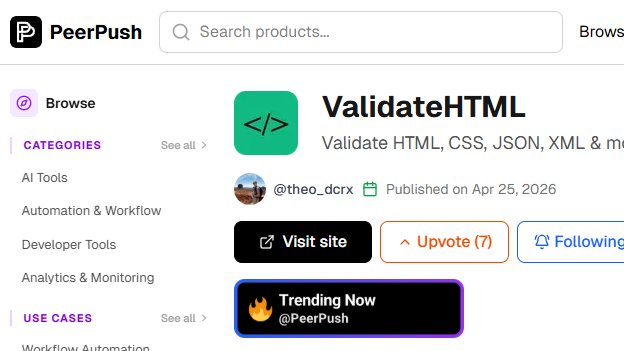
Just got featured on @peerpush_net - https://t.co/xDs0CS2oGN is trending 🔥
Free dev tools: HTML, CSS, JSON, XML validators + SEO and accessibility checkers. No signup, no ads.
Upvote if it's useful 🙏
https://t.co/rVfUKvIUUd
I just launched ValidateHTML on @ProductHunt 🚀
12 free validation tools in one place : HTML, CSS, JSON, XML, meta tags & more.
Paste code or enter a URL, get a quality score (0-100) instantly.
Built for devs tired of juggling 6 tabs.
👇 https://t.co/5OVYmBk7qg