Defining your core customer sits on almost every leadership team’s to-do list. Very few put it on the calendar.
Urgent work wins that fight every week, which is why strategic planning has to be protected on purpose. Grateful to @kevinwallace and the Wallace Properties team for clearing two full days and doing the hard part.
If every decision comes back to you, you can't scale. Your team needs your vision and values to decide without you.
Free 90-minute working session: https://t.co/kYxQehFVOH
If every decision comes back to you, you can't scale. Your team needs your vision and values to decide without you.
Free 90-minute working session: https://t.co/kYxQehFVOH
Revenue growth can hide a strategy that’s drifting.
A company adds a service because a good client asked for it. Then it takes on a type of customer it wasn’t built for, because the work was available and the team could handle it. Each decision makes sense at the time, and the top line keeps going up.
A few years later, the leadership team struggles to explain what the business is actually best at. Margins have thinned. The operation is more complicated than it needs to be, and the people doing the work are spread across more priorities than they can handle well.
What I’ve seen is that the hardest strategic decisions in a growing company are about what to stop doing. Saying no to revenue feels wrong when you’ve spent years fighting for it. It gets easier when the team is clear on the kind of business it’s trying to build, because that gives you something to measure each opportunity against.
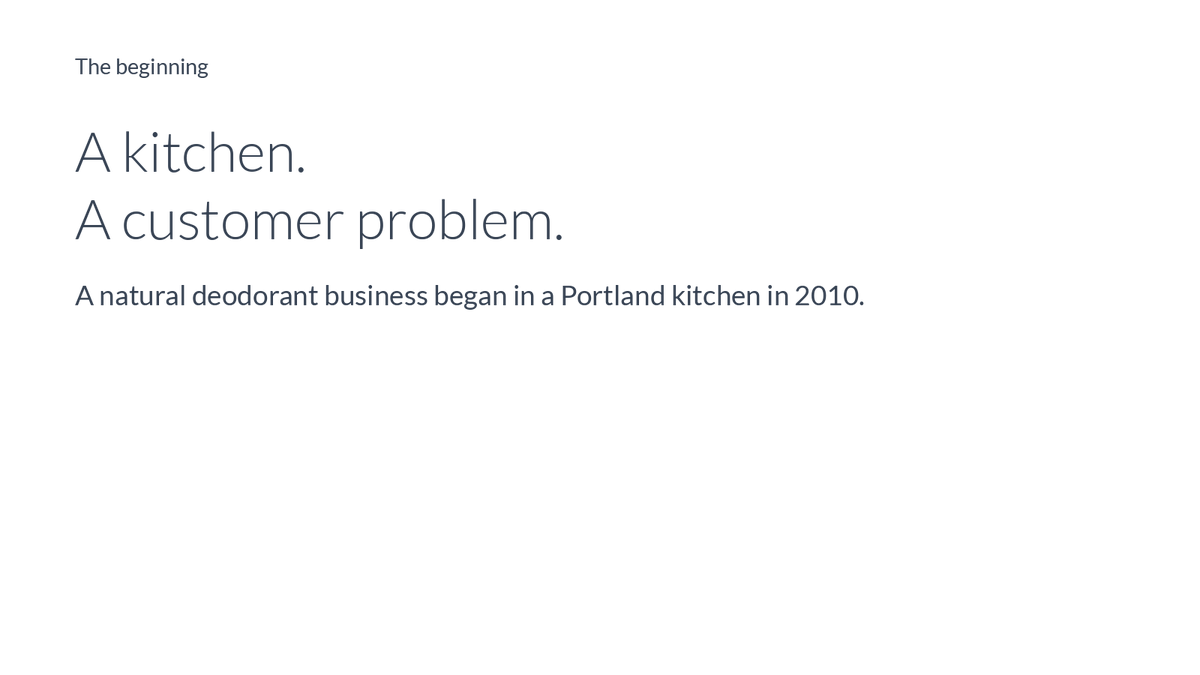
Unilever acquired Jaime Schmidt’s Schmidt’s Naturals in 2017. She said the buyer brought R&D, global distribution and supply chain strength. My takeaway: evaluate what a buyer can add, not just what it can pay. Which capability would matter most in your business?
Talent decisions take a long time to show up. The companies that recruited engineers to this region decades ago were solving a hiring problem. What they built along the way was a place.
The same thing happens inside a business on a smaller scale. Who you bring in, and how much they feel like they belong once they arrive, shapes what the company becomes long after anyone remembers why the hire was made.
That kind of advantage is slow to build and hard to lose, which is worth keeping in mind when the headlines suggest otherwise.
Great conversation with Kevin Wallace.
Before you hire a marketing agency, answer two questions:
Who is your ideal client?
What makes you different?
If you can't, the agency will guess. Free 90-minute session to work it out: https://t.co/kYxQehFVOH
“Most businesses do not have a people problem or an effort problem. They have a systems problem.” Jesse Kreun, OneAccord COO and Managing Principal of Technology Enablement.
https://t.co/7i79v88wvy
A leadership team can meet every week and still go months without deciding anything important.
I’ve sat in a lot of these meetings. Everyone gives an update, the discussion is reasonable, and the hour ends on time. Then the same issue shows up on the agenda the next week with a little more context and no more resolution.
Usually the problem is structural. Nobody is clear on who owns the decision, so the team keeps discussing it in the hope that consensus will form on its own. It rarely does.
A simple change helps more than people expect. Before an issue gets discussed, name the person who will make the call and the date they will make it. The conversation changes when everyone knows it’s leading somewhere.
Operational discipline doesn’t look impressive from the outside. Much of it comes down to a team that stops carrying the same unresolved questions from week to week.
Not a lecture. Not a seminar. A working session.
90 minutes, laptop open, free. Work on your vision, values and go-to-market strategy with Huba Rostonics and me.
https://t.co/kYxQehGtEf
Excited to be kicking off the two-day AI Multiple workshop at Sagecliffe Resort! Thanks to our event sponsors, @TaskletAI, Clay, and Merit Investment Bank, for helping make these two days valuable for everyone. Let’s GROW!!!
Asked owners: one AI system built by the end of two days?
Sales follow-up and pipeline: 43%
Operations: 29%
Customer service: 14%
Short clock, owners go straight to revenue.
https://t.co/uPkj5bryeN
The assessment we run for paying clients starts at $35,000. I turned it into a free prompt you paste into your favorite AI tool.
https://t.co/BAWWa5bGdF
@startupandrew@TaskletAI That’s exactly what we’re are doing - tomorrow/Tuesday with a room full of business owners.
Thanks for your support and partnership, @TaskletAI !
Loyalty gets complicated as a company grows.
The early employees who helped build the business carry a lot of history. They stayed when payroll was tight and did whatever the business needed. Over time, their roles grow in ways nobody planned for, and someone who was a great fit for the job at $5 million can find themselves stretched in the same job at $30 million.
The leaders I work with often see this long before they act on it. They delay because the conversation feels like a betrayal of someone who earned their trust.
Over time, I’ve learned that the delay is usually harder on the employee than the conversation would have been. They can feel the gap, and the rest of the team can see it too. Being honest early, and helping that person find the role where they can still do their best work, is a far better way to honor what they contributed.