One of our beta users said:
"You don't think in lines of code you think of structure. Of units of work."
I love it!
It connects to the heart of what we are building and how we are thinking @theoverlordcorp
We are expanding the beta soon: https://t.co/fGooSVwLiF
We are finally moving our embedded IDE, Overcode, to be a run-based rendering and layout system, and I am just happy that it naturally lends itself to being zero-copy!
Runs reference text segments of the underlying data structure. IDE writes update the doc 'version', which forces runs to rebuild.
Runs also make things like selection/find highlights and other IDE decorations to be implemented in a simpler way, and allow the rendering loop to be relatively simple.
Before we used to do the ultra-naive thing of doing layout, syntax highlighting, and so on every frame an IDE is visible even when nothing changed, but time to make it more proper.
Although, the stupid way was still so fast we hit stable 240fps on all machines tested haha. Computers are fast!
Since the early days of @theoverlordcorp I realized that an IDE that works through a semantic/ontological structure, rather than a soup of files, would allow semantic diffs.
Semantic diffs would be like:
- Endpoint X logic updated
- Column Y added to table Z
The code diff is there, but viewed through the ontology of the IDE, which increases the value of reviews and makes reviewing much more enjoyable.
After >1.5 years, this idea has become a reality!
It was an eye-watering amount of work to reach a point where this feature is both possible and a priority, but it finally exists.
It's a basic version and far from my vision, but nevertheless a step in the right direction, and should ship to our closed beta users within a day or two 🚀
@theoverlordcorp will be the first to make clear that harnesses can provide significant value to the point of models becoming largely commodity.
*All* our closed beta users, all AI-native, most SWEs, found out they do NOT need:
- Thinking
- Expensive models
- Sub-agents
- Plan/implement agents
They all have been using Luna/GLM-5.2/Grok-4.5; very affordable models, in one big chat, with large goals.
(Un)fortunately, doing this requires a staggering amount of work on the harness and tooling fronts, but the results are worth it.
@AnthropicAI suspended our account for usage policy violation when we have used ZERO tokens 🙃
I signed up using our company account, put in my @mercury credit card, and...blocked?!
Appeal rejected. No reason given...
They can't be serious. Can someone please help 😮💨
I have been very quiet lately, but it isn't for lack of progress!
All my time has been spent on @theoverlordcorp and after >1.5 years if work, it's starting to payoff.
These past few weeks we:
- Started our FIRST closed beta and people loved it 🤯
- Our agent is capable of working autonomously for hours with great results and minimal token usage
- Our production API is now built using the Overlord Engine
- We released our DB migration CLI
- We are working on semantic diff and simple deployments to your own VMs (pending our own infra!)
Over the next few months we will be expanding the closed beta, and then move into a public release. We will start with support for Go, and Typescript should soon follow, with Postgres the only DB for now.
The Overlord Engine is completely free. You only pay for AI usage. Don't want AI? You can use it to build and code manually. Whatever you like!
Make sure to signup for the beta (https://t.co/f3734Efg6d), we will be giving out some free AI credits for early users 😎
MASSIVE AI chat at solid 240FPS (less because recording). In DEBUG mode!
ChatGPT doesn't even let me send the message😂
Good things coming to @theoverlordcorp
This deserves a full article, but one way to think about what I am building at @theoverlordcorp is that it's an AI harness, but specialized for building production backends (and later all of web dev).
The reasoning is:
General purpose coding harnesses, like Cursor/Claude Code/Codex, have hit a local maxima in terms of performance (speed/quality/cost) and are very similar to each other because they are forced to cater to all programmers in the most general way possible. This has advantages, but it also means they are completely interchangeable and structurally stuck, sans a big product pivot.
On the other hand, what we are doing is akin to a GPU or an ASIC device. Custom built to do only a few tasks, but does them astonishingly better compared to a general purpose setup. We are talking 2x-10x improvements!
Now perhaps the most common programming paradigm, and definitely the one with the largest economic share, is web development. Over the past few decades we have developed very clear patterns to building and operating web dev systems across infra/backend/frontend/mobile/devops/etc.
AI harnesses that are able to notice, codify, and exploit the patterns and inherent structure of web dev will get massive capability jumps that prompts and general harnesses can only dream of, probably similar to the difference in power between two models many generations apart!
So where are we now? on small-scale tests, we (@theoverlordcorp) are already seeing up to 10x(!) better token efficiency, and >=2x faster task completion, and this is without even parallel tool calling!
Very soon our harness/engine will be mature enough to build our own backend in it, and we will start testing with a few users, and slowly expand access as we feel confident about the direction and the state of the Overlord Engine.
The hope and bet is that these initial successes will generally scale to full production backends, which will mean we:
1. Beat OpenAI/Anthropic/xAI (by a big margin)
2. Become the default way to build new backend systems (existing systems will require a one-time migration)
It should be noted that, just as a harness makes any given model better, so does this one. If you are building a backend, no matter how good your base model is, it is always boosted by the existence of specialized tooling and harness around it, making it as resistant to being deprecated by model advances as general purpose harnesses.
Very exciting times ahead!
Took some work, but @theoverlordcorp now uses FreeType to render text (through the great Dear ImGui) and it's noticeably sharper.
Text now looks very crisp! 😍
This is a cool example of what I mean when I say you need "semantic" tools specialized to your domain.
See how you can visually see (and manipulate) the roads and objects with color codes for everything.
Maybe you click on an object to open it's code, or maybe you want to see semantics to understand your system at a higher level.
In @theoverlordcorp we are working to enable specialized semantic tools for web dev (starting with backend). We will have pre-built tools and also an extensions system so you can build ones custom for your own project!
The full vision will take time, but there will be a set of core tools from day 1 to give you a taste, and every release things will get even more amazing!
Given that AGI has been achieved, I am happy to report that every copy of the Overlord Engine by @theoverlordcorp comes with OSAGI.
Introducing OSAGI™, our very own Overlord Systems AGI.
Thank you for your attention to this matter.
I am not even joking, if the early signs in @theoverlordcorp scale, this won't be an issue anymore.
Token efficiency can be way, way, higher than anyone imagines (at least within a domain). This also means very high signal-to-noise ratio context, so opensource models become competitive.
This means your agent is cheaper, faster, smarter (or as smart) ALL AT ONCE.
If this scales to larger programs (and we see no reason it won't) then this bs goes away and the big model providers won't be able to charge whatever they want, because their high context and high 'intelligence' models simply won't be required, or if they are still used, then they will be used at a 10x token efficiency.
The way agents were built is like us building JavaScript first, getting used to single-threaded, slow, RAM-hungry programs that take a GB and 10s to start, and thinking this is just how it is...then discovering C and assembly years later and realizing we can land on the moon with 4KB of RAM.
Overlord Systems (@theoverlordcorp) is aiming to be the C for web dev and web dev agents, and when you don't have C you don't need to pay $24 for code review :)
I think @theoverlordcorp is looking good insha Allah for a CLOSED ALPHA by April!
It will NOT have all features, but it will be enough to test the core engine, local dev, and AI agent features with few users.
Beta coming later.
Crazy month ahead to get this ready but excited!
Thoughts on business, product, and strategy:
In Overlord's (@theoverlordcorp) first investor update I noted the 3 core things we need for beta launch:
- An embedded code editor
- A production-ready core engine (local dev env, DBs, collaboration, logic, etc.)
- Cloud infra for deployments and other features
For a typical startup/SaaS, this is *way* too much. You should build the minimal useful thing, launch, and iterate. For example, me and 2 engineers built and released a VOD platform with many features and a large admin panel in 1.5 months.
Problem is, due to the nature of our product, the Overlord Engine, this approach doesn't work. I have recently come to think about products as being of two major types: "composite" and "monolithic".
Monolithic products need significant upfront time/effort/money. Cars, planes, space rockets, and video games are all monolithic. Most hardware products are monolithic.
You can't sell just the car engine, tires, or chassis. The parts alone aren't useful and customers don't care about them.
Monolithic products can be iterated as a whole but not in part. You can make rocket v2 or update your game, but you can't ship your game's physics engine and promise the rest later!
In comparison, composite products have small minimal-useful-parts and are easy to extend. Most software products are composite.
v1 of a SaaS can be an API to send emails, then you add analytics, then cron jobs, then team features, and so on. Low upfront investment and quick revenue.
Monolithic/composite is a spectrum. Composite is hugely advantageous, but be careful of ending up in a local maxima. Many such!
Note that deep tech is parallel to the above discussion. Gas cars are monolithic but *not* deep tech, while ChatGPT is composite but built on a (at the time) deep tech core.
Overlord? monolithic. This is something I internalized when I finished the proof of concept and saw how much effort that required. The "wow" point required more parts coming together than any product I ever worked on before.
The short term goal of Overlord is to become the default way to do web dev by rethinking and improving how we develop web software.
For this to happen, we have to figure out the atoms of web dev and to use them better than the status quo.
The magic of Overlord is when all the atoms come together such that the experience is greater than the sum of its parts. This is what happened in the PoC and it's what enabled our pre-seed round, but this is also the main challenge because it means individual features aren't enough (i.e., it's monolithic).
Releasing an individual feature doesn't work (the pieces are intertwined), doesn't provide 10x value, and will confuse people about what @theoverlordcorp is.
All this to say, it's taking a while, sorry, I wish we were live yesterday!
Although, I am seeing so much depth in the core engine that perhaps core engine and code editor alone can be a meaningful beta, with the infra soon after...👀
If you read this far, wow, thank you, and put your email here (and share with friends!): https://t.co/f3734Efg6d
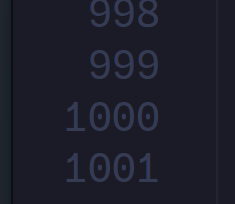
VS Code and Zed have a big static margin on the left for line numbers and breakpoints.
It avoids pushing text, but wastes horizontal space.
What if we had dynamic margins that took the minimal space + minimized shifts?
I think it's practically invisible👀
Btw this is the embedded @theoverlordcorp editor