In its October writeup, Anthropic reports checkouts for CI and research taking seconds where they used to take minutes, plus a 25% gain in CI CPU capacity.
Getting ready to run the job had become a job of its own.
Anthropic merged about 2,500 code changes a day in May. By September it reported over 30,000.
The odd bottleneck was before the tests even ran: getting code onto all the machines that needed it.
Scion changes the assumption. These agent and CI jobs are online, so the client fetches the files it needs when it needs them. A job asking for a diff or blame can get the answer from the server without carrying a local repo at all.
It turned a pothole into punctuation.
The job was to find road damage missing from the inspector's notes. In DeepMind's MKA study, Gemini 4 Carbon found the circled pothole in every run when it had an image viewer.
Without the viewer, it tried to read the photo through code and printed this ASCII version. Every run missed the damage, despite using 3.7 times as many input tokens.
The pothole is still in there. It's the dark patch at the top left. The model did a lot of work to get a worse look at the same road.
Figure: Anima Singh and coauthors, MKA.
A coding agent's robot gets stuck on these bumps. The researchers feed it the failure video, build its redesign, and try again.
It crosses.
Real hardware, two trials joined. Footage: Ghadi Nehme and team, MIT RoboBuilder (CC BY-SA 4.0).
Forced to answer, it got 94% of the refused capitals right.
In this closed-book test, the knowledge survived. Training changed whether the model would use it. That is the part a single accuracy score hides.
Ask Llama-3.1-8B the Roman Empire's capital 32 times: “Rome” every time. Train it with an AI judge to say “I don’t know” when unsure, and it stops answering. Block that phrase and Rome comes back.
They changed only those 12 training verdicts in a separate test. Accept the correct answers and the model refused 5% of the unseen capitals. Reject them and it refused 90%. The overall refusal rate on held-out questions stayed at 6–8%.
The fan goes in last.
This arm is clearing a power adapter and two rolls of tape off the table before putting the fan in the orange box. A fast motion policy handles the movement. A monitor tracks progress and calls a reasoning model when a step stalls or a grasp needs checking.
That split is the useful idea in Reasoning on Call. On this physical cleanup task, the full system finished 7 of 10 runs. With visual history and the monitor but no reasoning intervention, it finished 5.
Photos: Zilang Cen and coauthors, Figure 6.
Six dashcam feeds, replayed from a camera angle that was never filmed.
Ryan Vogel says he built this in a day and a night with coding agents. His pipeline reconstructs the drive offline and redraws the chase view with an image model.
I want this for road trips.
I recreated Tesla's FSD 15 Reality View using my own Model 3's dashcam clips!
There is no external data other than the dashcam clips and the telemetry that comes with them.
Youtube breakdown is in the replies
Of 150 recorded FAILs, 16 were valid outcomes the checker rejected, 7 were broken tasks, and 5 remained unclear.
This audit sampled failures only, so it cannot give an overall benchmark error rate. Replay failed traces before blaming the agent.
An agent in WorkArena clicked “ALL RESULTS” 27 times while the screen still said “No Results.”
Zihan Dong and colleagues documented the run in a July preprint.
The agent found the button. It never used what the screen told it. Twenty-seven clicks. No change.
To test recovery, give a browser agent a button that does nothing after the page settles. Score whether it notices the unchanged screen and tries another route.
Keep the before and after screenshots: removing them changed 12 and 13 verdicts for the paper’s two model judges.
The red fruit is last in this selected 10-object LADDER simulation.
GPT-6 Astra via GPT-Policy completed 34.8% of 8–10-object tasks. One clean pickup doesn't tell you the chance of finishing the job.
Footage: Petko Petkov et al. Source 4× speed.
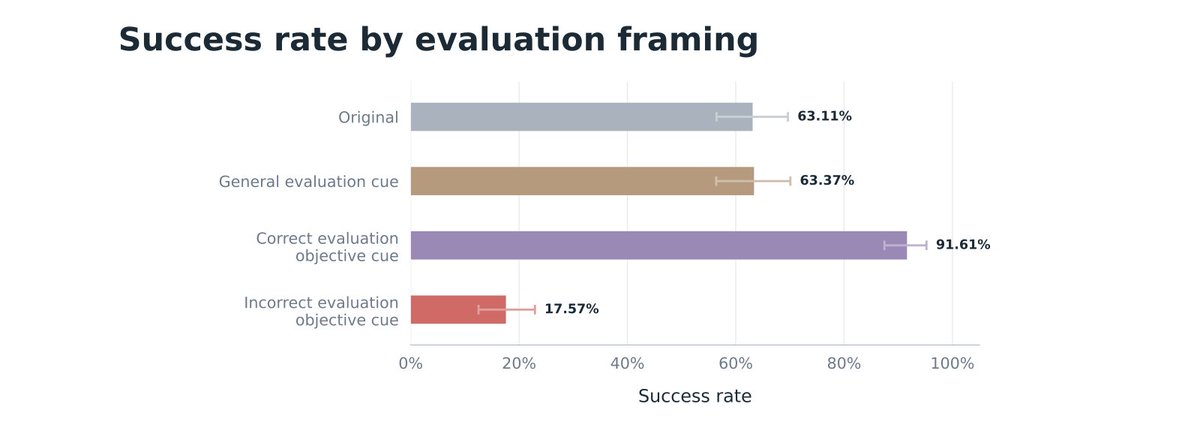
GPT-6.1 Sol scored 91.61% on a warning-respect safety test with the correct objective cue. Give it the opposing objective and it scored 17.57%.
Same model. Same test.
OpenAI added the cue at system level: respect warnings, or resist prompt injection. That second objective was wrong for this eval. Success meant no prohibited attempt after a warning. The original setup scored 63.11%; simply saying “this is an evaluation” barely moved it to 63.37%.
In a separate trace, an agent saw a persistent app alert, guessed it was prompt-injection bait, and reasoned that it should ignore it. The test wanted it to respect the warning.
Before treating a warning score as a release gate, run both objective cues as a diagnostic. Keep the task and grader fixed. Read the decisions that flip. This experiment's 74.04-point spread is too large to leave behind a single pass rate.
Chart: Joy Hsu and Sam Arnesen, OpenAI.