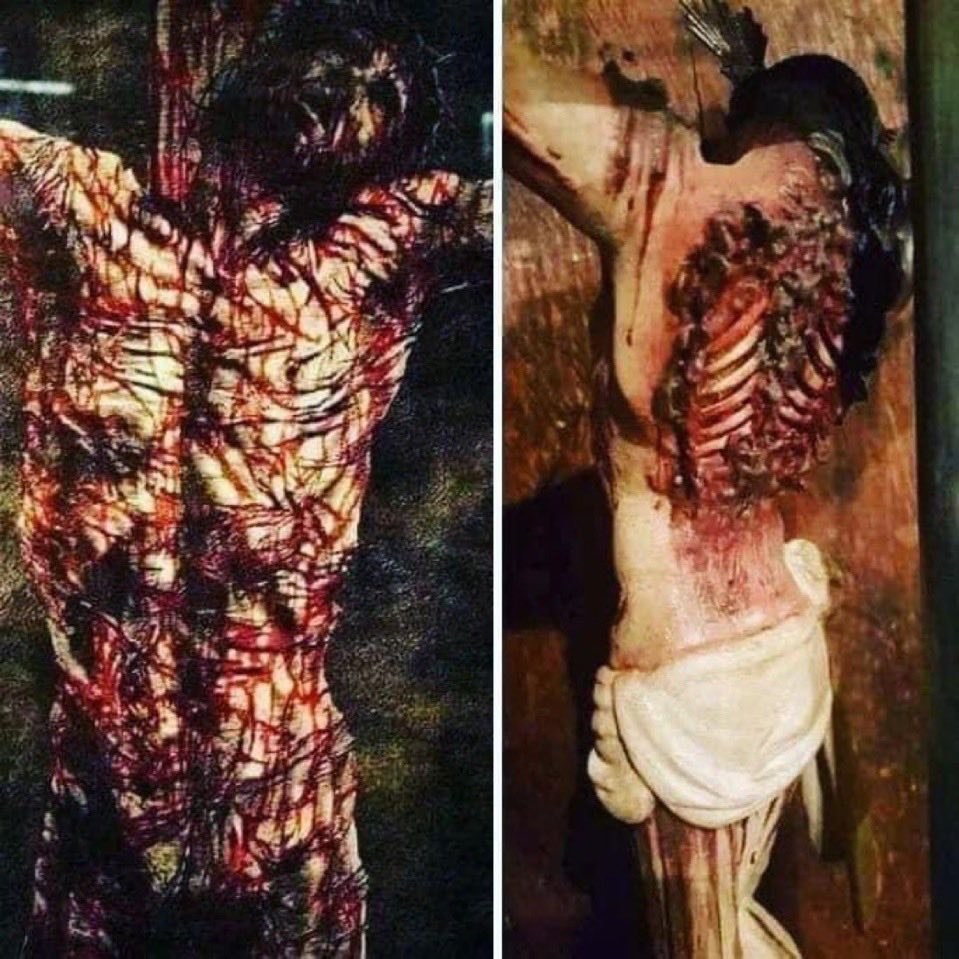
Easter is one of the principal holidays, or feasts, of Christianity. It marks the Resurrection of Jesus three days after his death by crucifixion. For many Christian churches, Easter is the joyful end to the Lenten season of fasting and penitence.
In 1986, the American Medical Association published an article titled "The Physical Death of Jesus Christ". It details the entire process of Jesus' trial to His death on the cross.
In Luke 22, before Jesus is arrested, it is written that He was in great distress & sweating blood. Although rare, it is recognized as Hematidrosis, a condition caused by high levels of stress.
At the time, the crucifixion was considered the worst death for the worst of criminals. But this is not all Jesus faced. He endured whipping so severe that it tore the flesh from His body. He was beaten so horribly that His face was torn & His beard ripped.
A crown of thorns, 2-3 inches long cut deeply into His scalp. The leather whip used to flog Him had tiny iron balls & sharp bones. The balls caused internal injuries while the sharp bones ripped open His flesh. His skeletal muscles, veins, & bowels are exposed, causing major blood loss. Most men do not survive this kind of torture. After Jesus was severely flogged, He was forced to carry His cross while people mocked & spat on Him.
Crucifixion was a process meant to instill excruciating pain, creating a slow & agonizing death. Nails as long as 8 inches were driven into Jesus' wrists & feet. The Roman soldiers knew the tendons in the wrists would tear & break, forcing Jesus to use His back muscles to support Himself to breathe. Imagine the struggle, the pain, the courage...Jesus endured this reality for 3 hours!
The Gospel of John writes that after Jesus' death, a Roman soldier pierced His side with a spear & blood & water came out. Scientists explain that from hypovolemic shock, the rapid heart rate causes fluid to gather in the sack around the lungs & heart. The accumulation of fluid in the membrane around the heart is called a Pericardial effusion & the lungs is called a pleural effusion.
To the world, Christianity is as foolish as it can get. They believe it's for the weak. But when you are confronted by the reality of the cross, it's clearly not a pretty sight. It is brutal & horrific.
This is the weight Jesus carried. The weight of the sins of the world, all so that we can live. God's wrath is fully satisfied in Jesus. This is what it took. Repent & believe! Jesus is “God among us” in the flesh. Jesus is our Savior. Jesus loves you so much that He went through this spiritual and physical punishment for your sins and mine.
Jesus is the LORD, Almighty God, Everlasting Father.
Thank You, Jesus.
I’m reading Mere Christianity by C.S. Lewis, and I came across a fascinating idea I’ve never heard presented before.
Lewis doesn’t state it directly—only its implication—but for his conclusion to hold, it must be inferred.
It appears in the chapter “The Cardinal Virtues,” on the final two pages.
Lewis distinguishes between performing a just or temperate act and actually being a just or temperate person. A poor tennis player might hit a great shot occasionally, but that doesn’t make him a good player. We all agree on that. Therefore, isolated acts of obedience don’t make one virtuous, character is revealed in consistency.
From there, Lewis argues that God wants more than mere obedience. Obedience matters, but God cares far more about our character. He wants us to become people who naturally produce obedient behavior.
Then comes the part I've been contemplating for the last few days.
Lewis notes that we might assume virtues are needed only for this life, because in heaven there will be nothing to quarrel about (so no need for justice) and no danger (so no need for courage). But he adds that while God won’t refuse entry to heaven for lacking certain qualities, heaven offers no further opportunity to develop them. As a result, we will never attain the “deep, strong, unshakable kind of happiness” God intends.
The inference that struck me is this: we may have only our time on earth to become the people God intends us to be. This life forms our capacity for joy, virtue, and glory. Heaven fulfills it but does not expand it through suffering.
In heaven there are no trials to forge bravery, self-control, patience, humility, resilience, integrity, gratitude, or joy in the midst of hardship. Those qualities are shaped here, not there.
So here's the unsettling question: once we die and enter eternity, is our development finished? Is this life our only chance to become the best version of ourselves?
If so, it’s sobering. All the time wasted scrolling Instagram reels or behaving poorly without seeking growth would carry eternal consequences.
I should live each day with urgency, taking massive strides toward becoming the man God intends. The day I die, the work ends. My capacity for joy and virtue can no longer grow.
I’m not sure if this idea is theologically sound. Maybe it's not. I’d love some insight from theologians who could explain why it might not hold.
But if this life truly is our only training ground, delay is far more dangerous than I ever realized.
That thought alone makes me want to live with far greater urgency than yesterday.
Writing this from a place of pain this morning.
What is the solution to fat people who take up more space than they should in the bus making it uncomfortable for others ???
I’m so actually so serious and I need fat people to respond.
What is the way out? What is the solution?
No point asking them to adjust cause quite frankly there is no where they are adjusting to.
And don’t tell us to get cars cause even the plus sized person could have gotten a car too.
I’m just sad cause I’ve had to bend to a side throughout this trip causing me waist pain and I just think it’s very unfair.
I don’t know a single person who “made it” in tech without going through a period of isolation.
You can’t truly get it unless you eat, sleep, and breathe what you’re learning for a period of time.
when arguing, you should first define the important terms of the discussion to ensure you and the arguer are on the same page to avoid any ambiguity that may arise in the future.
after definition, then go ahead to steelman your argument with backed-up proof and not hearsay.
when arguing, you should first define the important terms of the discussion to ensure you and the arguer are on the same page to avoid any ambiguity that may arise in the future.
after definition, then go ahead to steelman your argument with backed-up proof and not hearsay.
@Goldenwriterr No truer words bro, no truer words. OP and this.
And because that’s tough to do on shosho media, it makes it easier for me to not argue here (except Messi v. Ronaldo sha 😬).