The Stock Market Crash Prediction Nobody Wants to Make
Most people don’t want to say this out loud.
Here’s what’s catching my attention.
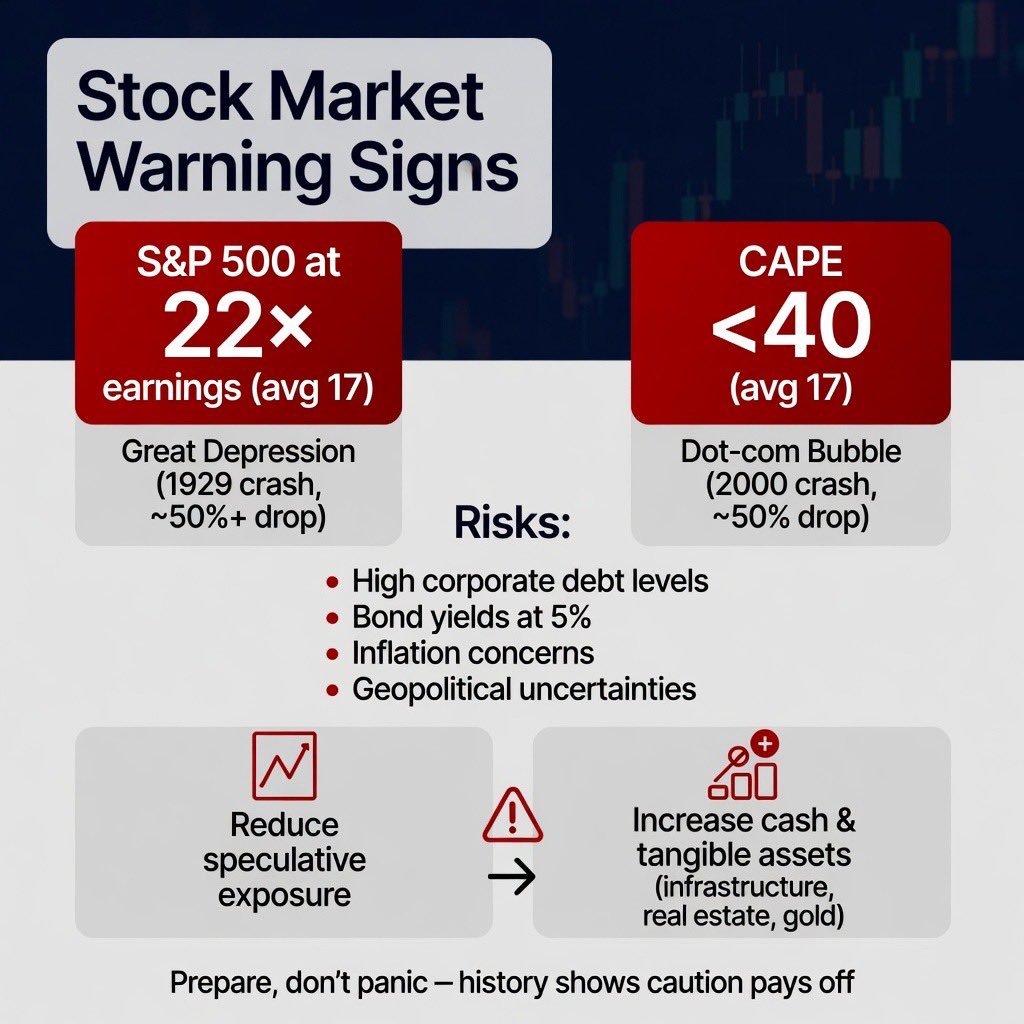
The S&P 500 is currently trading at around 22 times earnings, while the long-term average is closer to 17. That’s already a sign that valuations are stretched.
But the metric that concerns me even more is the CAPE ratio, which compares market prices to 10 years of inflation-adjusted earnings. Today, that ratio is hovering around 40, while the historical average is about 17.
In more than 152 years of market history, we’ve only seen levels this high twice before.
Once before the Great Depression and again during the dot-com bubble, just before the market lost roughly half its value.
We’re approaching those same levels today.
There are other warning signs as well. Government debt concerns are growing, long-term Treasury yields are near 5%, inflation remains elevated, and geopolitical tensions continue to create uncertainty. Some recession indicators are also flashing caution signals.
Meanwhile, the market has delivered strong gains for most of the past several years. History shows that no market trend lasts forever.
So what do experienced investors do when they see conditions like this?
They don’t panic. They don’t sell everything. They adjust.
They reduce exposure to the most expensive and speculative investments. They increase cash reserves, similar to what some high-profile investors have been doing.
They look for assets that generate income while they wait. And they add exposure to tangible assets such as infrastructure, pipelines, real estate, or gold, investments that tend to hold value during difficult periods.
Does that mean a market crash is imminent?
Not necessarily.
A downturn could happen tomorrow, next year, or not for several years. The point isn’t to predict the exact timing. It’s to recognize when risk is rising and prepare accordingly.
The current setup may not guarantee a crash, but it resembles periods in history when caution proved valuable. That’s why smart investors focus not only on maximizing returns, but also on protecting capital when markets become unusually expensive.
The solution sounds clean until you map what breaking actually looks like.
Hike rates hard enough to genuinely crush demand and you are not just cooling inflation, you are detonating commercial real estate, blowing out overleveraged corporates that rolled debt at zero, and putting 2 million people out of work. The Fed knows this, which is why they have spent five years choosing the slow bleed over the hard stop.
Easy money did not just inflate prices, it rewired every balance sheet in the economy to assume rates stay low forever. Unwinding that without a crisis requires either perfect timing or a miracle, and the Fed has never landed either.
It is whether they have the stomach to actually finish the job when unemployment starts spiking and credit markets seize up?
The U.S. Might win AI but crypto is pricing in the opposite trade right now.
Bitcoin at $58,707 while the Fed chair talks up American tech dominance tells you the market sees two different worlds. One where the U.S. Leads innovation, another where capital flows to harder assets because that same innovation accelerates money printing to fund the race.
If Warsh is right and the U.S. Wins, Bitcoin wins harder
Meta already owns one of the largest compute footprints on earth, built to train Llama and run inference at scale across 3 billion users. That is not a side project, that is a fortress moat most cloud players would kill for.
The 7% move is the market pricing in a new revenue stream with actual infrastructure already in place, not a promise. Meta does not need to catch up, it needs to open the door.
This is the hyperscaler oligopoly getting a fourth serious challenger with a balance sheet that can fund the fight
Your grandkids will ask where you were when Bitcoin was $58,604.
You'll either tell them about the streaming service you paid $20/month for.
Or you'll show them the wallet you opened that week.
Netflix killed Blockbuster.
Don't be Blockbuster.
Amazon found $90bn in revenue sitting in infrastructure they built just to keep their own shelves stocked online.
The move was not genius foresight, it was pragmatic excess capacity monetisation. They had the pipes, the compute, the edge locations, all running 24/7 for peak retail loads that only hit a few times a year. Selling that downtime turned cost into margin.
What made it work was timing. Cloud was still hand rolled infrastructure in 2006, enterprises were drowning in capex, and AWS arrived with pay as you go primitives at the exact moment SaaS needed cheap, elastic compute to scale.
Now AWS prints more operating income than the entire retail operation. The side project became the profit engine.
The pattern holds. Infrastructure built for internal scale, then productised and sold before competitors even see the category forming.
@stats_feed Wait, the 2026 World Cup hasnt happened yet.
Are you telling me Ronaldo only gets two goals in a tournament that exists entirely in your imagination.
Even in fantasy land he cant catch a break 😂😂😂
@AshCrypto When monthly momentum turns this negative, the typical path is not a V bottom. 2022 gave us three more months of chop after MACD hit similar levels before any sustained move up. The structure needs time to reset.
The 50 month EMA sits around $62,000 right now and we just closed February at $58,492.
2015 and 2019 Both times price chopped below it for months before reclaiming it marked the actual bottom.
What matters now is whether we get a fast reclaim or a long grind. 2019 took seven months to flip it back, 2015 took four. If this plays out the same way we are looking at summer or later before that level becomes support again.
The Strategy rumour is the interesting piece here, not the rate narrative everyone recycles.
If Saylor actually sells after building an entire identity around never selling, that is not just a headline. It breaks the one conviction trade left in this market. Bitcoin at $58,492 already prices in rate uncertainty, it does not price in the largest corporate holder reversing course.
UBS cutting to the bone on Nike right now.
The real issue is not just weak demand, it is the fact that every lever a turnaround normally pulls, Nike already burned through. They cut costs, they brought back old leadership, they tried to fix DTC after gutting wholesale partnerships. None of it moved the needle.
That $129.3B in six months puts Nasdaq on pace to beat every full year since 2021, when the market was pricing in free money forever and companies went public at 40x revenue with no path to profit.
The question is whether exits stay open long enough for the 2021 and 2022 vintage funds to actually return capital, or if something breaks before they get their turn
Imagine explaining to someone in 2010 that by 2025:
Zimbabwe would abandon its own dollar after hyperinflation
Venezuela would abandon the bolivar entirely
The US dollar would lose over 95% of its value since 1913
And one Bitcoin would be worth $58,553
They'd ask which one was the experiment
@stats_feed Canada finally getting their moment after years of apologizing for even showing up to qualifiers.
The Round of 16 is about to be wonderfully chaotic
@stats_feed Tomorrow is July, which means today is June 30th, which means you are either. A time traveller
Or posting this at 11.59pm like some kind of temporal daredevil
Over $100 million in BTC and ETH while sitting in the Oval Office is not a symbolic gesture, it is a structural conflict of interest that now runs both ways. Every regulatory decision, every SEC appointment, every banking guideline that touches digital assets has to be read through the lens of a personal position that size.
The implications are wild. If he pushes pro crypto policy, critics will scream self dealing. If he does nothing or lets agencies tighten rules, he is betting against his own book. Either way, crypto policy is now visibly tied to his net worth in a way no previous administration came close to.