Your anonymous internet identity can now be unmasked for $1
Not by the FBI. By anyone with access to Claude or ChatGPT and a few of your Reddit comments.
ETH Zurich and Anthropic just dropped a paper called “Large-Scale Online Deanonymization with LLMs” and the results are the most alarming privacy research I’ve read this year.
They built an automated pipeline that takes your anonymous posts, extracts identity signals, searches the web, and figures out who you are.
No human investigator needed. Fully autonomous. Works on Hacker News, Reddit, LinkedIn, even redacted interview transcripts.
Here’s how bad the numbers are.
On Hacker News users: 67% identified correctly.
When the system made a guess, it was right 90% of the time.
On Reddit academics posting under pseudonyms: 52%.
On scientists whose interview transcripts were explicitly redacted for privacy: 9 out of 33 still got unmasked.
The pipeline works in four steps they call ESRC. Extract identity signals from your posts using LLMs.
Search for candidate matches using embeddings across thousands of profiles.
Reason over top candidates with models like GPT-5.2. Calibrate confidence so when it does guess, it’s almost never wrong.
The classical deanonymization method from the famous Netflix Prize attack? Nearly 0% recall across every test.
LLMs didn’t just improve on old techniques. They made old techniques look like toys.
When they scaled to temporally split Reddit profiles, matching a user’s old posts to their newer ones across a full year gap, the pipeline hit 67% recall at 90% precision and 38% recall at 99% precision.
Meaning even a year of changed interests and different conversations wasn’t enough to hide.
More reasoning compute = better deanonymization. High reasoning effort doubled recall at 99% precision in some tests. As frontier models get smarter, this attack strengthens automatically. Every model upgrade is a privacy downgrade.
What makes it nearly impossible to defend against: the pipeline splits into subtasks that all look benign. Summarize a profile.
Compute embeddings. Rank candidates. No single API call screams “deanonymization.” The researchers themselves say they’re pessimistic that safety guardrails or rate limits can stop it.
Their conclusion is blunt: “Users who post under persistent usernames should assume that adversaries can link their accounts to real identities.” And it extrapolates.
Log-linear projections suggest roughly 35% recall at 90% precision even at one million candidates.
Every throwaway account. Every anonymous forum post. Every “nobody will connect this to me” comment.
It’s all searchable micro-data now. And the cost to run the full agent on one target is less than a cup of coffee.
Practical anonymity on the internet just died. The paper killed it with math.
Artificial intelligences do not undergo experiences, do not possess a body, do not feel joy or pain, do not mature through relationships, and do not know from within what love, work, friendship or responsibility mean. Nor do they have a moral conscience, since they do not judge good and evil, grasp the ultimate meaning of situations, or bear responsibility for consequences. They may imitate or even simulate, but they do not understand what they produce, for they lack the affective, relational, and spiritual perspective through which human beings grow in wisdom. #MagnificaHumanitas
Thank you. The important part is zeroing out taxes on the bottom half. Best way to put money in someone’s pocket is to not take it out in the first place. Bottom half is only 3% of total tax revenue. But it’s very meaningful to that person. Zero it out.
it’s in gemini, just create it in ai studio. oh, that’s for your personal google one account. for workspace you need gemini business. no, not gemini advanced, that’s ai pro now. unless you need ai ultra. oh agents? you do that in spark actually. no, not gemini api managed agents, that’s different. for coding use jules. unless you mean the agentic ide, that’s antigravity. no, that’s the old antigravity, download the new one. actually gemini cli is being deprecated, use antigravity cli. no the flash model is smarter than the pro model. unless you need pro. if it’s video, use flow. no, flow uses veo. no, nano banana is images. actually that’s in gemini now. unless you’re in search, then it’s ai mode. no, research is notebooklm. anyway it’s all very simple.
sell me this devtool
@minitap_ai has launched minitest. Fully managed AI QA engineer for mobile, w/ zero authoring, zero maintenance. It catches the UI/UX, performance, payment issues your users would've hit, before they hit them.
comment for free 2 months unlimited access and a personal onboarding from the team
in the meantime enjoy my Oscar-worthy acting
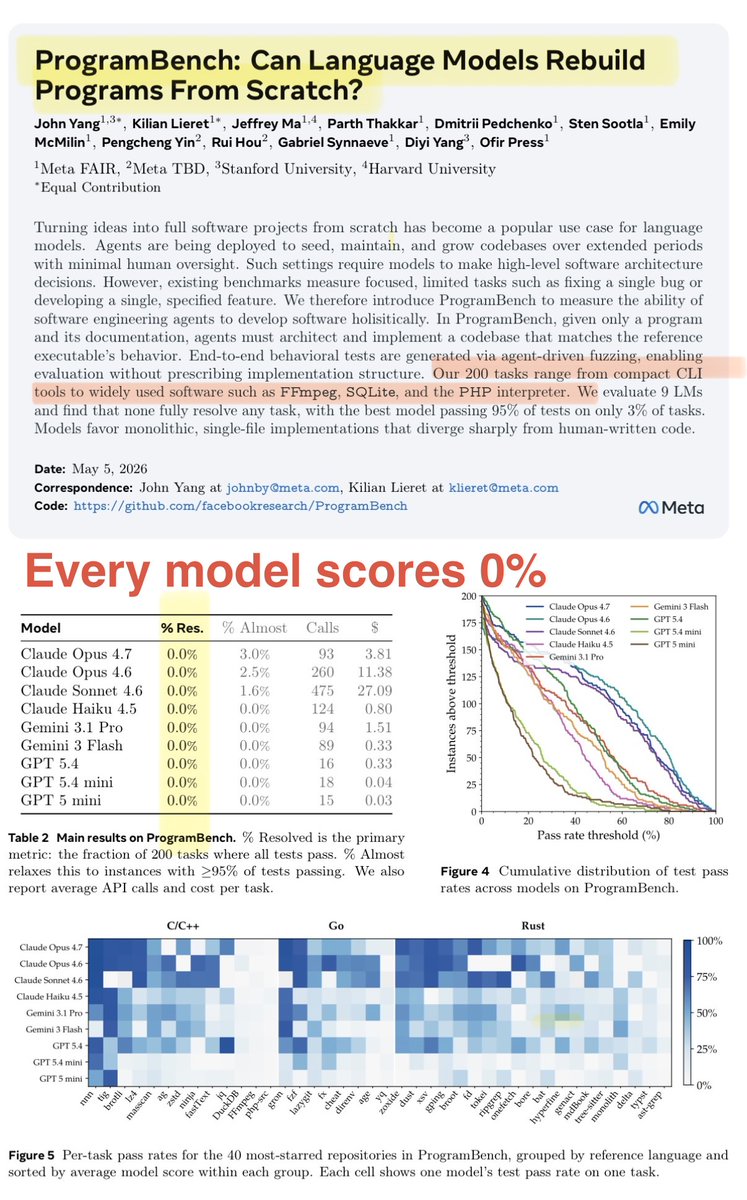
The creators of SWE-Bench just dropped a really simple new benchmark every LLM gets 0% on.
ProgramBench asks: can models recreate real executable programs (ffmpeg, SQLite, ripgrep) from scratch with no internet?
We are far from saturated on model quality.
If you have an LLM that can; discover new material compositions or cure diseases. Why would you sell it for $20 p.m.? or even thousands...
It makes more sense to keep them secret and sell end product e.g. blockbuster drugs to people who can monetize innovation
Christ is risen from the dead, and with him, we too rise to new life! This Easter proclamation embraces the mystery of our lives and the destiny of history, reaching us even in the depths of death. #Easter
→ https://t.co/oVqNoE5YfB by @therealdanielq is a no-code AI automation platform that builds and manages workflows for you from plain-English instructions!
Spin up 24/7 AI workers with 3,000+ integrations and 100+ templates to crush support, lead gen, and sales outreach automatically!
🔴 Live on Dev Hunt → https://t.co/XrcnZ0mtCU