Next year's misinformation will be overwhelming if you let it in.
Disconnect from every "For you" feed on your social platforms. You don't need personalized content. You need clarity to recognize manipulation, resist emotional traps, and stay rational when narratives are engineered to provoke fear, outrage, or blind compliance.
If you won't do it for yourself, do it for the people who depend on you.
The "matrix" will intensify. Only those who deliberately step back will see straight.
🎁1 year LATF membership giveaway🎁
I just gave free access to my "VIP group" for one week.
This is where I have taught people everything I know for the last 5+ years. This is where I breakdown all of my trades, everyday.
I hope that was a great experience for those of you wanting to make a change in 2026!
It was a transparent look at what I do everyday.
The option to join with a 1 year membership discount will be removed in 2 days. (This is my last year).
To join the giveaway, like and share.
Hello @Moneytaur_ aficionados. This week we will be covering...
- Take Profit -
- Profit-Taking Is Designed to Feel Wrong
The perfect entry with ideal sizing means nothing if you don’t take profit.
Whales orchestrate the market to keep you holding. The most bullish news drops at the top. Engineered liquidity forms familiar “bullish” patterns that are designed to induce FOMO.
“In this space everyone buy, but who actually sell?…
They give you one target, and if price is going up they will not tell you to sell, but give you another target (higher). Then the run is done and they tell you to DCA into each pullback, and you will be buying all the way down ☠️”
Why the illusion? Simple, whales need exit liquidity. They can’t sell size without buyers. Every top buyer enables their distribution.
“The moment you wake up to this reality, the game changes. Understanding the true nature of the system is the first step toward playing it to your advantage, and finally winning.
Profits only exist when taken, everything else is vapour. Be systematic, drop the emotions and learn to operate rationally, not emotionally.”
They control the narrative, dictate PA, and outcomes. The most bullish or bearish news marks the top or bottom. These are the liquidity games, learn to play them.
Selling is a discipline.
https://t.co/0AitkOPMg8
“Moral of the story: You only earn when you sell on profit, and you will end up losing because it’s never enough.”
“You’ll start making money when you accept what the market offers rather than demanding it meet your expectations. There’s a reason I set take profit levels and trail my stops, to secure gains and protect my positions.”
https://t.co/BphLYrEWhy
-------
- The Mindset Behind Sustainable Profit
Set realistic quarterly and yearly portfolio targets. Enter and exit based on your plans, not fear or greed. Build sustainable longer term profit through strategy and the correct mindset. Accept loss as part of the game and take what the market gives you.
“If people set realistic 3-month and yearly targets, they’d struggle far less with trading. Most, however, don’t plan or consider the average monthly profit needed to meet their yearly goals.”
Furthermore, play level to level. Control what you can and build your skills over time while staying exposed to the market.
“Whether you’re a newbie or experienced, trying to guess the next major move is always a bigger headache than simply identifying the most powerful and likely reversal levels.
The smarter approach?
Wait for them to hit, take action, take profit, and get out.”
https://t.co/9lgQOyDGUw
Always take profits and protect your position once in profit. Do not chase ridiculous targets. Stay aware of what money actually gives you: freedom, time, and options.
The moonshot stories exist to bait you. It can happen, but rarely. And most who catch it, lose it. Base your approach to markets on a disciplined and refinable system. This is the only sustainable and realistic approach to making consistent money in markets.
“The stories of someone turning pocket change into millions are crafted to lure you in, much like the illusion of winning the national lottery, where the odds of life-changing success are microscopic.”
Real performance comes from preparation, hard work, and learning to be in control of your emotional reactions, not luck. You don’t need to bet on the “right” asset. You need to become the person who can extract value from any asset in any direction.
“Instead, focus on having a solid strategy. One that includes a plan to trail your position as the move progresses, both for futures and spot. Even with wide stops, this approach ensures you minimize losses if your thesis is wrong. Remember, when things don’t go as planned, it’s not the market failing you, but your (lack of) preparation or execution. It’s your timing. The problem is you, and you must optimize your game.
It’s all engineered to empty your pockets over time. It’s a system built to profit off your hope and ignorance. The promise of “life-changing tech” is just a façade, a narrative crafted to keep you buying in. At its core, it’s a calculated money grab.”
Set TPs at key levels, sell into parabolic moves, and stay detached from hype. Scale out deliberately. Never regret taking profit. When your emotions start pulling you into euphoria or FOMO, treat that as a signal to reduce risk, not to add to it.
“The key is selling gradually into parabolic moves while tuning out CX noise. And when I say gradually, i don’t mean 5-10% only to FOMO back in on the next 4H green candle – I mean significant percentages.”
“Question: Do you DCA out or do you sell everything at your target levels (talking about spot holdings)?”
“MT: DCA out, but something like 40% > 30% > 20% while moonboys will DCA out something like 2% > 3% > buying back higher on the first pump they see after selling a micro % of their portfolio.”
https://t.co/Jbp2sLQTXW
When your TP hits, sell. Don’t move the target. That’s how discipline breaks, and bag-holding begins.
https://t.co/0nIEW5nJ0P
“Herd Mentality: Stick to your investment plan. Don’t get swayed by market hysteria and irrational behavior of others. CT is mostly a brainless space.”
https://t.co/H39D4lV8KK
-------
- When to Take Profits
Remove yourself from the fantasy of selling the exact top. Start thinking probabilistically. If there’s a real chance price will reverse at a key level, sell a substantial amount to cover that scenario. When in profit, trail your position to protect downside.
“The real cheat-code is probabilistic thinking.
You’ll never know exactly what’s next, but you can map the highest-probability plays and size your bets in proportion to the odds. The sharper you get at this, the more the game bends in your favor.
The only people who are always certain are the ones who keep stepping into traps because they only ever prepare for one scenario instead of the full spectrum of outcomes.“
https://t.co/NGpurp9Nvm
“I’ve seen some asking: “Why are you taking profits already if you expect higher?”
“…Mfer, because I am shooting for my weekly, monthly and yearly goals, and the market doesn’t go up only, but you don’t fucing get it because you’re a greedy NPC 💀”
Instead, they aim to maximize every position, often resulting in holding spot bags through cycles, watching good gains turn into major losses and then saying “meh, i already lost too much on this one so im not selling here…”
https://t.co/BphLYrEWhy
Treat every trade (spot included), with discipline. Pre-plan your TPs and allocate a portion to trail. This mindset creates consistent, compounding wins while defending against sudden reversals. Before entering any trade, define at least two realistic TP levels and stick to them.
Pre-defined TPs matter because they:
• Give you a structured plan.
• Allow proper RR calculations.
• Prime you to act instead of hoping.
• Instill routine and discipline.
• Filter which trades are even worth taking.
“If you can’t clearly identify take-profit levels, don’t enter a trade and “hope for the best”
Set your entries and targets with precision, refining them as much as possible”
https://t.co/J5AnlGHltv
“Always have @ least 2 take profit levels.”
-------
- Where to Take Profits
Finding TP levels follows the same logic as finding high probability entry levels. The difference is that, once the trade is in profit, we allocate portions of the position based on how likely a level is to produce a reaction against us. Scaling out secures realised gains, reduces active exposure, and frees up part of our maximum allowed risk to be deployed elsewhere.
- Main Focus
Liquidity Levels
We should prioritise taking profits at key liquidity levels and at supply and demand zones that align with our setup and sit within the range we are trading. Target the levels that are structurally relevant.
https://t.co/694w45Xztf
Market Structure
Taking profits at key highs and lows is always valid. Some swings will not offer clean liquidity levels, and that does not invalidate the move. When structure is unclear, simple range highs and range lows remain legitimate TP targets.
https://t.co/EhDLU4O1Y1
Imbalances
Price tends to fill imbalances. Taking profits at these points can offer valid TP opportunities, either at the EQ or at full fill.
https://t.co/E99uhPSvj1
Key Fib Levels
The 0.5 fib is a major inflection point. It often marks the transition between potential reversal and continuation, so taking partial profits just before it is a good habit.
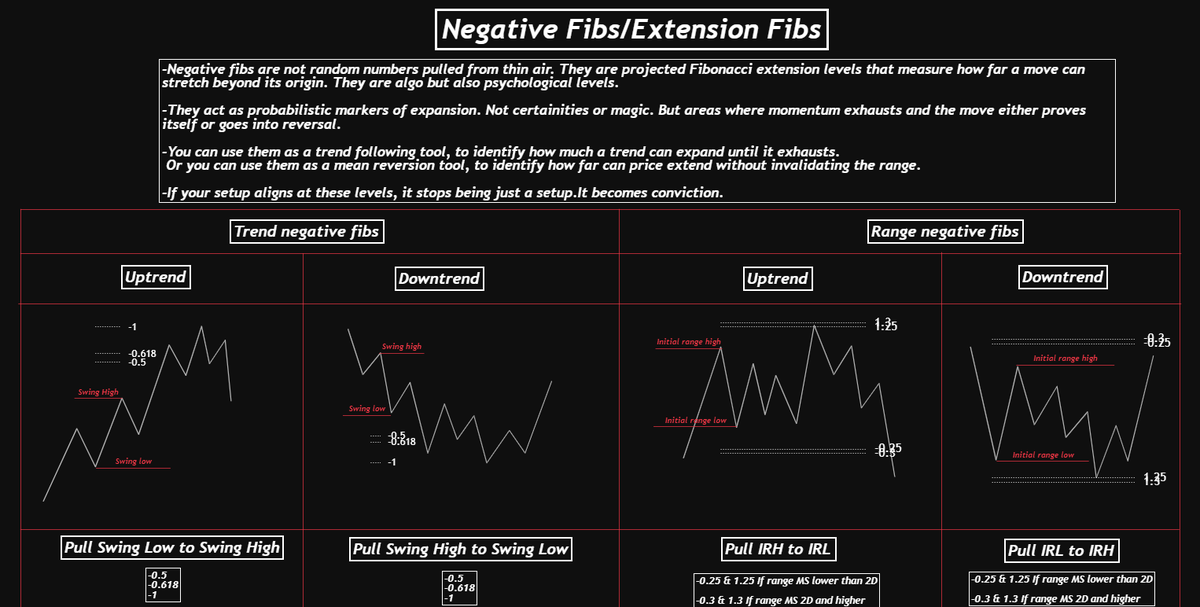
In price discovery, negative fibs and Fibonacci extensions provide reference points for identifying valid TP levels when no historical liquidity exists.
https://t.co/msF4mO3Xzu
Majors Confluence
Always cross reference with the major charts. If something like USDT.D is approaching a key HTF level, take partials or at minimum move your SL to BE or into profit. This matters even more for altcoins.
- Complementary Signals
Patterns
Patterns that lead into key levels can act as confluence, strengthening the probability of an already marked level.
Round Numbers and Psychological Levels
Clean numbers like 100 or 1.00 often act as magnets. Price frequently reacts at, or just before, these levels because retail targets them and they are routinely exploited.
Spoofing
Market makers use the order book to push price in their desired direction. Both buy and sell orders serve a purpose. Spoofing creates the illusion of directional liquidity or balance or imbalance, but it’s engineered.
In premium, large bid walls placed below current price send a signal: “strong demand is waiting, price is unlikely to break lower.” This perception encourages buyers to push price upward, discourages sellers at current price, and deters other participants from shorting. It creates a manufactured sense of safety, while market makers quietly distribute through iceberg orders that never fully appear in the order book.
Once price nears the spoofed levels or the objective is met, the orders are pulled. The trap is sprung, and the real trade is already done.
“Spoofing: Placing large buy or sell orders with no intention of actually executing them.
This is done to manipulate the market by creating a false sense of supply or demand, thereby moving prices more favorable to the spoofer. Once the price moves in the desired direction, the spoofer cancels the original large orders and profits by making trades on the opposite side of the market.”
https://t.co/OjraSUldl7
We can use our knowledge of liquidity and key levels to help expose these liquidity games. If price is approaching a true key level at 92, but the order book shows massive sell pressure at 100, that’s a red flag. The mismatch between real levels and spoofed intent is often where manipulation reveals itself.
“A 💡 for identifying levels where whales may be looking to take profits: observe which higher levels they’re spoofing. However, exchanges typically limit this data to just a few weeks, so you’ll only have the full picture if you recorded the information as it happened.”
https://t.co/MC3MqTV7jh
🔺Be especially wary when known scamfluencers post about large buy or sell walls.
Aggressive Price Action
Another useful guide is prior price action. If we zoom into levels that showed strong reactions and observe aggressive price action on micro timeframes, there’s a high probability that the level will produce a similar reaction when revisited.
“A 💡 for spotting the next aggressive top: watch for two or more hits to the same high, with aggressive reaction on micro timeframes.
Whales can’t fill all sell orders at once, so a double or triple tap at the same price level often indicates a significant probability of a local top, or even macro.
2 hits to the same high ✅
extra confluence.��
https://t.co/ujHRaPNLcH
- Additional Considerations
Trade Types
Take profit levels must match the type of trade you are taking. A position initiated at bear-market lows has no business taking profit at a 4h range high. Adapt your targets to the realistic potential of the setup and the timeframe it belongs to.
The lower the timeframe, the more aggressive your take profit strategy should be.
Dynamic Reassessment
A TP does not need to always be static. If macro factors flip, adapt your plan, but only if it aligns with system logic, not emotion.
Volume/Order Flow Clues
VSA, FRVP and other tools can help refine exits, just as they do for entries.
Post-TP Planning
Plan for re-entry or reversal after TP. Profits free up capital and focus. If the level is strong, consider taking the opposite side, as a hedge, a reversal setup, or a clean re-entry with fresh RR.
If you want to know how strong a hidden M lvl can be, just look at History!
The biggest bear market we have seen so far after Covid run up (Jan 2022) was created by a M lvl 👀
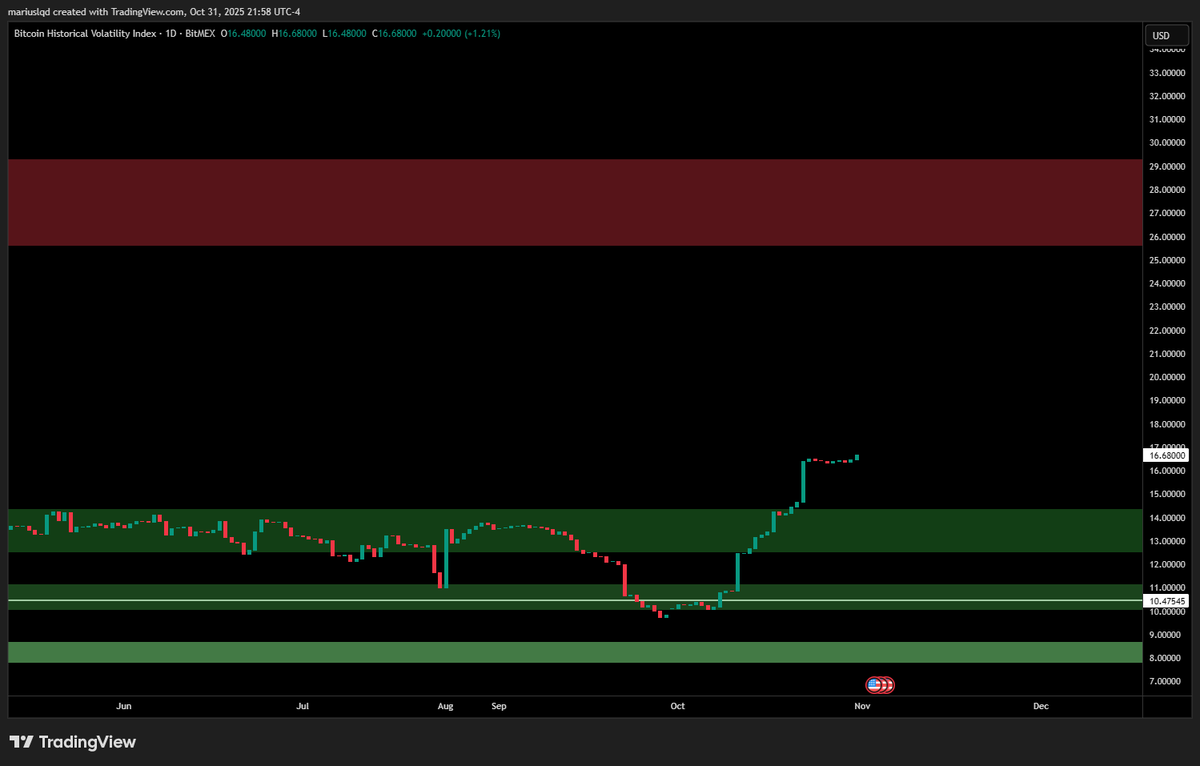
Bvol also just started moving and has decent room for expansion!