A French engineer who lives quietly in Paris has spent 30 years writing software that the entire internet now runs on without knowing his name.
He wrote the code that streams every YouTube video, every Netflix show, every TikTok clip. He wrote the code that runs the virtual servers underneath AWS, Google Cloud, and Microsoft Azure. He calculated more digits of pi than anyone in history. He has no Twitter. He has no marketing. He just keeps shipping.
His name is Fabrice Bellard.
Here is the story, because almost nobody outside the systems programming world knows what one man has built.
Fabrice was born in 1972 in Grenoble, France. He studied at École Polytechnique, the top French engineering school. He never went to Silicon Valley. He never built a startup empire. He just wrote code.
In 2000 he started a project called FFmpeg, an open-source multimedia framework for encoding, decoding, and streaming video. He was 28. The project did one thing nobody else had done well. It handled every video and audio format that existed, in one library, on every operating system. He led it himself for years.
Today FFmpeg is the invisible engine of the internet. YouTube uses it. Netflix uses it. VLC uses it. Chrome and Firefox use parts of it. Every Android phone, every iPhone, every smart TV, every video editing tool you have ever touched runs FFmpeg somewhere underneath. If you have watched a video on a screen in the last 20 years, Fabrice's code processed it.
He was not done.
In 2003 he started QEMU, a machine emulator and virtualizer. He wrote it solo until version 0.7.1 in 2005. QEMU lets you run any operating system on any other operating system. It became the foundation of modern virtualization. KVM, the Linux kernel hypervisor, runs on top of QEMU. Every major cloud provider, AWS, Google Cloud, Microsoft Azure, IBM Cloud, runs virtual machines on infrastructure built around it. The Quick Emulator is the most cited piece of cloud infrastructure code on Earth.
He kept going.
In 2001 he won the International Obfuscated C Code Contest with a small C compiler that grew into TCC, the Tiny C Compiler. TCC can compile and boot a Linux kernel from source in under 15 seconds. In 2004 he calculated the most digits of pi ever computed at the time, using a personal desktop computer and an algorithm he derived himself called Bellard's formula. In 2011 he wrote a complete PC emulator in pure JavaScript that runs Linux in your browser, a project called JSLinux that engineers still cannot believe is real.
In 2019 he released QuickJS, a small but complete JavaScript engine that fits where V8 cannot. In 2021 he released NNCP, a neural network based lossless data compressor that immediately took the lead on the Large Text Compression Benchmark.
Then he turned his attention to large language models. He built TextSynth Server, a web server with a REST API for running LLMs locally. He released ts_zip and ts_sms, compression utilities that use language models to compress text and short messages at ratios traditional algorithms cannot reach. He released TSAC, a very low bitrate audio compression system. In December 2025 he released Micro QuickJS, a new JavaScript engine for microcontrollers, separate from QuickJS, designed for environments with almost no memory.
Fabrice co-founded a telecom company called Amarisoft in 2012, where he serves as CTO. Amarisoft builds 4G and 5G base station software used by carriers and labs around the world. He has been running it for over a decade while continuing to ship personal projects from his own home page at bellard dot org
He has no Twitter. He has no Instagram. He gives almost no interviews. His personal website is a flat list of projects with no styling, no fonts, no marketing copy. Just titles and links.
A quiet French engineer who never moved to Silicon Valley wrote the code that quietly runs the internet.
He is still shipping.
🌀Agentic trades are now provable on-chain!
Using @aztecnetwork for Noir, @ZKVProtocol for ZKP verification, @primus_labs for zkTLS, we built a zero-knowledge proving system for @knidosxyz trading agent.
How did we achieve proving Knidos AI with ZK? 👇
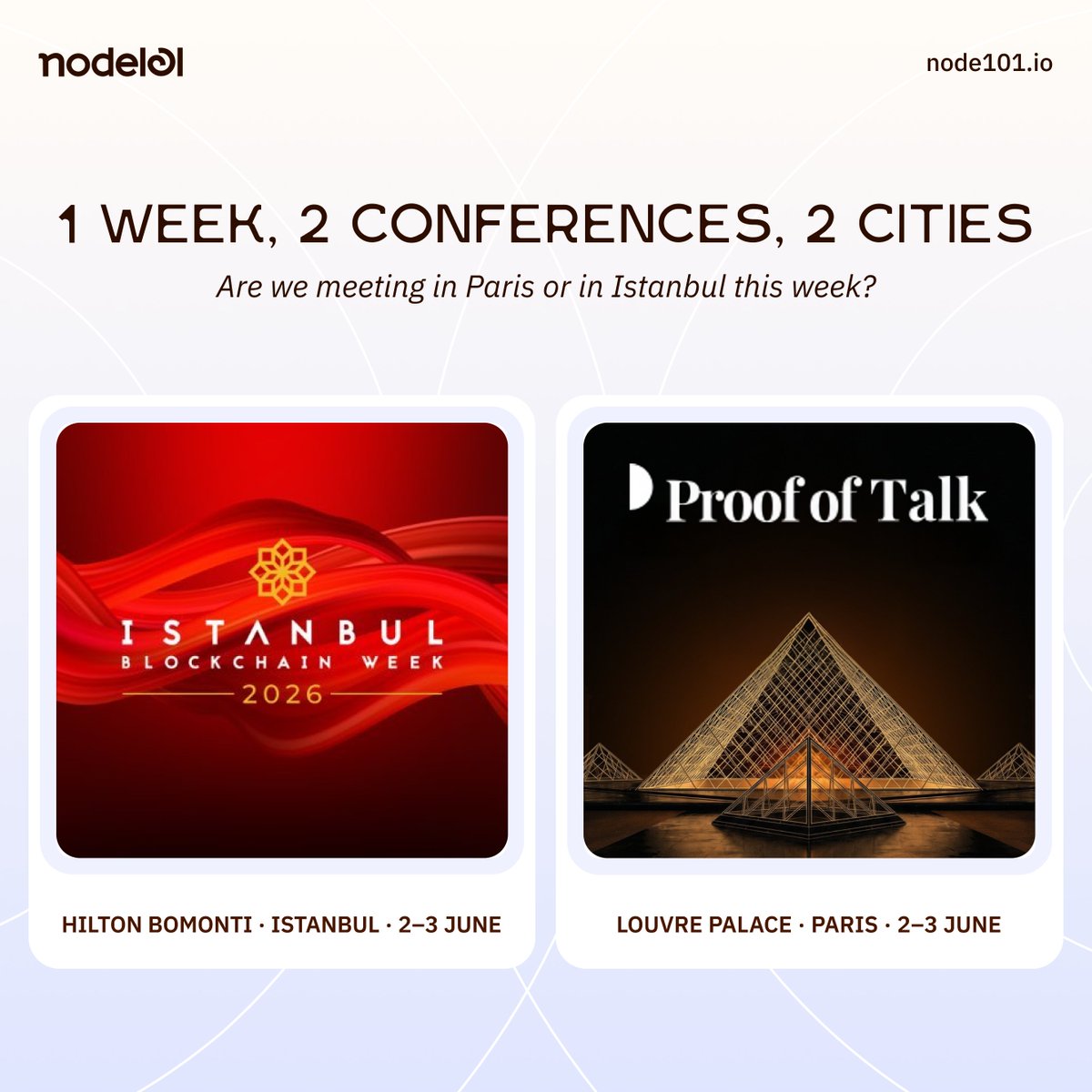
Let's meet in real life!
node101 is joining 2 events in the east & west capitals of Europe this week!
It seems that everyone thinks june 2nd was the perfect date for their event, which one do you prefer?
Blockchain developer ecosystem is growing,
probably faster than you think.
So far, 15.6 million commits
were sent to 722 thousand repositories
by 361 thousand developers
in the blockchain ecosystem.
How do we know the numbers?
We counted them one by one.
More soon.
The Hidden Peril:
Do you really verify ZKPs on blockchains?
This week, we discuss the dangers of ZKP verification in blockchains, and how this may have drastic results in the long run.
The problem is neither about costs, nor the soundness;
The very consensus behind may be at risk.
Did you hear the news?
Turkish Presidency Communications Directorate is now using IPFS and Ethereum to cryptographically secure their institutional archive 🥳🇹🇷
Don’t you know how you can use this data?
Use node101’s Ethereum RPCs to trustlessly access the archive and secure your connection to blockchain.
Let’s build something unordinary 🌀
Infrastructure is important, particularly for RPC highways that connect to blockchains.
node101 is an official infrastructure provider for @ParibuCom, delivering ultra low latency RPC services.
✅ <50ms Latency
✅ Regulatory Compliant Local Servers
✅ Powered by @HuaweiCloud1
Building the backbone of the Turkish #Web3 Infra
Reach blockchains with node101!
Thanks to our local infrastructure, we
1. protect you from Turkish regulation 🇹🇷
2. improve decentralization with real distribution 🌍
Don’t trust us, verify.
Try our RPC services now.
We keep asking "centralized vs. decentralized" when we should really be asking "where does the knowledge live?"
Wrote a new piece with @node_101 on the impossible dream of central planning and what it actually means for blockchain design.👇
Why does high APY always shrink?
In a low-commitment environment, "selling early" becomes the risk-dominant strategy. It’s the safer default when you can't trust the crowd to stay.
We break down how Nash Equilibrium eats your yield and why incentives force you to the exit.👇
Konuk sohbetlerimize kaldığımız yerden devam ediyoruz! 🎙️
Bu X Space’te @node_101 ekibinden @therealOG_101 ile birlikte:
🔸 BTC & BABY staking
🔸 Fırsatlar, riskler ve güvenli staking
konularını ele alıyoruz.
🗓️ 25 Aralık • 20:00
🎁 Ödüllü Q&A
https://t.co/nnAgySOWkq