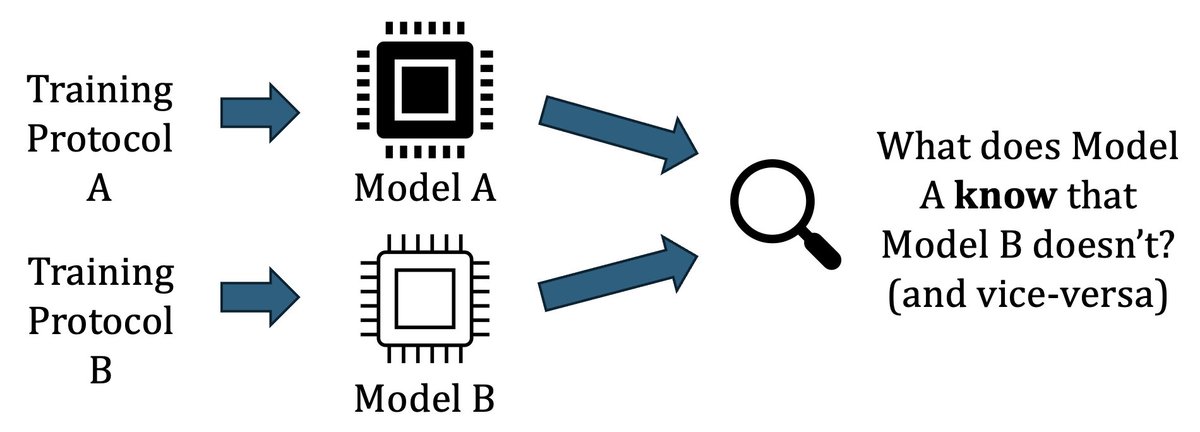
Excited to share our paper Representational Difference Explanations (RDX) was accepted to #NeurIPS2025! 🎉RDX is a new method for model diffing designed to isolate 🔍 representational differences. 1/7
LLMs are like Schrödinger’s cat: many possible trajectories, but you only see one outcome per run.
To really understand models, and debug where they go wrong, you can find the "forking tokens" that lead to different trajectories. Our new research does this 100x more efficiently!
We’re giving out $1M in grants of free Silico usage for academic and nonprofit researchers focused on AI interpretability and alignment.
We feel extreme urgency about advancing interpretability for alignment, and we want to help more researchers push it forward. 🧵
Are neural scene representations privacy-preserving just because the map is hidden in the weights?
In our #ECCV2026 "Seeing Through the Weights", we show that SCR models can leak 3D geometry and appearance of their training environments.
Project page: https://t.co/sgsatumDBm
Every human has millions of mutations in their genes. How do we know which ones are harmful?
@jaanakprashar built MAPS, a Mechanistic Atlas of Protein Sequences, explaining 2.1 million genetic variants — and asking not just *whether* a mutation is harmful, but *why* 🧵
I was lucky enough to get access to Silico called Silico last week and tried it out on a problem I’ve been wanting to tackle for while: H&E whole-cell segmentation.
The Visium / HD users out there can probably appreciate how important segmentation is.
1/
The dominant paradigm for VLAs today is to pair a pretrained VLM with a continuous action expert and connect them densely across depth through cross-attention or a shared prefix. But which parts of that interface actually carry the information that determines behavior ?
Silico is out🔥
General-purpose human motion AI models can meaningfully detect Parkinson's gait impairment. But how do they do it?? I used Silico to break these models open and figure out what about someone's walk actually drives their predictions. 🧵
Silico, the platform for ambitious AI research, is publicly available today.
AI is advancing fast. The tools to understand it need to advance even faster. Silico lets you interpret and train your models at frontier scale.
Learn more + get access 🧵
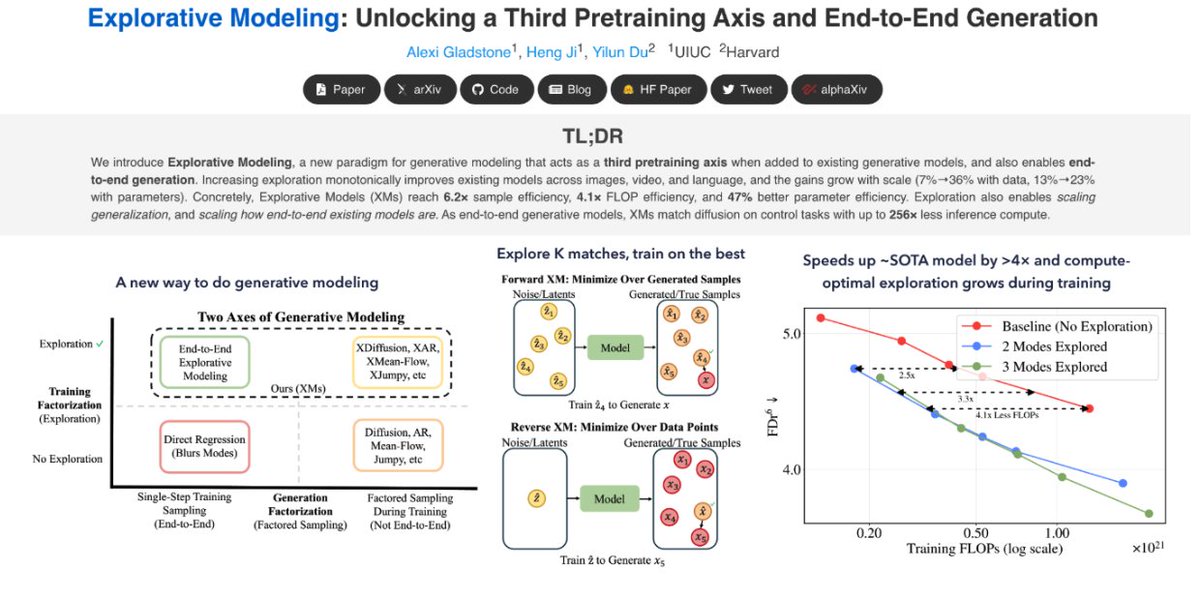
We discovered a third pretraining axis beyond parameters and data: exploration.
Scaling exploration monotonically improves existing models across images/video/language, and unlocks end-to-end generation.
In the simplest case, it's just a for loop.
Introducing Explorative Modeling.
TLDR:
- Gains from exploration grow with scale: 7%→36% as data scales, 13%→23% as parameters scale, and gains double at 3× the compute
- Adding exploration to ~SOTA baselines improves data efficiency by 6.2×, FLOP efficiency by 4.1×, parameter efficiency by 47%, and hits a near-SOTA 1.43 unguided FID on ImageNet
- Exploration lets you trade training compute for generalization, and scales how end-to-end your generative model is
- End-to-end Explorative Models (XMs) match diffusion performance on control tasks with up to 256× less inference compute
🧵Thread:
You ask an AI model a question. Why does it answer the way it does?
Using the model's own neurons, we can trace how it makes decisions — and steer it toward better ones.
Case study: we tested an LLM and found that it sometimes endorses drunk driving.🧵 (1/5)
In a recent hackathon, we trained an LLM to label its own neurons. But our RL run collapsed. 94% of labels opened with the word "texts."
Instead of reworking our data + retraining, we edited the weights directly - dropping “texts” from 94% to 5% with minimal side effects. (1/5)
3 months ago, we used interpretability to predict which of 4.2 million genetic variants cause disease.
Now, we've validated several of those predictions with real-world datasets, including a national biobank, clinical data, and RNA sequencing data.
4 examples: (1/6)
PCA reveals beautiful geometry inside a protein language model. But does the model actually use it?
I explored how protein folds—like this beta-propeller fold—are represented in ESMC-6B using the interpretability tools built into Silico, @GoodfireAI's research platform 🧵
> replicate J-space on GLM 5.2
> train a reward model and run RL to reduce hallucinations
> show me how this model makes cancer predictions
Using our platform Silico is like having a team of AI researchers ready to run experiments like these.
Private beta is open now. 🧵 (1/6)
Can LLMs predict the next World Cup champion?
Goodfire partnered with @EternisAI to improve how LLM forecasters use available evidence and manage uncertainty.
We found models were overconfident in their predictions – but probes significantly improved calibration. (1/6)
A Neural Sheet Discovers the Shape of Data
A self-organizing map (SOM) starts as a flat sheet of neurons with no knowledge of the data around it. For every input sample, it finds the best-matching neuron,
c = argminᵢ ‖x - wᵢ‖,
and updates that neuron together with its neighbours,
wᵢ ← wᵢ + η(t)hᶜᵢ(t)(x - wᵢ).
As the neighbourhood radius shrinks during training, the sheet gradually bends and folds onto the hidden geometry of the dataset while preserving its neighbourhood structure.
Developed by Finnish computer scientist Teuvo Kohonen, the Self-Organizing Map remains one of the most elegant examples of competitive learning, where order emerges from thousands of simple local updates.
#MachineLearning #ArtificialIntelligence #SelfOrganizingMap #NeuralNetworks #DataVisualization #Mathematics #ComputerScience #Finland #TeuvoKohonen
Neural CAs are amazing, but they've never scaled past low resolution.
We propose a simple solution that allows an ~8x resolution boost with minimal extra parameters.
The core idea: Treat cells as local neural fields instead of pixels.
Try the demo: https://t.co/Nnq8VFOGbB
🧵
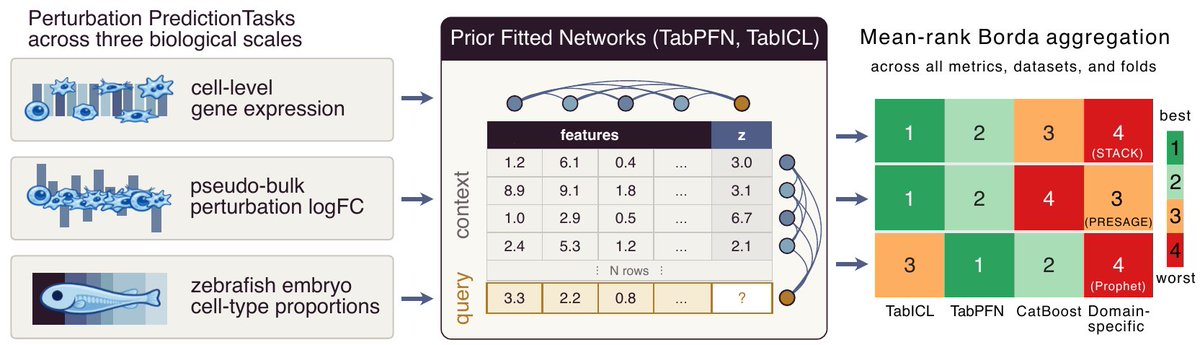
1/📢 New preprint! Do you actually need a biology-specific foundation model to predict how cells respond to perturbations? Surprising answer: a general-purpose tabular model - never trained on a single cell - matches or beats the specialists!
📄 https://t.co/nRvpH27djc
@biohub
excited to see what BSFs will unlock for science models!
early exploration finds subspaces that divide protein folds into subdomains. here's one in ESMC-6B showing a circle of subdomains within the ATP grasp fold