Build a company ontology without graph databases or proprietary models.
Just open-weight models and Postgres.
Open-source. No Anthropic and OpenAI
91% accuracy on LoCoMo and 79% on BEAM.
Agents work across increasingly large amounts of data, but don't understand how information relates and spend millions of tokens just reading files.
Cognee now connects GitHub, Slack, Linear, Notion, and 10+ other integrations with your agents or software factories and automatically builds an ontology of your company
It's:
- Free
- Runs on Postgres
- Uses small models to construct different memory elements
- Uses retrofitted embeddings to avoid graph databases
- Automatically builds an ontology
Here's how it works:
I fine-tuned 2 GLiDE models for a few dollars on previous festival line up posters and my Spotify listening history - I can now drag and drop new line ups as they drop and see if it fits with my taste and quickly generate playlists.
Try our training API today: https://t.co/JvQa4JUz8a
Technical Thread below
Introducing the GLiDE family: five open-weight decision models, from 0.4B to 27B.
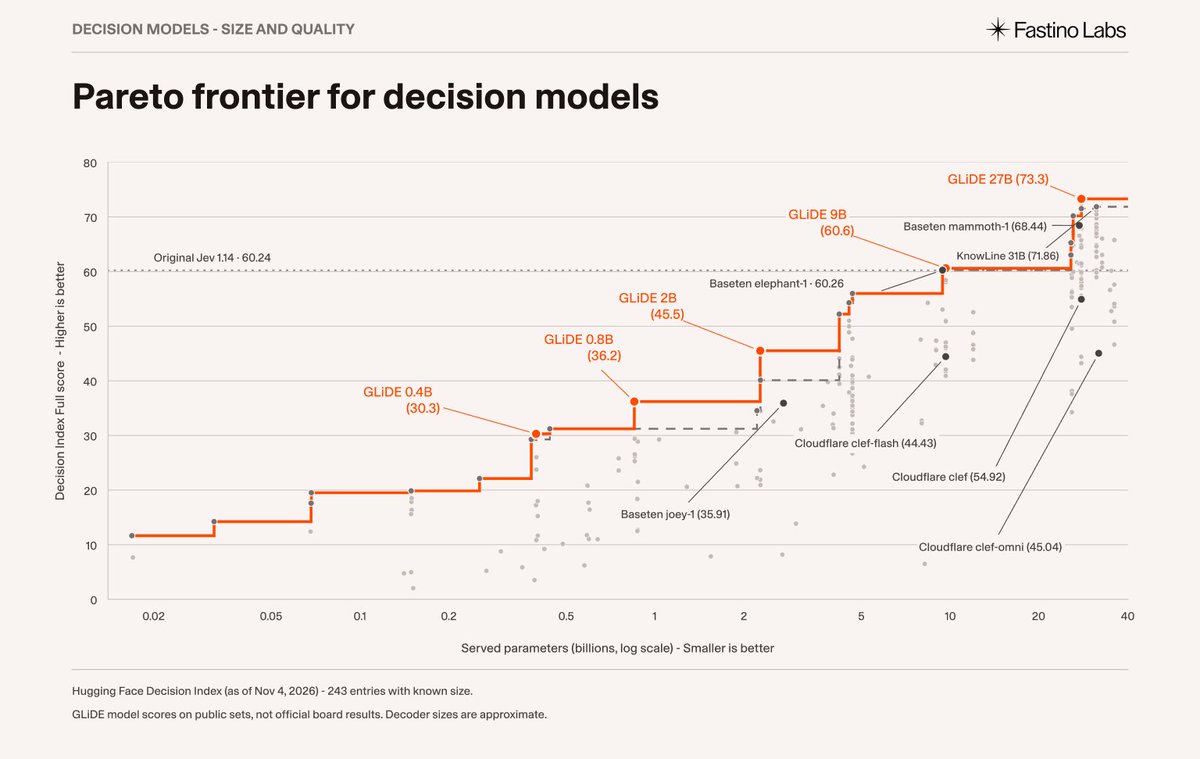
Together, they set a new Pareto frontier for decision models. On @huggingface Decision Index, each model is expected to score higher than alternatives with the same or fewer parameters in this comparison.
- GLiDE 2B: 45.5 vs. 40.11 for StartLux 2B (+13.4%)
- GLiDE 9B: 60.6 vs. 60.26 for Baseten elephant-1
- GLiDE 27B: 73.3 vs. 71.86 for KnowLine 31B, with approximately 11% fewer served parameters
Every model returns a choice and a probability for each option in one forward pass, with no reasoning tokens.
All five share the System One schema, so you can switch sizes without changing your questions or how you parse the answers.
Weights: https://t.co/Zm3mwqmvvt
API: https://t.co/vZ8enLvARJ
Blog: https://t.co/gz7iqRCAAY
Today we’re releasing the GLiDE family: five open-weight decision models, from 0.4B to 27B.
Together, they set a new Pareto frontier for decision models.
Most decisions inside an app don’t need a model that thinks out loud. They need a fast, clear, and calibrated answer. That's why we built GLiDE.
The part I’m most excited about is the recurrent depth in 27B and 2B models. Selected middle layers run twice, giving the model more computation before it answers without adding parameters.
On the Hugging Face Decision Index, GLiDE 27B is expected to score 73.3 vs. KnowLine 31B's 71.86, a 2% higher score with approximately ~11% fewer served params.
All five models use the System One schema. Test the same tasks across sizes, evaluate them on your own workload, and run the smallest model that meets your needs.
We release the first improvement to the lower bound on the unrestricted circuit complexity of 3-SAT. Central to P vs NP, 3-SAT is arguably the most intensely studied and foundational problem in theoretical computer science and one of the most for mathematics. Yet in the 50+ years since 3-SAT was defined, there has been not a single improvement to the lower bound on complexity of this problem. If you can improve the lower bound on 3-SAT enough, then you can prove P≠NP and resolve the Millennium Prize Problem. This is the first such improvement to the lower bound on 3-SAT in its history.
This is not to be confused with the upper bound on 3-SAT, which has seen consistent progress leading up to OpenAI's seminal work reducing the upper bound sufficiently to disprove the Exponential Time Hypothesis (ETH). However lower bounds have seen virtually no progress before our work.
Sanjeev Arora, a Princeton professor, and two-time Gödel Prize recipient, and Boaz Barak, a Harvard professor and ACM Fellow wrote in their complexity textbook: “Progress on general circuits has been almost nonexistent”. Lance Fortnow, an ACM Fellow wrote that “circuit lower bounds hit a brick wall”. Their expertise and textbooks, research and community leadership make these assessments useful historical context for why even improvements to linear lower bounds receive attention.
Our work has been formally verified in Lean.
Link: https://t.co/D6BvDcWaRc
Have you ever wondered “How do the top labs train a Frontier Model?”
Read this technical report I wrote on how we trained the Best Decision Model in the world (according to Hugging Face’s official rigorous rankings). https://t.co/CwwHNhtV9L
Keep in mind, that we did it with a fraction of the resources that the other brilliant frontier labs on the leaderboard have. They have made incredible models and deserve applause as well.
Official Jev Decision Index leaderboard: https://t.co/ti1BCdmQa4
Our newest decision model is the world's best decision model.
Introducing GLiDE v1.2, the #1 model on the @huggingface Decision Index.
With an overall score of 71.5, GLiDE v1.2 also has one of the lowest calibration errors on the entire Decision Index, meaning its confidence more closely reflects how often its answers are correct.
Beyond improved benchmark performance, it also adds support for multimodal inputs, enabling decision-making using text, JSON, and images.
We are excited to release the model weights on Hugging Face. For hosted inference, you can also run GLiDE v1.2 through the Fastino API at $0.04 / million input tokens.
Use promo code GLIDEIS1 for $10 in API credits.
Model weights: https://t.co/FQ8F2XM971
API: https://t.co/vZ8enLvARJ
Blog: https://t.co/7EeErLDqse
The best decision model in the world. GLiDE v1.2 is here (and it’s multimodal).
#1 on the @huggingface Decision Index, beating the next best model by 1.7 points.
The benchmarks are genuinely impressive:
- 71.5 full score
- 82 ms latency on NVIDIA RTX PRO 6000
- 1.9% calibration error on held-out decisions (one of the lowest on the index)
This model is smart, fast, well-calibrated, and open weight. Everything a good decision model should be. We’ve also dropped our pricing to $0.04 / million input tokens.
Try it today. Use promo code GLIDEIS1 for $10 in API credits.
API: https://t.co/f4dEil3Req
Weights: https://t.co/qwAETCoZcg
just updated the Decision Index to 0.4 🧭
what's new?
🛡️ curbing benchmaxxing: score now exclusively made from private & in-house benchmarks
🔒 stronger private benchmarks on new domains
🏆 224 models evaluated, new top models in all sizes
come play 👉https://t.co/Su4OXqJwz0
You can now post-train Qwen3.6-35B-A3B with the Fastino Training API. Here are 3 ideas for what you can build:
Decision model → FT on context-plus-options pairs labeled with the correct choice. RL rewards picking the right option with well-calibrated confidence in a single short answer.
Text-to-SQL analyst → SFT on question-to-query pairs for a specific database schema. RL runs each query and rewards an exact match with the correct result set.
Fast reasoner that thinks less → SFT on concise reasoning traces for math or code. RL rewards correct answers minus a penalty for thinking tokens, so it gets cheaper while maintaining accuracy.
Training API: https://t.co/vvM2QxBEVJ
@NirantK Thanks for thinking of us! It’s been great to see all the attention on these models and we’re all for more of them coming into the ecosystem. On our side, we recently released GLiNER2.5Decide, which just passed 100k downloads. Let us know what you think! https://t.co/40fZYQUFR0