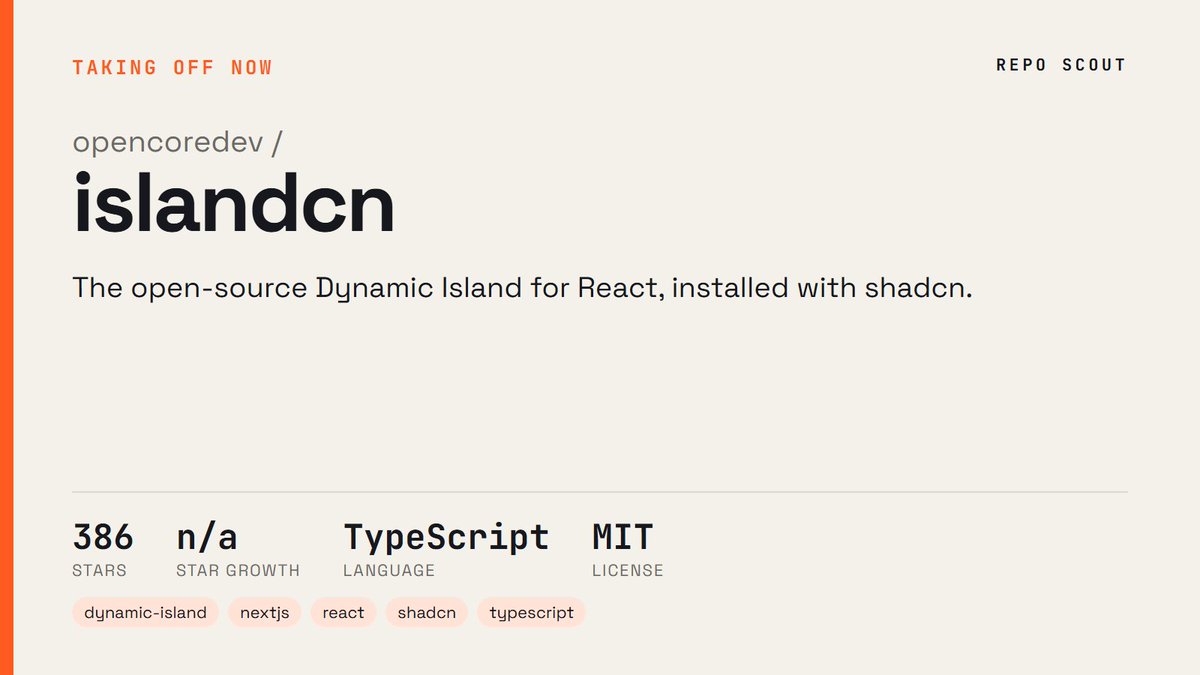
islandcn is a Dynamic Island-style component for React that you add with the shadcn CLI. Its springs were fitted to frame-by-frame recordings of Apple's real island, and the repo sits at 386 stars.
The API in the README is small. Mount IslandProvider once near the root, then call island.start() from any component with compact and expanded content, update() it as an upload moves, and end() it. A playground builds an island from a preset and copies the code.
The recordings behind the motion aren't in the repo, so the page that compares the web side against them is empty and its one test is skipped. I'd take the fidelity on trust for now. MIT, React only.
https://t.co/vDcXaTp7jI
Modern Web Guidance puts curated notes on modern web APIs and browser compatibility data into your coding agent's context, so it reaches for native dialogs and popovers instead of bloated JS. The Chrome, Edge, Firefox and MDN teams steward it.
This is the source repo, with the authoring and eval code. The cheapest test needs no install. Run npx modern-web-guidance@latest legacy-scan . in a project and see what it flags.
https://t.co/VD9afbil1D
chat-demo, a new repo under the deepseek-ai org, is a full chat client that ships as static files. Unzip a release, double-click index.html, add your API key, and the browser talks to the DeepSeek API directly. It has 407 stars so far.
It does more than most demos. You can edit a prompt and switch between message branches, and replies render KaTeX math and Mermaid diagrams. Your key sits in localStorage and conversations in IndexedDB, with no server of its own in between.
Don't expect to point it at any endpoint. It calls deepseek-flash through Anthropic-compatible Messages and Files APIs and adds extensions for search and link reading. The README says the configured service has to support those.
Going by the README alone, it looks like a solid reference client to fork if you build on the DeepSeek API. MIT licensed.
https://t.co/UhygjScHG7
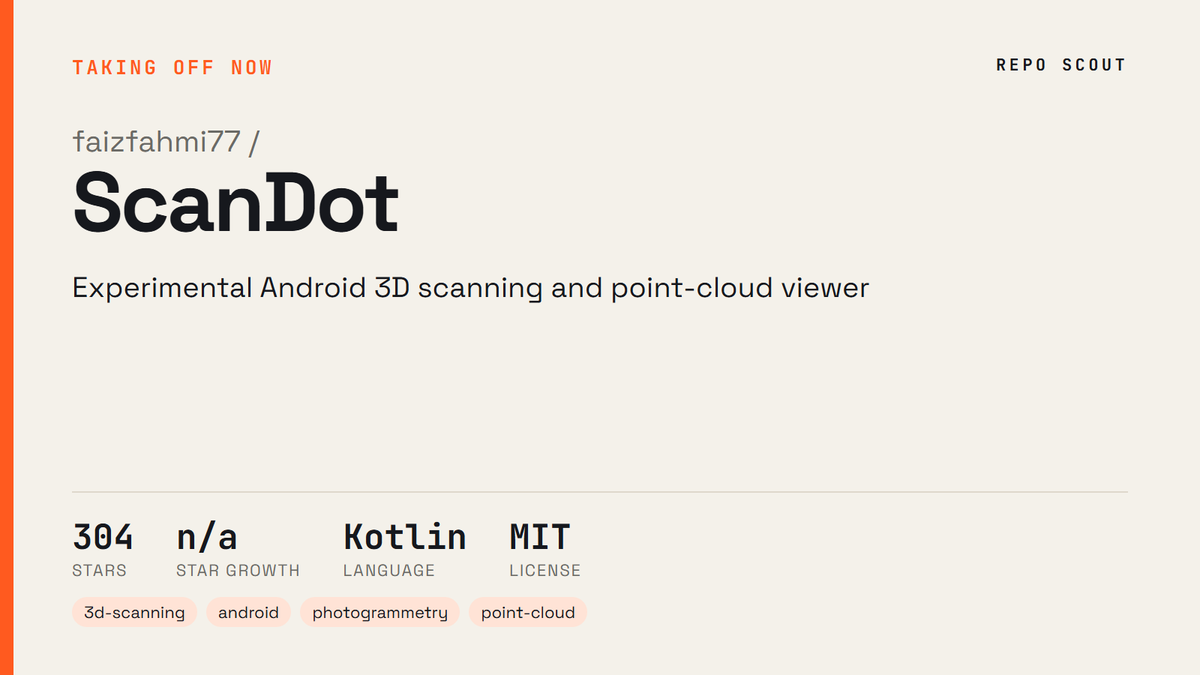
ScanDot is an experimental Android app that captures 3D point clouds on phones with ARCore Depth support. It pairs ARCore camera tracking with depth estimates, keeps scans on the device and opens them in an interactive viewer. Kotlin, MIT, 304 stars so far.
The README is careful about scope, and I trust it more for that. The phone app does not run photogrammetry on ordinary video. That job belongs to a separate Python pipeline on a workstation, which prepares frames with FFmpeg and runs a sparse or dense COLMAP reconstruction.
Building the app takes JDK 17, Android SDK 36 and a device with ARCore Depth. From android-app, run ./gradlew assembleDebug lintDebug testDebugUnitTest. A preview APK exists too, though its release notes mention compatibility and signing limits.
I only read the README, which calls this an early prototype. Expect gaps and drift, no textured meshes or validated measurements, and uninstalling wipes your scans. A small, honest base to build on.
https://t.co/mJUFsPSQCU
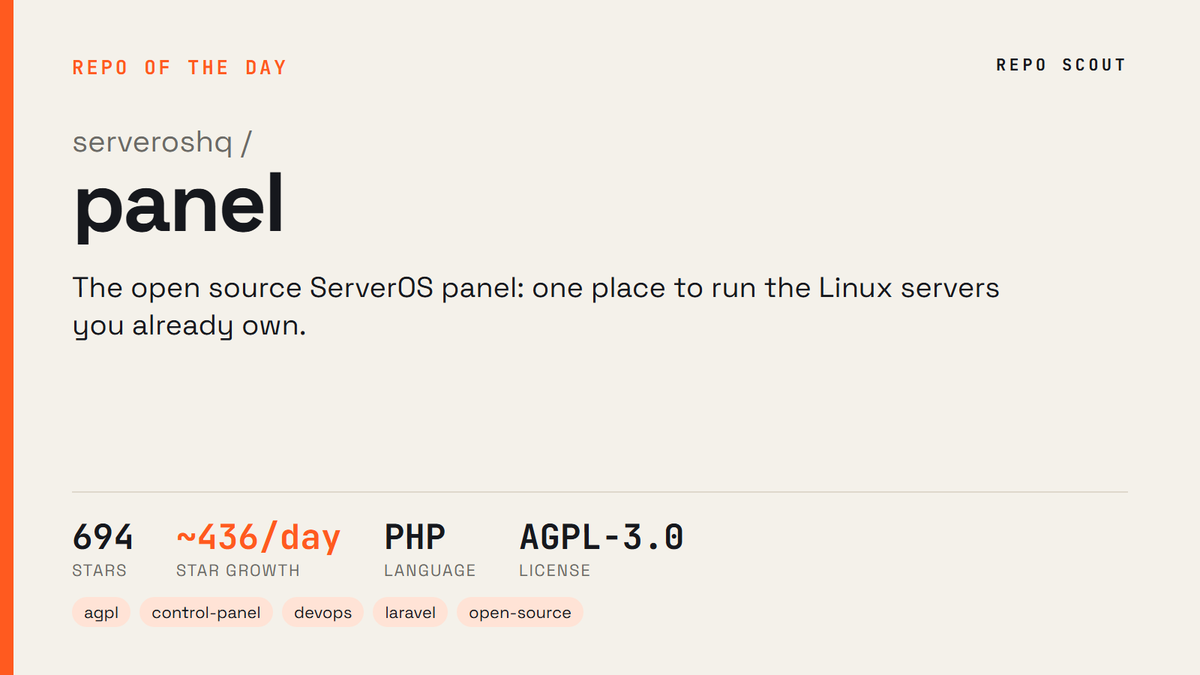
ServerOS panel is a self-hosted web app for the Linux servers you already rent. You connect a VPS from any provider with one command, then deploy apps and databases to it from a browser. The servers stay with your provider, on your account.
Each machine runs serverosd, a small open source daemon that connects out to the panel on port 8443. Servers dial in rather than waiting to be reached. I've only read the README, and it doesn't spell out what the daemon is allowed to do on the box.
Deploys come from Git or a template, with domains and HTTPS. The feature I'd use first is copying a project to a test environment before it goes live. There's also an MCP server and an API, so your own scripts and assistants can work with the servers.
Self-hosting needs a Linux server with Docker, ports 80, 443 and 8443 open, and a domain with two A records, one of them a wildcard. A single curl script installs it and prints a setup code you enter in the browser.
This is open core. Building from the repo gets you the AGPL community edition. The official image adds panel-ee, which stays off until you add a license key; the key turns on SSO, SCIM and other paid features. The company also runs the same panel as a hosted service.
It also sends an anonymous daily ping, and the docs say how to turn it off. Stars are arriving at roughly 436 a day, but I'd put it on a spare VPS before production.
https://t.co/qvOQRHJIri
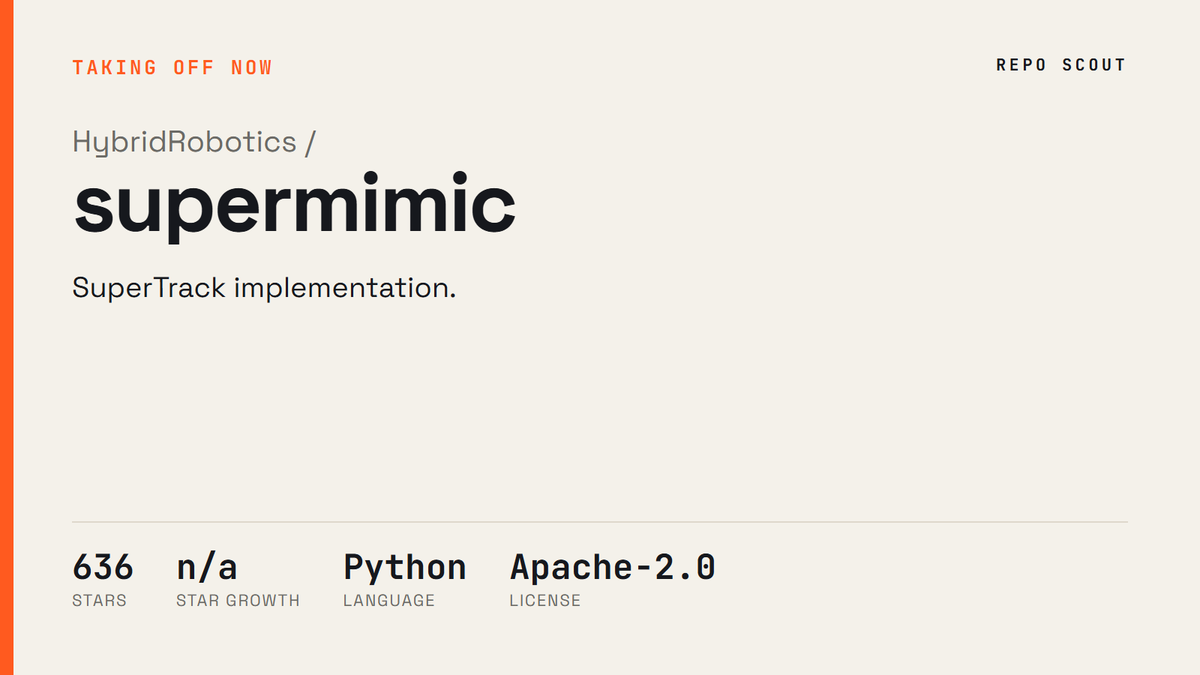
SuperMimic is a new open implementation of Ubisoft's SuperTrack, built on mjlab. It trains a learned world model and a policy that mimics motion data. The repo is already at 636 stars.
Two tasks ship, both for the G1. One describes the body in generalized coordinates and the other in maximal coordinates, and you choose between them with the task ID. A single https://t.co/ZyhRlXgyOn run fits the world model and the policy together.
Setup needs uv and two clones side by side, SuperMimic plus a research copy of mjlab it depends on. Training expects a CUDA GPU. Playback loads a trained model from a Weights & Biases run path.
I've only read the README, and it shows no results, videos or notes on where the motion data comes from. Treat this as research code for people already working in mjlab. Apache-2.0.
https://t.co/eozuQ59Mvf
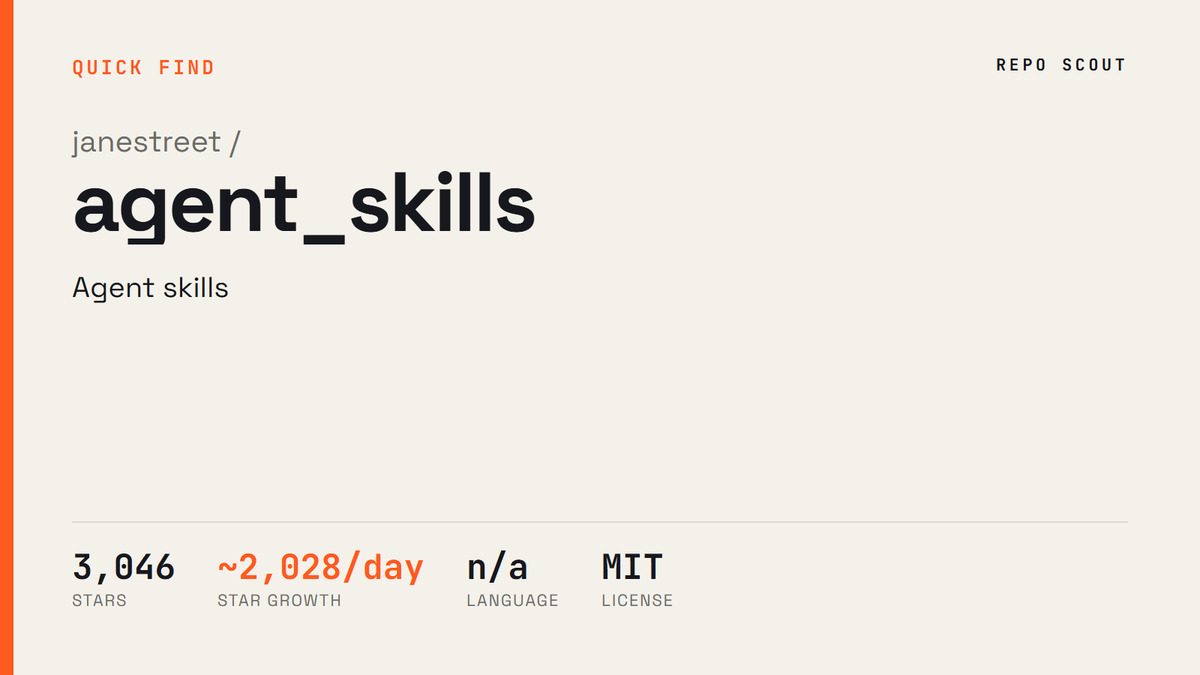
Jane Street's new agent skills repo holds one skill so far, socratic-tutor. It makes an LLM act as a strict tutor that asks one question at a time and scores you on levels 0-5. It is picking up about 2,028 stars a day lately, by our estimate.
The whole skill is one SKILL.md you can also paste into a plain chatbot. MIT licensed. How well it teaches depends on your model, so test it on a topic you already know first.
https://t.co/RZj25B1bTo
ha-mcp is an MCP server with 87 tools that lets Claude, ChatGPT and other clients build and change a Home Assistant setup, not only flip switches. It is picking up about 792 stars a day.
Home Assistant already ships its own MCP Server integration. That one runs on Assist and only sees entities you exposed to Assist. ha-mcp reaches everything, creates and edits automations, scripts and scenes, and can debug an automation from its traces.
The permission design is the part I like most, going by the README. With ENABLE_TOOL_SEARCH=true, tool calls go through separate read, write and delete proxies, so a client can auto-approve reads and confirm deletes. It also spares small local models all ~87 schemas.
The preferred install is the HA-MCP integration from HACS, which runs the whole server inside Home Assistant 2026.8.0 or newer. Setup ends with a connect URL you paste into your client. A separate host can run it with uvx ha-mcp@latest instead.
Every call runs with Home Assistant admin rights, so a wrong instruction changes real config. The README recommends a separate local-only admin account over your own token, plus a /readonly endpoint suffix for agents. File and YAML editing is still beta.
MIT licensed. Worth an evening if you write automations by hand and lose time digging through traces when one breaks.
https://t.co/rWH8wf8eQv
Erosion-CN is a Simplified Chinese fork of Erosion, an iOS toolbox for reading and editing the MobileGestalt device cache. It claims full support for iOS 27.0 to 27.2 and the 27.3 beta 1.
The main reason to look is a persistence fix. Per the README, upstream saved edits through a temp-file replace, which broke the cache file's inode and _mobilegestalt ownership, so iOS rebuilt the cache on reboot. This fork overwrites the file in place by default.
Installing means sideloading Erosion_v0.5.2_zh-Hans.ipa with a signer that keeps or injects an App Group entitlement, such as SideStore or AltStore. Building it yourself takes a Mac with Xcode 26 or 27.
I've only read the README. On iOS 26 the sandbox blocks MobileGestalt writes, the UI is Chinese only, and the author says to back up over a computer first. GPL-3.0.
https://t.co/6N4iahkTGM
GestaltX is a SwiftUI app that edits MobileGestalt, the file of device capability flags, on iPhones and iPads running iOS 27.x. It has 2,592 stars and is adding roughly 4,472 a day by our estimate.
Most of the attention is on the region code switch. Picking United States sets RegionCode to LL, and the README says that alone is usually enough to try enabling Apple Intelligence. There is also a raw field editor for anyone who wants to change keys by hand.
The backup handling looks careful on paper. It saves a copy before every write and records the original values, so reverting a preset puts back the old values and types and removes keys that were not there before.
It ships as an ad-hoc signed IPA that SideStore or AltStore re-signs. The app and its share extension need at least one common App Group, so keep the extension when you sign. iOS 26.x is not supported for on-device access.
A flipped flag may do nothing, since the README says effects depend on the device and OS. It also warns that edits can force a device restore, so back up first. GPL-3.0.
https://t.co/7VVarybjJb
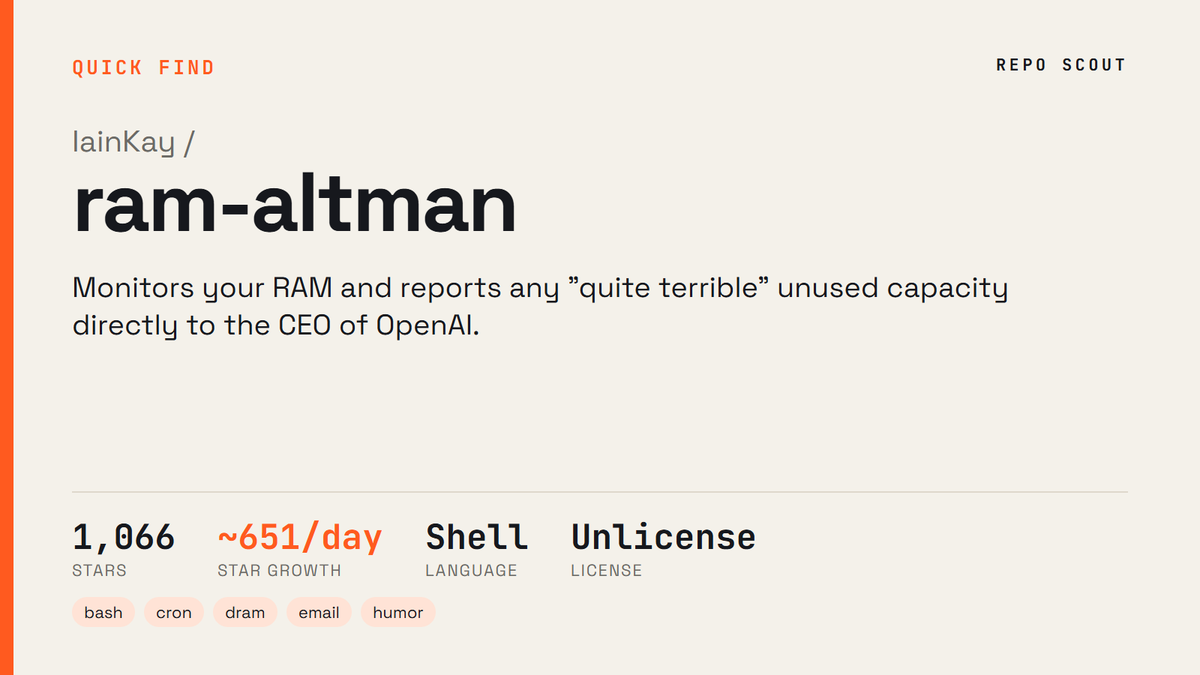
Ram-Altman is a parody bash script that sends one email a day whenever more than 10% of your RAM sits available. It's a reply to Sam Altman calling personal DRAM "quite terrible" for global allocation, and it's picking up roughly 651 stars a day.
The memory math is real (used = MemTotal minus MemAvailable, read from /proc/meminfo), so it's Linux only. No recipient address ships with it, and ./ram-altman.sh --dry-run gets you every joke without filling anyone's inbox.
https://t.co/u6es5YCgLV
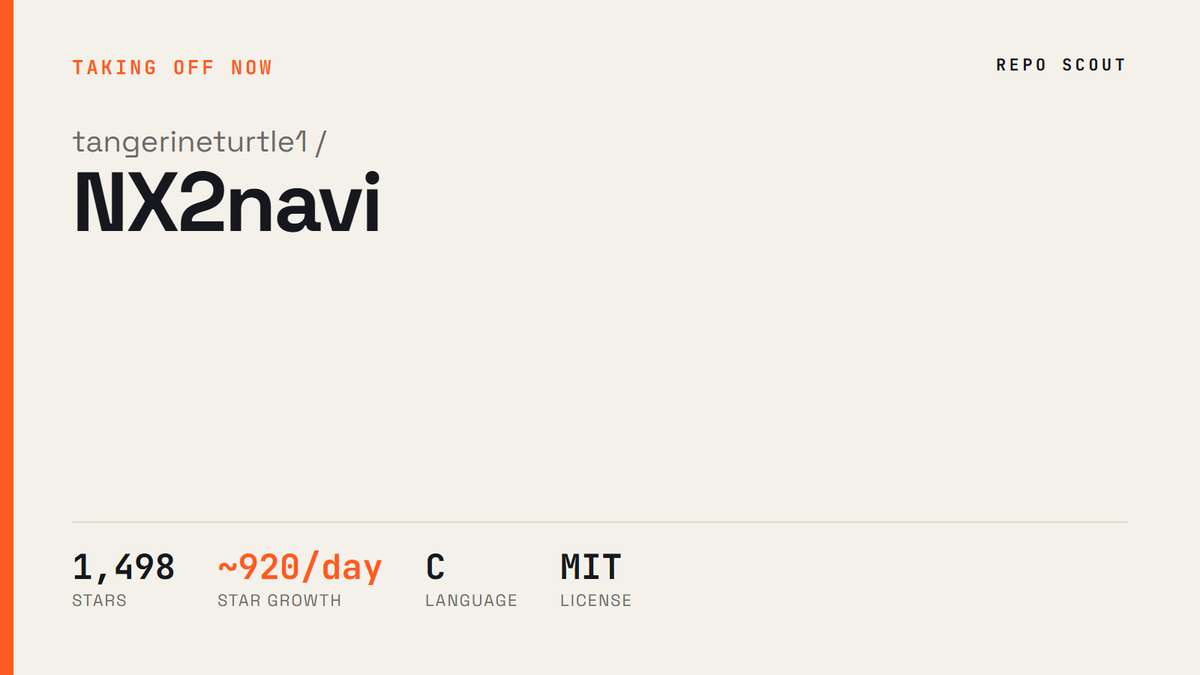
NX2navi is a static recompilation of Ocarina of Time, the Switch 2 release (version 1.1.1), into a native x86-64 Windows app with a Vulkan renderer. It runs native code, not an emulator. The repo is picking up roughly 920 stars a day.
It ships no game files. The setup sits next to your own .nup dump, and its launcher builds the game on your PC in 10 to 25 minutes, once. The README calls it early but playable, with Kokiri Forest and Kakariko running at 60 fps and up.
You need Windows 10 or later, 16 GB of RAM, about 30 GB free for the game, and a GPU with Vulkan 1.3 and mesh shader support.
Two things in the README to weigh first. The setup is unsigned, and despite the MIT label on GitHub, only the base import is MIT. The project's own additions are all rights reserved.
https://t.co/H0APh51rWJ
S2Arm rewrites the ARM64 code of Switch games at build time so it runs directly on an iPhone, iPad or Apple silicon Mac, with graphics calls translated straight to Metal. There is no CPU emulator in between. It sits at 760 stars so far.
The README's benchmarks come from a 16 GB M3 MacBook Air. A cold build of Diablo III for iPhone takes 6.4 min, Tears of the Kingdom 34 min. On an iPhone 17 Pro Max, Ocarina of Time runs at 60 fps while cool and 37 to 43 fps once it heats up.
You need iOS or iPadOS 18, or an Apple silicon Mac on macOS 15. Builds run from a Mac or Windows launcher, you bring your own keys and games, and you sign with your own Apple ID. Every game lands in one app, so the library costs a single signing slot.
Those are the author's numbers, and I've only read the README. 32-bit games won't work because Apple silicon can't execute 32-bit ARM code, and no games or keys ship with it, so sourcing them legally is on you.
https://t.co/a9FZIwzqaF
A front-loading washing machine in 38 lines of Python, each part named and four joints saying how they move. That comes from one of this week's underrated repos, all listed below. I went by the READMEs and have not run any of them.
sand3d writes 3D objects as short Python programs over Blender's bpy, built for an LLM to write. The whole API fits in a prompt at about 3,600 tokens. One export call writes GLB or URDF, with the file extension picking the format.
https://t.co/YZdoJ6iIxL
cinecode has an AI coding agent write a film's script and build every frame in code, then hand you an MP4. It runs locally in Claude Code or Cursor. Every frame of its demo reel came from code rendered in headless Chrome.
https://t.co/R9AxuY0sgy
From a Mac, Poki lets an AI agent operate a real iPhone through a local MCP server, with no jailbreak. The README warns plainly that it will send messages or make payments if asked, and screen contents go to your model service.
https://t.co/UL3PUtWaUa
Before guarding anything, Stroq reads your past Claude Code and Codex sessions and counts the commands that came from text the agent read, plus which keys left your machine. Its hooks can then deny curl | sh in the next session.
https://t.co/XEMT5yTOkA
OmniDiff is a content-aware diff written in Rust. Where git only says a PDF or web font differs, it shows which page or glyph changed. On code it marks just the changed parts of a line instead of whole lines.
https://t.co/l8qgz20xzt
Two things to check first. Poki's physical iPhone support is verified only on iPhones using the Chinese interface. OmniDiff's README shows an AGPL badge while GitHub lists a custom license, so read its terms before you depend on it.
If you open only one, try OmniDiff, since it already ships prebuilt binaries and plugs in as git's external diff.
Hookshot is a static recompilation of the Switch 2 Ocarina of Time remake that runs the game natively on Windows and Linux, with no emulator. It is picking up roughly 1,232 stars a day (estimate).
A Python script translates the game's ARM64 code to C, which is compiled with a layer that stands in for the console's system. The NVN2 graphics calls are recorded and replayed on Vulkan. You build all of it from your own copy, and a build takes about 40 minutes.
You need a GPU with Vulkan 1.3 and mesh shaders, plus 16 GB of RAM. The build wants about 60 GB free and accepts exactly one game version, build e0f3ccfa. The repo ships no game files or keys.
I've only read the README, which calls it experimental. It was tested on one PC, mostly near the start of the game. Hyrule Field onward and AMD or Intel cards are untested. GPL-3.0.
https://t.co/sTECjAVue7
Three open-source support desks describe themselves as alternatives to Intercom, and one of them counts another as a target too. Libredesk calls itself "A lightweight alternative to Intercom, Zendesk, Chatwoot."
Chatwoot, a Ruby app around since 2019, puts website chat and email in one inbox along with messaging channels such as WhatsApp. It also ships a help center portal and an AI agent, Captain, for routine questions.
https://t.co/XjFoHIs9mN
Libredesk is one Go binary. Running ./libredesk --install sets up the Postgres database, and it then serves email and live chat, plus WhatsApp through the Meta Cloud API. SLA targets warn you about conversations close to breaching.
https://t.co/UoIi33Zvgw
DeskcommCRM is a TypeScript CRM for businesses that sell over WhatsApp, with AI agents that answer and qualify leads. One installer brings up the whole CRM, WhatsApp included, on a Docker VPS, with 4 GB of RAM recommended.
https://t.co/dYsCrOBdGb
Check licenses before switching. GitHub doesn't match Chatwoot's to a standard one, though its README says MIT, and Libredesk is AGPL-3.0. DeskcommCRM dates from April 2026, and its main README is in Portuguese and built around a HostGator partnership.
I've only read these READMEs, not run them. For a small team I'd start with Libredesk, since one binary and a live demo make it cheap to evaluate.
We're giving away a Hogwarts Legacy custom wrapped NVIDIA GeForce RTX 5090 to celebrate its official release with DLSS 5 🪄
To enter:
🟢 Share this post
🟢 Comment #RTXON
Terms and Conditions: https://t.co/45T3R732hf
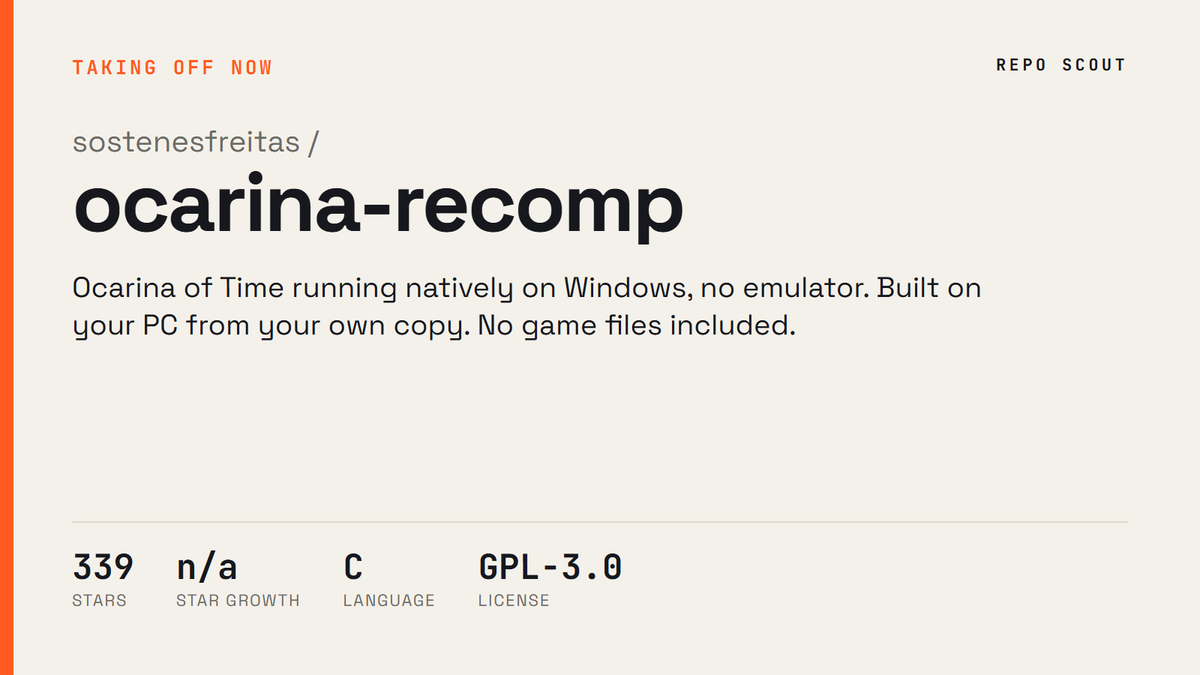
Ocarina Recomp translates the ARM64 code of the Switch 2 Ocarina of Time into C and compiles it as a native Windows program, with no emulator. You build it on your own PC from your own copy. The repo ships no game files.
The graphics path is the clever part. A runtime converts the NVN 2 calls to Vulkan, and the Switch 2's Ampere shaders get lowered to Maxwell, then translated to SPIR-V by a patched Ryujinx.
Going by the README, you need 64-bit Windows 10 or 11 with AVX2, a Vulkan 1.3 GPU with mesh shaders, and the game at version 1.1.1 exactly. The ZIP installer wants 40 GB free, and the build takes 30 minutes to 2 hours.
The author marks it experimental. It was tested on one PC with an RTX 5090, only up to the Deku Tree, and AMD and Intel cards have never been tried. GPL-3.0.
https://t.co/mj8IKsMiBE
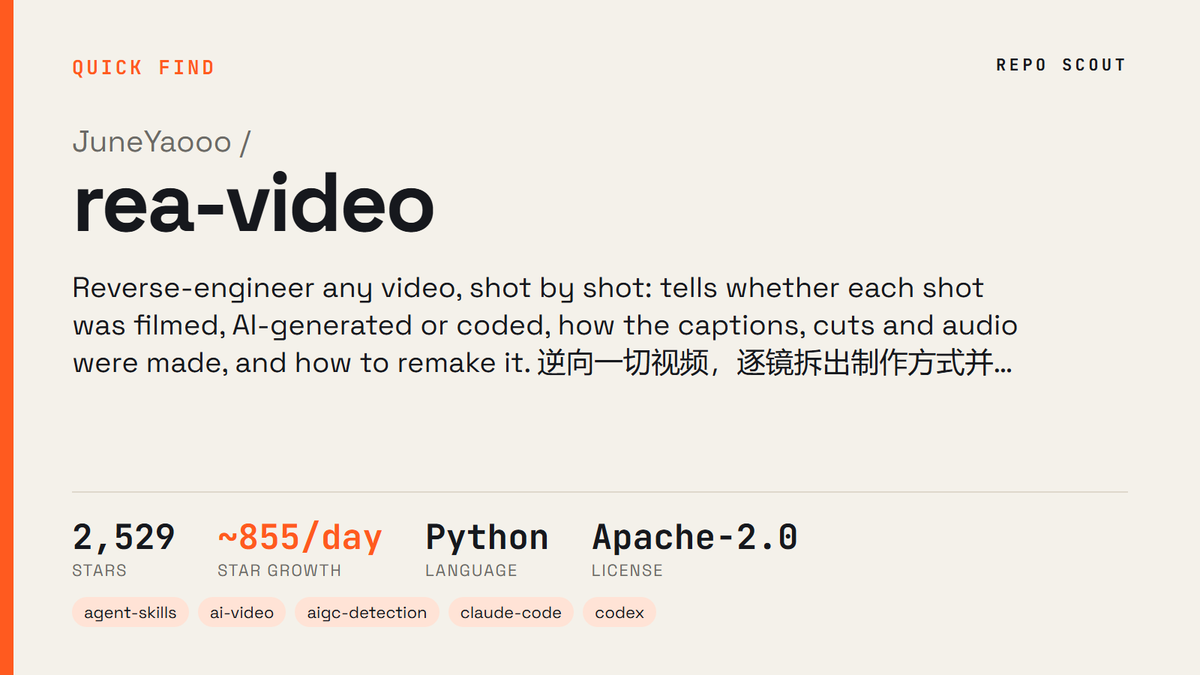
rea-video is a Python skill for Claude Code and Codex that breaks a video down shot by shot into filmed, AI-generated or coded, then writes a remake plan. Its demo calls a phone-shot TikTok ad all live footage, and an AI remake of it 8 shots doable in 3 generations.
Platform downloads are the weak spot. On a recompressed unboxing clip the offline tools called 35% of it AI, and agent review brought it to 97% live-action. Apache-2.0, and the deeper docs are in Chinese.
https://t.co/DIw6ZS7tyY by @yao_june12106