10 legendary investors. Their biggest lesson, one sentence each.
1. Nick Sleep: Find businesses that share their scale advantages with customers, then give the flywheel decades to work.
2. Warren Buffett: Buy a wonderful company at a fair price and let time do the compounding.
3. Charlie Munger: Avoid obvious stupidity, wait for the fat pitch, and sit on your hands.
4. Chris Hohn: Concentrate in a few exceptional businesses and use ownership to make them stronger.
5. Bill Miller: Value is the cash a business will produce, not a low multiple — go where the crowd refuses to look.
6. Li Lu: Demand a margin of safety, then own businesses that can compound for a very long time.
7. Peter Lynch: Start with what you actually understand, then do the work most people skip.
8. Chuck Akre: Find a great business, great people, and a long runway to reinvest — then don’t interrupt it.
9. John Templeton: Buy at maximum pessimism, then let time prove the crowd wrong.
10. Mark Massey: Own a handful of exceptional businesses and do almost nothing else.
Notice how many of them need time: a holding period long enough for the investment to play out and for compounding to do its magic.
The goal of a sound investment process is to make positive expected value bets.
Expected value is a mathematical formula which factors in probabilities of success and the payoff (or write-off) if it materialises.
Probabilities of success are basically reliability. It means low variance, which also suggests the risk of an adverse outcome is very low.
On the other hand, payoff is looked at from an asymmetry or convexity point of view. Asymmetry suggests that losses are small, but when you win, it's a home run. Convexity means most attempts produce nothing, but if you hit one, it produces everything!
No single setup, opportunity or instrument gives you both the likelihood of success and very high asymmetry/convexity.
Anything marketed as giving you both is mispriced, misdescribed, or outright fraud.
The bears have been predicting the end of Adobe's $ADBE business for a while already, and they are getting louder and louder. It is definitely worth considering their point of view.
But it is also worth considering that extreme bearishness is the market consensus. It is expected by all and (mostly) baked in, but what is the variant perception?
Money is made by discounting the obvious and betting on the unexpected.
Stock prices influence us, and they do it way too much.
Whether we admit it or not, in the end, it is the price—and not the business performance—that determines whether we remain bullish or bearish on a stock.
Even if a business is performing well for years, while the stock price happens to be in a major multi-year downtrend, we will never feel comfortable until the P/L statement in our brokerage account is showing signs of green (profit/positive gains).
All the while, we will—sometimes entirely—ignore the fact that the underlying business might have been growing ever bigger intrinsic value.
In the end, we are way too influenced by what the stock price says. We think we have independent and original thoughts, but we really don’t.
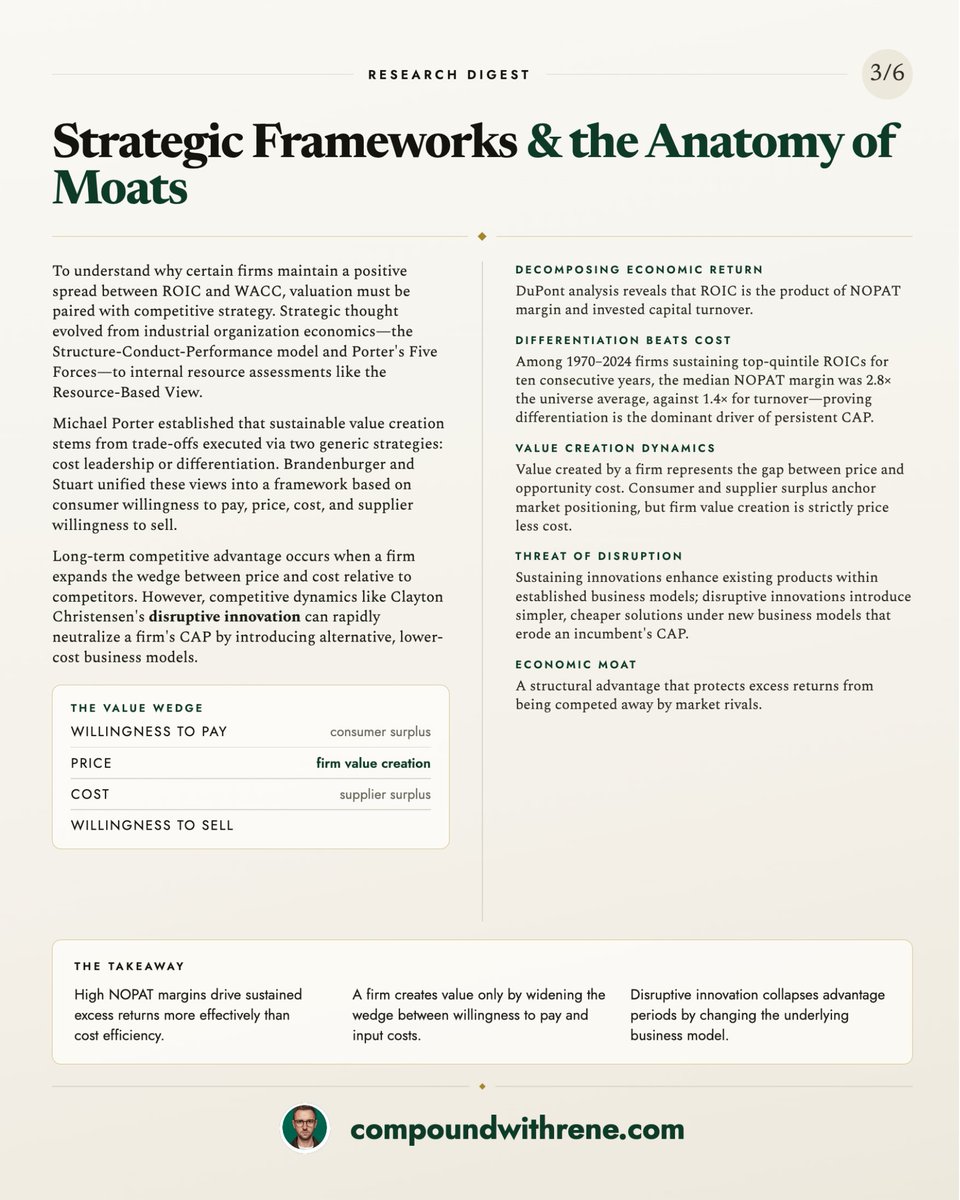
Michael Mauboussin’s 2026 paper “Competitive Advantage Period - The Neglected Value Driver” is a must-read for intelligent investors.
Key Takeaways 👇🏻
1/2
You’ve probably heard that investing is more of an art than science.
But have you heard anyone argue that investing is very similar to fine art?
Reading about the famous artists of the world, it got me thinking about the very close links to investing.
Here are just a few of my thoughts organised as bullet points:
1) In both investing and art, overdoing it ruins it. Less is more.
• In painting, there is a term known as "overworking" a canvas where a painter adds brushstroke after brushstroke, trying to refine a line or fix a detail, only to muddy the colours and destroy the energy that made the original sketch appealing
• Investing is not all too different as “overworking” manifests as analysis paralysis and overtrading (checking a portfolio daily converts noise into fake signal, leading to emotional stress and impulsive decision-making; spending 100 hours and thousands of word thesis analysing a complex business often creates an intellectual sunk cost, making you feel compelled to execute a trade l to justify the effort)
2) In both investing and in art, quality always comes over quantity. Dilution is the enemy of excellence.
• In art collecting, owning three museum-grade masterpieces will always outshine a gallery filled with fifty mediocre paintings—it’s as simple as that!
• This closely links to what Peter Lynch called “diworsification"—the tendency to add investments to a portfolio for the sake of sheer numbers until high-conviction ideas are diluted by mediocrity
• Artists do not use every colour in the wheel on a single canvas and the best ones often choose a very strict, intentional palette as this allows for clear boundaries, harmony within the sketch and directs the eye
• Similarly, a investor does not need to do everything; Warren Buffett’s famous "20-slot punch card" mental model suggests treating your career as if you only have 20 total decisions to make and you only make them on high-conviction setups—where the edge is clear and obvious
If you’re fixated on the latest quarter, zoom out.
If you’re fixated on the latest annual performance, zoom out.
Zoom out. Get your bearing right, and understand the long-term situation.
Always zoom out.
It is impossible to isolate influences. 👇🏽
Even the best investors cannot "black out" environmental influences in financial markets.
That is true because markets are fundamentally reflexive systems (totally opposite to passive processing).
Prevailing narratives, social sentiment, and price movements do not merely sit alongside market fundamentals—they actively alter them.
When a narrative gains traction or an asset's price surges, it changes participant expectations. But not only that—it shifts corporate behaviour.
It also dictates access to capital (open or closed borrowing windows), and generates feedback loops back into the underlying reality of the price itself.
Because market participants incorporate these factors, it is nearly impossible to block out the environment influences and the feedback loops they generate.
Under such conditions, how useful is your conviction? I would argue that flexibility, via Bayesian updating, is a far more effective tool.
Whether you like it or not, the environment will always influence you and you cannot sidestep it.
Strong priors (initial beliefs), weakly held.
Theory vs practice of sizing bets.
In theory, the bets that deserve the biggest size are those where your confidence is the highest. This is unsound theory, proven by real world practice (empirical evidence).
The old proverbial Wall Street saying describes how we hold too much of a stock that’s going up the least, and too little of a stock that’s going up the most.
This sad, unfortunate and ironic outcome happens to everyone. 😂
How can we improve our position sizing?
Intermediate investors make bets based on their conviction. Conviction is an internal process. The bets which get the biggest size in their portfolio are those where they have arrived at the highest confidence level. We should NOT do this, as it will result in undesirable outcomes due to bias and subjective perception.
Instead, great investors make bets based on the mispricing of the asset, commonly referred to as an edge. An edge is an external, situational condition. The bets which get the biggest size are those where the mispricing is the largest, irrespective of their subjective conviction.
Additionally, great investors are great Bayesian updaters. They will update their position sizing as the market moves and new information becomes available.
Currently, my biggest position is the one where I have average to below-average confidence. The interesting thing is, this stock is going up a lot while my other “higher conviction” bets are not yet moving. Therefore, only this stock also happens to be the one where I am buying more, as it is confirming the uptrend—after many years of a downtrend.
I’m fully aware that just because I am not super confident about it, I could be missing the bigger picture. It is possible for even the greatest of investors to miss objective reality because the way we analyse and interpret information is via subjective, biased perception.
If you cannot figure out whether a stock is a buy or a sell, you don't understand it and it’s outside of your circle of competence.
You should never invest based on other people's opinions.
You alone have to do the work, and while you're doing it, you have to sidestep as many biases as possible that might lead you to faulty conclusions.
Following other people and their opinions is just another bias (social imitation, conformity bias, and authority bias... like some fancy X investor with a lot of followers, myself included).
Unfortunately, that's not how markets actually work.
Having a moat doesn't automatically translate into a higher stock price.
An economic moat is a qualitative judgment call. On its own, it is always going to be insufficient.
Why?
Because stock prices do not respond to qualitative insights but to quantitative improvements.
Despite its moat, what Disney needs is excess returns on capital, which is the quantitative evidence. And it needs expanding ROC where earnings grow, but the asset base does NOT.
In plain English: just because a company has a structural advantage (for Disney, that's a moat built on brand intangibles) doesn't mean its management can actually convert that advantage into excess returns and growth.
What does that look like, financially speaking?
It would mean high-margin profitability growth (the numerator part of the ROC formula) without inflating the asset base (the denominator part of the ROC formula) or borrowing money to finance it.
Almost all investors gravitate towards revenue growth, earnings multiples and free cash flow generation.
Hardly anyone covers the balance sheet or the management team.
The balance sheet is the MOST crucial of the three financial statements. And the management is literally your partner, so shouldn't you know about them?
When you purchase a stock, you are getting two things:
1. The assets & obligations of the company
2. The people who run it become your partners
Interesting chart by @KoyfinCharts on LVMH rating (multiple ratio). Here is how investors should think about historical multiple ranges. 👇🏽
A common error in financial analysis is assuming multiples are a stationary data series.
What does that mean?
Stationary data assumes statistical concepts like the mean and variance remain constant over time. If true, they guarantee mean reversion and successful movement within the range.
In plain English, if multiples were a stationary indicator, it would guarantee that a lower bound should be considered "cheap" and vice versa for the upper bound.
However, the reality of multiple ratios is that they are a non-stationary data series because the underlying economic characteristics of the business and macro environment are dynamic.
They change over time.
LVMH is not the same company it was 20, 15, 10 or even 5 years ago. The further back in history we go, the more useless the historical multiple ratio is relative to today's reading.
Everything has changed.
Changes in interest rates, inflation or deflation conditions, corporate tax rates, the company’s geographic exposure, its balance sheet, the margins and returns on capital, growth rates... it has all changed.
These changes, and many others, have permanently altered the baseline of what the market is willing to pay for the company today versus a long time ago.
Buffett and Munger often cautioned against precise mechanical tools (such as any financial ratios, especially multiples). They always advised thinking far more qualitatively (considering the management decisions and the structural moat of the business) than taking two numbers and dividing them to get a magical answer on whether something is a buy or a sell.
If you ask "What is the moat?" you're priming yourself for misjudgement.
It is better to ask "Is there a moat, and if so, how can I prove it?"
Moats are often proved when they are under attack.
Almost all companies don't have moats and could not survive an onslaught of competitive attacks.
THE QUIET EDGE IN TRADING or BOREDOM ≠ INACTIVITY
If you’ve chosen trading as your profession and/or expect it to provide a meaningful share of your monthly or annual income, there’s something you need to understand:
If you’re often bored during the trading session, you’re probably doing it right.
Profitable trading is boring most of the time.
You don’t need to find trades every day, constantly buy and sell, or feel excitement, fear or urgency every time you look at the screen.
Your job is to wait until the market actually gives you a mathematical edge.
A professional trader can spend weeks or even months simply watching.
Because they understand one simple rule:
No trade is better than a bad trade.
If you’re constantly excited, scared, tempted, or looking for something to click, chances are you’re no longer trading your system – you’re entertaining yourself with your own money.
There’s a casino for that.
It’s prettier, and the food and drinks are free.
Boredom in trading is a good sign.
It means you’ve stopped looking for action and started waiting for an edge.
Continued ↓
Michael Mauboussin has identified five critical behavioral traps that systematically distort human judgment, particularly in market forecasting and valuation:
1️⃣ Relying Too Much on the "Inside View" (Ignoring Base Rates):
Decision-makers tend to focus heavily on unique internal details, personal intuition, and optimistic projections while ignoring historical baseline statistics (the "outside view") from similar past reference classes.
Remedy: Use reference-class forecasting to establish a realistic baseline before adjusting for specific project details.
2️⃣ Ignoring Reversion to the Mean:
People frequently assume exceptional outperformance or underperformance will persist indefinitely, underappreciating that outcomes revert toward average over time when luck is involved.
Remedy: Evaluate where a task sits on the luck-versus-skill spectrum; higher reliance on luck means faster mean reversion.
3️⃣ Overconfidence:
This trap shows up as overestimation (believing you can perform better than you can), overplacement (believing you are above average), or overprecision (setting confidence intervals that are far too narrow).
Remedy: Test individual calibration and intentionally widen probability ranges to reflect genuine uncertainty.
4️⃣ Confirmation Bias & Tunnel Vision:
The instinct to seek out and favor information that validates an existing thesis while ignoring or downplaying disconfirming evidence.
Remedy: Conduct "premortems" (assuming a failure in advance to identify vulnerabilities) and form "Red Teams" to actively challenge mindsets.
5️⃣ Underestimating Context and Environment:
Overlooking how subtle external cues, group dynamics, emotional state, and organizational incentives dictate choices rather than pure logic.
Remedy: Audit the decision-making environment and maintain a decision journal to record reasoning before outcomes are known.