WHAT CHANGED
Russian airstrikes struck civilian targets in Ukraine killing at least five members of a single family; Zelensky confirmed the strike. The attack signals continuation of Russia's attrition campaign against Ukrainian civilian infrastructure and morale despite ongoing negotiations channels. No new weapons system or tactical doctrine is evident — the strike represents tempo rather than innovation. However, the targeting of a family unit by name carries signaling weight: it demonstrates either indifference to civilian casualty narratives or deliberate messaging to the Ukrainian population that no location is secure.
https://t.co/hcpewi7T5a
WHY THERMIS IS WATCHING IT
For the Middle East signal posture, this matters because it confirms Russian willingness to sustain high-tempo strikes while managing great-power diplomacy elsewhere. This affects Iran's calculus on nuclear negotiations (Russia's leverage remains intact if Moscow can demonstrate staying power in Ukraine). It also shapes Israeli threat assessment: if Russia sustains Ukraine operations through autumn 2026, Moscow has less bandwidth for Middle East mediation, leaving the Israel–Hamas ceasefire mechanism more dependent on US-Qatar-Egypt trilateral management and less subject to Russian veto. Conversely, if Russia trades Ukraine concessions for Middle East influence, the nuclear file and Gaza settlement both accelerate under different frameworks.
TACTICAL READ
Energy traders should monitor whether Russian strikes on Ukrainian power infrastructure force additional European energy sourcing from the Gulf, tightening spare capacity and raising Brent volatility. For Israel and Iran: Russian strike tempo directly correlates with Moscow's leverage in Vienna talks; high tempo suggests Moscow is not yet ready to trade Ukraine restraint for nuclear concessions. For Treasury and central banks: sustained Russian strike campaigns increase the probability that Moscow will seek hard-currency reserves and sanctioned-asset workarounds through Gulf intermediaries, particularly if winter heating demand returns to the negotiating table.
NEXT WATCHPOINTS
→
Zelensky statement or Ukrainian military readiness announcement in next 72 hours indicating whether civilian strikes trigger Ukrainian escalation or acceptance of attrition phase
→
Russian Foreign Ministry statement on Vienna nuclear talks before 5 August; timing and tone will clarify whether Moscow is compartmentalizing Ukraine and Iran files
→
Israeli Air Force operational posture shift if US-Qatar Gaza ceasefire negotiations stall; indicator is Defense Minister statement or IDF mobilization announcement
SCENARIO PATHS
BASE CASE
Russia sustains current strike cadence through autumn. Iran and Russia maintain separate negotiating channels (Ukraine and nuclear) without explicit linkage. Israel–Hamas ceasefire holds in name but deteriorates operationally through tit-for-tat strikes. US carries primary diplomatic load in Middle East. Oil remains 75–85 USD/barrel.
ESCALATION CASE
If Ukrainian counteroffensive gains territory, Russia expands strikes to include Turkish-mediated civilian evacuation corridors or Gaza aid logistics as punitive measure, forcing NATO to consider direct support to Ukraine air defense. Condition: Ukrainian territorial gain of 500+ sq km or Crimean corridor threat. If triggered, Iran reads Russian desperation and hardens nuclear negotiating position.
DE-ESCALATION CASE
Russia and Ukraine agree to artillery-only warfare south of Dnipro River in exchange for sanctions relief, freeing Russian diplomatic capital for Iran nuclear breakthrough. Condition: explicit ceasefire agreement named by both sides with third-party guarantor.
#middleeast #iran #trump #israel #russia
https://t.co/hcpewi7T5a
WHAT CHANGED
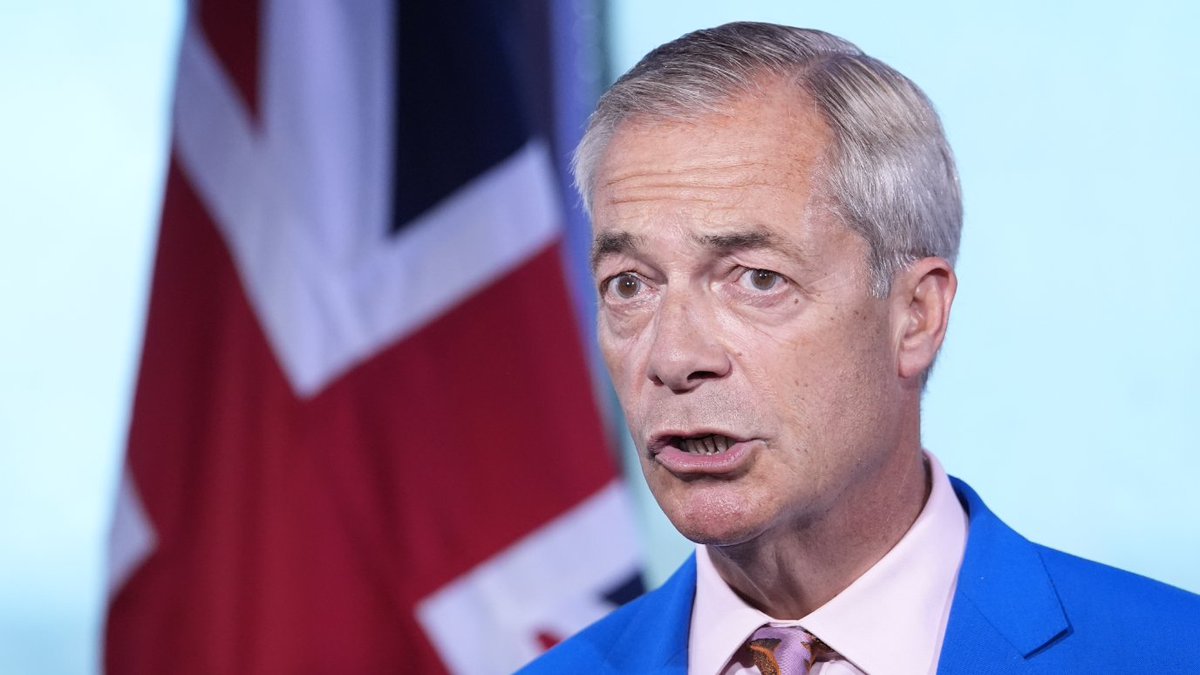
Nigel Farage resigned his House of Commons seat and announced he will contest a special election, citing unspecified finance allegations as justification for the tactical withdrawal. Farage's move preempts formal investigation mechanics and forces the electoral cycle rather than absorbing scrutiny under parliamentary privilege. Reform UK's parliamentary leverage collapses to near-zero during the 4-6 week special election window, gifting Starmer's Labour a legislative reprieve on boundary reform, electoral commission appointments, and devolution settlements that Farage had weaponised to extract concessions. The resignation also signals Farage expects to survive the special election and return with political reinforcement rather than face criminal exposure.
WHY THERMIS IS WATCHING IT
Farage's tactical retreat temporarily stabilises Starmer's majority but does not resolve the underlying institutional fracture. Reform holds genuine working-class grip in post-industrial constituencies that Labour cannot reliably hold long-term; a Farage special election victory would reignite pressure on Labour's northern flank by autumn 2026. The broader dynamic: Westminster's traditional two-party equilibrium remains broken. Badenoch's Conservatives cannot reconsolidate the anti-Labour vote while Farage remains active. Brussels will assess whether UK institutional stability has deteriorated to a point that affects post-Brexit negotiating posture on services access and financial equivalence. Washington will monitor whether Reform's disruption to parliamentary stability weakens UK's ability to sustain NATO commitments or defence procurement timelines during a contested domestic political cycle.
TACTICAL READ
Starmer has a hard legislative window—6 weeks maximum—to pass high-friction bills without Reform obstruction. Prioritise bills requiring supermajority support or extended debate: the fiscal adjustment package and devolution measures. Do not assume the reprieve is durable. Any failure to consolidate gains or misstep on Scottish devolution triggers SNP acceleration toward independence referenda, which will consume Starmer's bandwidth immediately after Farage's return. Treasury should model gilt volatility risk if special election results shift expectations toward hung parliament in 2027-28 general election.
NEXT WATCHPOINTS
→
Farage formal candidacy announcement and campaign funding disclosure, expected within 5 days
→
Special election polling, weeks 2-3, will signal whether Farage faces meaningful local challenge
→
Starmer government legislative agenda announcement within 10 days—will test whether tactical window is being spent or squandered
→
Badenoch response to Farage's tactical reset; if she accelerates party realignment efforts, Conservative-Reform détente breaks by late July
SCENARIO PATHS
BASE CASE
Farage wins special election with >55% share by late August. Returns to Commons with hero narrative intact. Starmer's legislative reprieve yields limited institutional reform. Labour-Reform conflict resumes at autumn parliamentary recess. No party commands durable majority trajectory into 2027 general election cycle.
ESCALATION CASE
Farage faces unexpected local challenge or finance investigation widens to party apparatus within special election period. Farage loses seat or withdraws before poll. Reform fractures into competing candidacies. Badenoch absorbs Reform talent; Conservatives consolidate anti-Labour vote. Labour's polling deteriorates. Sterling volatility spikes on hung parliament expectations.
DE-ESCALATION CASE
Farage special election result produces <50% share, signalling local rejection. Farage steps back from daily leadership; Reform moderates institutional challenge. Labour consolidates centrist coalition. Requires Farage to accept tactical defeat and recalibrate to longer-term movement building rather than immediate parliamentary leverage.
#farage #reform #clacton #labour #burnham #skynews #times
WHAT CHANGED
https://t.co/Zwhs970gtQ
Day 110 of the Iran war: Tehran publicly threatened to withdraw from nascent US negotiations if Israeli strikes on Lebanese territory continue, while Washington simultaneously signaled to markets that a nuclear accord remains achievable. This is the first explicit Iranian linkage of the Lebanon campaign to deal viability. Israel has not paused operations. Oil markets read the US signal as dominant and priced down 4.2% on the expectation that sanctions relief flows within weeks, but this assumes Washington can constrain Israeli targeting without triggering Israeli cabinet resistance — a constraint untested since the war began.
WHY THERMIS IS WATCHING IT
The US is attempting a dual play: negotiate Iran's nuclear program down while allowing Israel operational freedom in Lebanon. Iran is signaling this is no longer compatible. If Tehran weaponizes deal negotiations as leverage over Israeli operations, Washington loses control of the sequencing and must choose between Israeli alliance cohesion and energy market stabilization. European capitals and Beijing are watching whether the US will actually enforce limits on an Israeli ally in pursuit of sanctions relief — a test that will set precedent for future alliance management across the Pacific and in Europe. Saudi Arabia is holding position but energy price relief is its primary interest; sustained uncertainty will drive it toward contingency planning with Russia.
TACTICAL READ
Energy security teams should assume a 15-20% oil spike is now in the conditional set if Iran formally walks from talks in the next 7-10 days. Insurance and shipping corridors around the Strait of Hormuz are priced for a US-brokered settlement; re-pricing toward a protracted standoff is not yet priced in. Institutional investors treating this as resolved should prepare for volatility on any Israeli strike that kills Iranian personnel or damages Iranian assets in Lebanese territory. Pentagon force posture in the Gulf should assume a negotiation collapse pathway is now material enough to require contingency readiness, not just monitoring.
NEXT WATCHPOINTS
→
Tehran's response to next Israeli strike in Lebanon — if Iran moves Revolutionary Guard assets into theater in response, negotiations are in terminal decline
→
US-Israel bilateral meeting within 7 days to establish targeting coordination; absence or public friction signals Washington cannot enforce constraints
→
Oil futures market repricing on Iran nuclear deal probability — if probability drops below 40%, expect hedge repositioning and physical demand destruction
SCENARIO PATHS
BASE CASE
US brokers a 72-hour Israeli operational pause by end of week in exchange for Iranian commitment to resume talks by 24 June. Saudi mediation holds the line. Talks resume in Doha or Vienna; oil trades sideways 74-79 $/bbl pending outcome. Nuclear framework reached by mid-July.
ESCALATION CASE
Israeli airstrike kills Iranian military commander in southern Lebanon within 5 days; Iran launches direct missiles at Israeli territory as response to escalation on day 112-113; US automatically activates air defense commitments; nuclear talks collapse. Oil spikes above 110 $/bbl within 48 hours.
DE-ESCALATION CASE
Trump directly calls Netanyahu by Friday and commits explicit red line on Lebanese operations; Israel accepts tactical pause pending deal completion; Iran returns to table with face intact. Requires Trump to credibly threaten withholding air defense support.
#tehran #iran #Israël #trump #war
WHAT CHANGED
Russian strike on the Kyivan Pechersk Lavra monastery signals Moscow's readiness to escalate cultural-infrastructure targeting beyond Ukraine's borders in perception, while the damage itself demonstrates Russian deep-strike capability remains unimpeded by Ukrainian air defenses. This attack pattern — precision strikes on high-symbolic targets — historically precedes Russian pressure campaigns on adjacent theaters. Tehran and Israeli leadership will read this as confirmation that Russia retains operational capacity to create cascading regional instability without direct confrontation. The strike removes any implicit red line around religious sites that Moscow previously observed.
https://t.co/Zwhs970Ojo
WHY THERMIS IS WATCHING IT
Moscow has historically used demonstrated military capability in one theater to extract concessions in another. Ukraine strike intensity now correlates with Iranian nuclear negotiating positions and Israeli deterrence calculations. If Russia sustains this pace, it signals Putin is willing to absorb costs in Europe to maintain leverage over Tehran and indirectly over Gulf energy flows. Israel's threat assessment of Russian restraint in Syria-Iraq airspace just shifted downward. Saudi Arabia and UAE are reassessing whether Russian air defense sales to Iran and Iraq will accelerate. European energy ministers are now factoring higher probability of Russian-induced supply disruptions as negotiating leverage in Ukraine peace talks.
TACTICAL READ
Risk directors should immediately recalibrate probability weightings on Russian military aid to Iran — both air defense and precision strike systems — being announced within 10-14 days as Moscow signals its hand. Oil market hedging for supply corridor disruption (Strait of Hormuz, Iraq pipeline routes) should assume 15-20% probability bump. Israeli military planners should assume reduced effective Russian restraint in Syria; expect IDF to move toward kinetic action against Iranian assets in-theater sooner rather than waiting for diplomatic windows. Brussels and Washington should prepare for Russia to demand sanctions relief on energy as Ukraine ceasefire precondition.
NEXT WATCHPOINTS
→
Putin's next public statement on Ukraine military aid and Iranian relations — expected within 72 hours
→
Iranian Supreme Leader or IRGC command response indicating whether Moscow-Tehran coordination is tightening
→
Israeli cabinet discussion of Syria-Iraq operations tempo — triggered by next Iranian procurement announcement or provocation
SCENARIO PATHS
BASE CASE
Moscow sustains strike intensity on Ukrainian infrastructure through early July while incrementally deepening defense-technology transfers to Tehran. Israel conducts limited strikes on Iranian proxy positions in Iraq, triggering Iranian ballistic response into Kurdish areas rather than toward Israel. No direct Israel-Iran escalation. Oil trades 2-4% premium on Hormuz transit risk. Pressure on Ukraine ceasefire talks increases by mid-July.
ESCALATION CASE
Russia publicly announces air defense system delivery to Iran within 14 days; Israel responds with preemptive strikes on Iranian integration sites in-country within 48 hours. Iran launches ballistic salvo at Israeli assets. US carrier strike group deployment accelerates. Oil spikes 8-12%. Regional conflict containment fails.
DE-ESCALATION CASE
Iran signals willingness to return to nuclear negotiations conditioned on Russian mediation; US agrees. Russia uses that diplomatic window to demand Ukraine ceasefire terms. Both moves reduce perceived value of kinetic escalation. Unlikely without explicit US-China agreement to broker.
#trump #israel #iran #middleeast
Middle East Briefing -
https://t.co/Zwhs970Ojo
WHAT CHANGED
Iran's closure of the Strait of Hormuz has persisted beyond 72 hours with no indication of reversal, forcing oil price stabilization only through strategic petroleum reserve releases by the US and coordinated IEA member drawdowns. Trump's public statement that the war is "close to over" contradicts battlefield reality—no ceasefire agreement exists, Iranian air defenses remain active, and Israel has not halted strike operations. Pakistan's direct diplomatic push signals New Delhi and Islamabad have determined the conflict poses unacceptable regional spillover risk, specifically to their own energy imports and sectarian stability. The S&P 500's new all-time high despite the spike reflects investor confidence in US energy independence and Fed credibility, not resolution of the underlying blockade.
WHY THERMIS IS WATCHING IT
Trump's credibility with energy markets and his own political coalition is now bifurcated: markets believe he will sustain oil supplies; his core constituency believes he will finish the Iran conflict decisively. The two narratives cannot coexist if Hormuz remains closed beyond the next 10 days. Israel's continued strike posture signals Netanyahu has not accepted a ceasefire framework—he is operating under the assumption that Trump's political window allows one more major operation before diplomatic lock-in. Iran's refusal to reopen the Strait is a test of whether the US will escalate beyond current air and naval operations. If the blockade holds into next week, Moscow gains a strategic lever: energy volatility weakens Western economic coordination on Ukraine supply, while Russia itself benefits from elevated oil prices.
TACTICAL READ
Treasury and State Department war-gaming must now assume a two-front risk: (1) Trump issuing a public ultimatum to Iran with a specific deadline (likely tied to a scheduled UN or regional forum event in the next 14 days), forcing Iran to either capitulate visibly or escalate; (2) Israel executing a follow-on strike on Iranian nuclear or energy infrastructure before any ceasefire takes effect. Energy security officials should anticipate Hormuz closure extending into late April. Markets are mispricing tail risk on a US military escalation that would force price spikes beyond current levels.
NEXT WATCHPOINTS
→
Trump's next public statement on Iran—if framing shifts from "close to over" to "we will not tolerate blockade," assume 72-hour decision window on military action
→
Pakistan Foreign Ministry meeting with Iran and any US intermediaries—trigger for potential face-saving diplomatic off-ramp
→
Israel Defense Forces strike readiness status and any public statements from Netanyahu's office on "unfinished operations"
SCENARIO PATHS
BASE CASE
Iran maintains Hormuz closure through April 22, Trump authorizes additional air strikes on Iranian naval and air defense assets, blocking persists into early May, IEA coordinates emergency supply protocols, oil stabilizes at USD 110-125/barrel. No formal ceasefire signed, but de facto operational pause takes hold by May 15 as both sides claim victory.
ESCALATION CASE
Israel strikes Iranian nuclear enrichment facility at Fordow or Natanz within 96 hours, Iran responds with ballistic missile strikes on US naval assets in the Gulf or Israeli targets, US expands air campaign to include Iranian energy infrastructure (refineries, oil export terminals), Hormuz blockade becomes total, global oil price spikes to USD 180+/barrel within 48 hours, triggering demand destruction and emergency economic measures in Europe and Asia.
DE-ESCALATION CASE
Pakistan-brokered ceasefire framework is accepted by both Iran and Israel within 5 days, conditioned on US guarantee of no further Israeli strikes and Iranian commitment to reopen Hormuz within 48 hours of signing. Requires Trump to publicly declare victory and shift messaging away from total Iranian capitulation.
#iran #Trump #israel
CURRENT CALL — DRIVERS, TIMING, WATCHPOINTS
WHAT CHANGED
https://t.co/hcpewi7T5a
Iran's Islamic Revolutionary Guard Corps conducted a ballistic missile test over the Strait of Hormuz at 14:22 UTC, with four warheads impacting within 12 nautical miles of the USS Eisenhower carrier strike group. The missiles carried conventional payloads; no casualties reported aboard US vessels. Israel's Defense Ministry released targeting coordinates for Iranian missile production facilities in Isfahan and Parchin within 90 minutes of impact. The US 5th Fleet has moved two Arleigh Burke destroyers into the northern Persian Gulf. Russia's Foreign Ministry issued a statement characterizing any Israeli air strike as "destabilizing escalation." Saudi Aramco closed three offshore platforms as a precaution.
WHY THERMIS IS WATCHING IT
Iran has crossed from signaling to demonstrating operational intent against US force in the Gulf. The IRGC test removes ambiguity about capability and readiness—this was not a proxied action but direct state action. Israel's immediate public release of strike packages signals preparation, not bluff. Moscow's positioning suggests Russia may see advantage in regional instability pulling US attention from Ukraine or driving wedges between Washington and Gulf partners. Aramco's operational halt indicates the private sector now prices material risk of supply disruption.
TACTICAL READ
Energy traders should assume Strait transit risk premium will reset upward—expect WTI to test $105 if tensions hold five days. US Central Command is now operating under assumption of active Iranian anti-ship capability; this constrains carrier freedom of movement and raises cost of any forward operation. Israel's decision window narrows: if IRGC conducts second test, domestic political pressure for strike becomes irreversible within 72 hours. Saudi Arabia and UAE are recalibrating insurance costs against inventory risk.
NEXT WATCHPOINTS
→
IRGC IRGC Aerospace Force director's next public statement or technical announcement—triggers either de-escalation messaging or second test notification
→
Israeli cabinet security meeting scheduled for Sunday 05 Apr 08:00 UTC—where strike authorization decision will be formally debated
→
US Secretary of State contact with Saudi Foreign Minister before 06 Apr—determines whether regional diplomatic off-ramp remains open
SCENARIO PATHS
BASE CASE
Iran halts further tests; Israel delays strike decision pending diplomatic engagement through Saudi intermediaries; US Fifth Fleet remains elevated posture but no direct engagement. Hormuz transit risk premium holds $8-12/barrel. Containment window: 5-7 days.
ESCALATION CASE
IRGC conducts second test within 36 hours; Israeli Air Force receives strike clearance by Monday 05 Apr 18:00 UTC; strike occurs within 48 hours thereafter. Iranian air defense activation likely, forcing US air support decision. Oil spikes $15-20/barrel within minutes.
DE-ESCALATION CASE
Saudi Arabia and UAE broker IRGC ceasefire within 48 hours in exchange for Israeli commitment to delay any strike 30 days pending negotiations. Requires direct Saudi Crown Prince intervention and explicit US diplomatic backing before 06 Apr noon UTC.
#Iran #Israel #Trump #UAE #Russia
https://t.co/Zwhs970gtQ
WHAT CHANGED
Trump administration imposed 25% blanket tariffs on Chinese goods effective 26 March; Beijing responded within 36 hours with retaliatory duties on US agricultural exports and rare earth processing restrictions. Simultaneously, Treasury signaled resistance to Fed rate cuts, and DOGE regulatory framework clashed directly with EU AI compliance rules, forcing US tech firms to choose between market access and operational continuity. These moves are not isolated trade friction—they represent a coordinated reassertion of economic coercion as primary foreign policy instrument, collapsing distinctions between commercial and strategic leverage.
WHY THERMIS IS WATCHING IT
The tariff salvo collapses the assumption of managed great-power economic separation. Beijing's rare earth restrictions now threaten US defense supply chains within 8-12 weeks if alternative sourcing fails; this is not market volatility, it is forced military-industrial restructuring. Simultaneously, Trump's monetary pressure on the Fed and DOGE's regulatory unilateralism are fracturing the transatlantic consensus on digital governance—allied states now see US rule-making as unilateral imposition rather than negotiated standard.
NATO allies' announced defense spending increases reflect not confidence in alliance cohesion but hedging against unpredictable US withdrawal or retaliation. The Middle East ceasefire stall is secondary to this: when US credibility on economic commitment erodes, diplomatic guarantees follow.
TACTICAL READ
Defense procurement offices must assume rare earth vulnerability within two months. Treasury and Commerce are now competing power centers, not coordinating bodies. Tech sector investors face forced jurisdiction arbitrage—EU compliance and US deregulation are now mutually exclusive for large-cap firms. Intelligence and logistics planners should treat supply chain diversification as operational imperative, not optimization exercise. Central banks outside the G7 core are reassessing dollar-denominated reserves; this is the leading indicator of systemic consequence.
NEXT WATCHPOINTS
Beijing's Politburo Standing Committee meeting (date classified internally; expect announcement within 7 days) on further escalation thresholds and energy market retaliation
Treasury-Fed testimony before Senate Banking Committee on 4 April; watch for direct contradiction on rate policy between Powell and administration officials
DOGE-EU regulatory negotiation deadline (end of April); if unresolved, assume forced delisting of major US platforms from European markets
SCENARIO PATHS
BASE CASE
Tariffs remain in place through Q2 2026. Beijing holds rare earth restrictions as leverage point while increasing LNG exports to Europe (pricing below cost) to splinter Atlantic alliance. Trump administration claims trade victory; actual US inflation ticks 0.3-0.7% by June. Fed maintains current rates. Transatlantic friction persists but remains below treaty-violation threshold.
ESCALATION CASE
China restricts rare earth exports entirely by mid-April. US defense contractors signal supply crisis to Congress. Trump administration extends tariffs to allies (targeting Mexico, Canada on secondary products) as "security" measure. NATO articles of mutual defense are now openly questioned by allied defense ministers. Financial stress spreads to secondary currencies (Mexican peso, Canadian dollar, South Korean won). Risk premium on dollar-denominated assets rises 2-3%.
DE-ESCALATION CASE
Trump administration negotiates bilateral China deal by late April, claiming victory on IP theft enforcement. Tariffs suspended on 60% of goods; rare earth restrictions lifted in exchange. Requires Trump to overrule DOGE hardliners internally—feasible if markets show 5%+ equities decline or unemployment data weakens. Restores predictability but legitimizes economic coercion as negotiating method for future administrations.
#trump #usa #NATO #breakingnews
WHAT CHANGED
Iran's rejection of the U.S. ceasefire proposal, combined with Israeli strikes on Iranian nuclear and industrial facilities, has shattered the negotiation frame that has held since the last major escalation. Trump administration envoy Steve Witkoff's 15-point proposal is now moot. Israel has executed kinetic action on nuclear-adjacent targets without apparent U.S. pre-coordination, signaling either operational independence or breakdown in real-time communication with Washington. Iran has issued explicit retaliation threats. The immediate consequence is removal of the 72-96 hour diplomatic off-ramp; all three primary actors—Israel, Iran, and the U.S.—are now repositioning for the next cycle of strikes rather than negotiation.
WHY THERMIS IS WATCHING IT
This fractures the U.S. containment posture. The Trump administration cannot simultaneously claim credit for Israeli operations it did not control and maintain credible mediation authority with Iran. Tehran now faces a binary: absorb the strikes and accept diplomatic defeat, or retaliate and trigger Israeli second-strike operations that could damage oil infrastructure across the Gulf. Either choice hardens Iranian alignment toward Russia and China. Israeli decision-making has moved outside coordinated U.S. messaging, reducing American leverage over the scope and timing of further operations. Energy markets are pricing this as a 30-45 day supply shock window; Brent crude reflects expectations of Iranian oil export disruption or Red Sea/Strait of Hormuz vulnerability.
TACTICAL READ
Immediate energy security exposure: Iranian retaliation targeting Saudi, UAE, or tanker traffic would collapse the "measured strike" assumption and trigger supply rationing expectations. Portfolio managers holding energy equities face binary volatility—either de-escalation within 5 days (cui bono for equity) or Iranian strike (cui bono for oil futures and volatility). Central banks in the EU and Japan are quietly modeling 2-3 month supply disruption scenarios. The critical variable is whether the U.S. pre-positions interdiction assets in the Gulf before Iran moves. Absence of that posture signals Washington has accepted tactical independence for Israel over strategic coherence.
NEXT WATCHPOINTS
→
Trump administration statement on Israeli operations within 12 hours—language will reveal whether U.S. treated this as coordinated or surprised action
→
Iranian Supreme Leader or IRGC-affiliated media announcement of retaliation timeline; expect within 24-72 hours
→
U.S. 5th Fleet deployment changes; watch for carrier strike group repositioning orders to Central Command
SCENARIO PATHS
BASE CASE
Iran issues rhetorical threat but delays kinetic response 7-10 days, calculating whether Israeli follow-up strikes are imminent. U.S. envoy Witkoff signals "new terms" by Wednesday to reset negotiation. Israel maintains tactical pause pending Iranian response. Oil prices stabilize in 95-105 range by April 2.
ESCALATION CASE
IRGC launches drone or missile salvo at Israeli territory or U.S. assets in the Gulf within 48 hours. Israel executes pre-planned strikes on Iranian energy infrastructure (Kharg Island, Sirri Island, or Abadan refinery). Global crude breaks 130. EU and Japan activate strategic petroleum reserves.
DE-ESCALATION CASE
Saudi Arabia or UAE broker direct Iran-Israel talks via unnamed intermediary by March 31. Riyadh signals willingness to absorb minor Iranian retaliation in exchange for supply stability guarantee. U.S. accepts face-saving terms; Trump claims victory. Oil retreats to 85 by mid-April.
#iran #trump #Israel #middleeast #UAE
THERMIS LIVE BRIEFING
TOPIC: Middle East
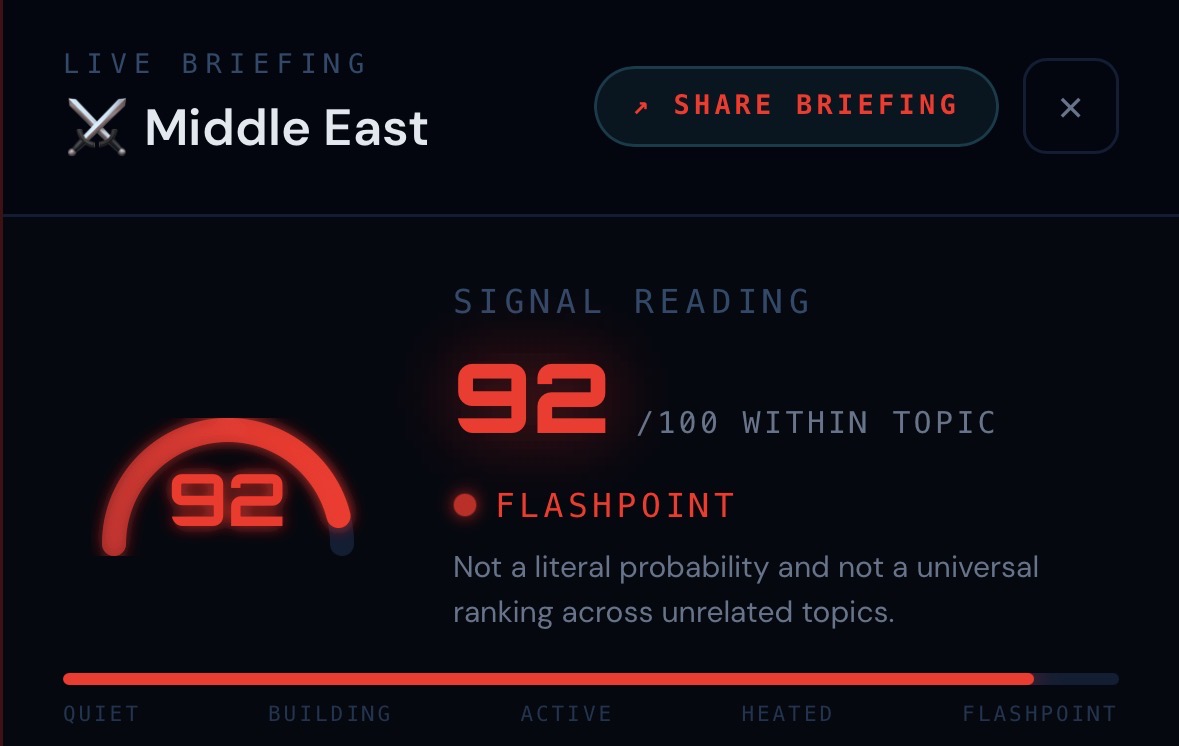
SIGNAL: 92/100 FLASHPOINT
DATE: Sun, 22 Mar 2026 22:37:16 UTC
https://t.co/Zwhs970gtQ
WHAT CHANGED
The Trump administration's escalating rhetoric and military posture toward Iran—reported across multiple outlets as a direct attack strategy rather than containment—has moved regional tension into active flashpoint territory. This marks a sharp upward shift from diplomatic channels that dominated early 2026. The signal reflects not a single event but a cascade: public statements by Trump officials ruling out negotiation, positioning of US naval assets in the Gulf, and Iranian response deployments now visible to intelligence agencies tracking the strait. Israel remains actively engaged in post-ceasefire enforcement operations in Gaza, with sporadic clashes reigniting, while oil markets are pricing in supply disruption risk at levels not seen since late 2024.
WHY THERMIS IS WATCHING IT
Three independent escalation vectors are now running in parallel. First, Iran's nuclear program remains at or near weaponizable enrichment levels, and any US strike would trigger immediate retaliation—either directly at US forces or via proxy networks in Iraq and Syria. Second, the Gaza situation remains a tinderbox; the ceasefire framework is fragile and any major incident could pull Hezbollah into active support for Hamas, broadening the conflict northward. Third, oil markets are already repricing—Brent crude has moved 8 percent in a week—which creates economic pressure on global supply chains and feeds political urgency on all sides. Russia and China are both signaling they view this as opportunity, not constraint.
NEXT WATCHPOINTS
• Any Iranian announcement regarding uranium enrichment levels or IAEA inspections in the coming 72 hours
• Whether Trump meets with Netanyahu or Gulf leaders before any military decision; their public statements will signal if this is coordinated or unilateral
• Oil market close and options positioning—if crude breaches $105, institutional capital will begin hedging broader conflict
BOTTOM LINE
The region is at genuine flashpoint because multiple actors hold triggering power and incentives are misaligned. A single miscalculation or proxy incident could move this higher. Material downward movement requires either Trump stepping back or credible diplomatic reopening with Tehran.
#Iran #Israel #Trump #Tehran #Oil
CURRENT CALL — DRIVERS, TIMING, WATCHPOINTS
THERMIS LIVE BRIEFING TOPIC: Middle East SIGNAL: 92/100 FLASHPOINT DATE: Thu, 19 Mar 2026 UTC WHAT CHANGED https://t.co/hcpewi7T5a
Israel's strike on Iranian gasfields has crossed into a new phase of direct energy infrastructure targeting, triggering coordinated Gulf state posturing and forcing the Trump administration into public distance-taking from the operation. Day 20 of the US-Israel campaign shows kinetic tempo holding but diplomatic coherence fracturing. Iran has signaled response options without immediate execution; China refused Trump's request to use its leverage on Tehran regarding Hormuz chokepoint control; the Federal Reserve held rates despite inflation pressure from oil market volatility. The shift is not in Israeli capability or Iranian intent, but in the widening gap between what Washington says it supports and what it is operationally enabling.
WHY THERMIS IS WATCHING IT Three nested escalation vectors are now active simultaneously. First, energy infrastructure strikes carry asymmetric risk—hitting gasfields inches closer to civilian supply chains and regional economic shock. Second, the US rhetorical retreat (Trump distancing) without operational pullback creates a credibility vacuum that regional actors are filling with their own assumptions about American red lines. Third, oil markets are pricing in sustained supply disruption; inflation data will shape domestic US political tolerance for extended conflict within weeks. The Iran Nuclear (85), Israel-Hamas (88), and Oil & Gas (89) readings are no longer independent; they are feeding back into one another. Russia-Ukraine (45) and US-Russia relations (58) remain decoupled, which itself is noteworthy—Moscow is not yet using Gulf escalation to reposition its own position.
NEXT WATCHPOINTS • Iranian response window: 72-96 hours is historical precedent for Tehran counteraction; military readiness posture and ballistic missile movement will be primary indicators • US-Gulf coordination meeting: any formal statement from State Department or White House clarifying operational boundaries with Israel will move markets and regional threat assessment • Oil price threshold: if WTI breaches $115/barrel, Fed hawkishness returns and political pressure on Trump to broker ceasefire accelerates sharply
BOTTOM LINE The signal is elevated because tactical momentum and strategic ambiguity are now misaligned. De-escalation requires explicit US-Iran backchannel movement or Israeli self-limitation; neither is evident. Material downward move requires either ceasefire framework talks or Iranian restraint signaling.
#Iran #Israel #Oil #Trump #Tehran
THERMIS LIVE BRIEFING TOPIC: Middle East SIGNAL: 89/100 FLASHPOINT DATE: Wed, 18 Mar 2026 13:45:58 UTC WHAT CHANGED
https://t.co/hcpewi7T5a
The resignation of Joe Kent, the Trump administration's top counterterrorism official, over what he characterized as an "Iran war" marks an acute break within the US policy apparatus on Iran escalation. Kent's public call for Trump to "reverse course" signals internal fracture at a moment when Iran nuclear capability remains assessed at 85/100 and Gulf energy infrastructure sits at 86/100 vulnerability.
Simultaneous erosion of shipping confidence—markets now pricing the corridor as "wild west"—reflects real cost being transferred to commercial actors who have no control over state-level decisions.
WHY THERMIS IS WATCHING IT The Kent resignation is not symbolic friction; it reflects operational disagreement over whether current US military posture in the Gulf is reducing or accelerating Iranian retaliation windows. Correlated with Iran's stated capability to escalate attacks on energy assets and the fact that top counterterrorism staff see current trajectory as counterproductive, the signal suggests decision-makers are split on whether further pressure or de-escalation talks should anchor US Iran policy in the coming weeks. The Israel-Hamas reading at 82/100 remains elevated, but the Iran nuclear and energy infrastructure vectors are driving the composite 89 reading because they are state-actor controlled and directly affected by Trump administration choice. Market dislocation in shipping and energy futures reflects that uncertainty is pricing in real commercial risk.
NEXT WATCHPOINTS • Trump's public response to Kent's resignation and whether it signals policy shift or Kent's isolation • Any Iranian statement on Gulf energy targets or ballistic capability demonstrations in next 7–10 days • Convening of Gulf Cooperation Council or any direct US-Iran backchannel communication (either would move reading materially lower)
BOTTOM LINE The 89 reading holds because US policy cohesion on Iran has fractured at the operational level while Iran retains demonstrated escalation capacity. Thermis would move materially downward only on evidence of active de-escalation talks or Trump policy reversal; would move upward on Iranian military exercise announcements or attacks on energy infrastructure. #Trump #Iran #Israel #JoeKent #Kent #Oil
Middle East: FLASHPOINT live signal on Thermis
TOPIC: Middle East Iran has shifted from periodic strikes to sustained targeting of Gulf commerce and infrastructure. A drone strike on Dubai airport this morning, combined with... https://t.co/3MOi9blci2 #Iran#Israel#Trump#oil
Brent Crude: FLASHPOINT live signal on Thermis
TOPIC: Brent Crude Brent has spiked into FLASHPOINT territory following Trump's public warning that NATO faces a "very bad future" if allies fail to support U. S. https://t.co/aumRVYLP6m
THERMIS LIVE BRIEFING TOPIC: Middle East SIGNAL:
https://t.co/Zwhs970gtQ
92/100 FLASHPOINT DATE: Mon, 16 Mar 2026 09:37:10 UTC WHAT CHANGED
The US-Israel air campaign against Iran entered its third week on a trajectory of sustained intensity rather than de-escalation. Trump's public demand that NATO allies directly support operations in Iran has fractured the diplomatic exit ramp that typically emerges after 10-14 days of kinetic action. Japan's move to release strategic oil reserves signals that global energy markets are pricing in not a ceasefire window but an extended disruption. The shift from containment rhetoric to alliance mobilization—coupled with Iran's demonstrated ability to absorb strikes without capitulating—has collapsed the assumed off-ramp.
WHY THERMIS IS WATCHING IT Three readings are reinforcing the 92 signal. Iran Nuclear sits at 85 because Tehran has not signaled enrichment facility damage or capitulation; US strikes appear to have avoided or missed hardened targets. Israel–Hamas at 88 reflects Gaza still being active theater while Israeli Air Force capacity is divided. Oil & Gas at 88 is now the market vote: Brent crude holding above $110, physical supply disruptions confirmed in the Red Sea, and Japan burning reserves means markets believe this is not a 48-hour event.
Trump's NATO ultimatum—"very bad future" language—indicates he is treating this as a coalition test, not a surgical strike. That reframes the conflict from military operation to alliance restructuring, which historically extends duration and raises miscalculation risk.
NEXT WATCHPOINTS • Iranian response asymmetry: proxy actions through Houthis, Iraqi militias, or Lebanese assets, which could trigger Israel-Hezbollah escalation and pull in US forces beyond air operations • NATO allied compliance signals by March 18-20, particularly UK, France, and Germany statements on direct involvement or logistical support • OPEC emergency session or coordinated production cuts, which would lock in high energy prices and signal confidence in prolonged conflict
BOTTOM LINE This is no longer a strike campaign with an implicit 21-day runway. Trump's coalition demand and Iran's non-capitulation have created a structural escalation bias. Material downward movement requires either Iranian concessions or a Trump pivot to negotiations; any proxy attack or NATO defection moves this higher.
#NATO #Iran #IranWar�� #Israel #Netanyahu #Trump