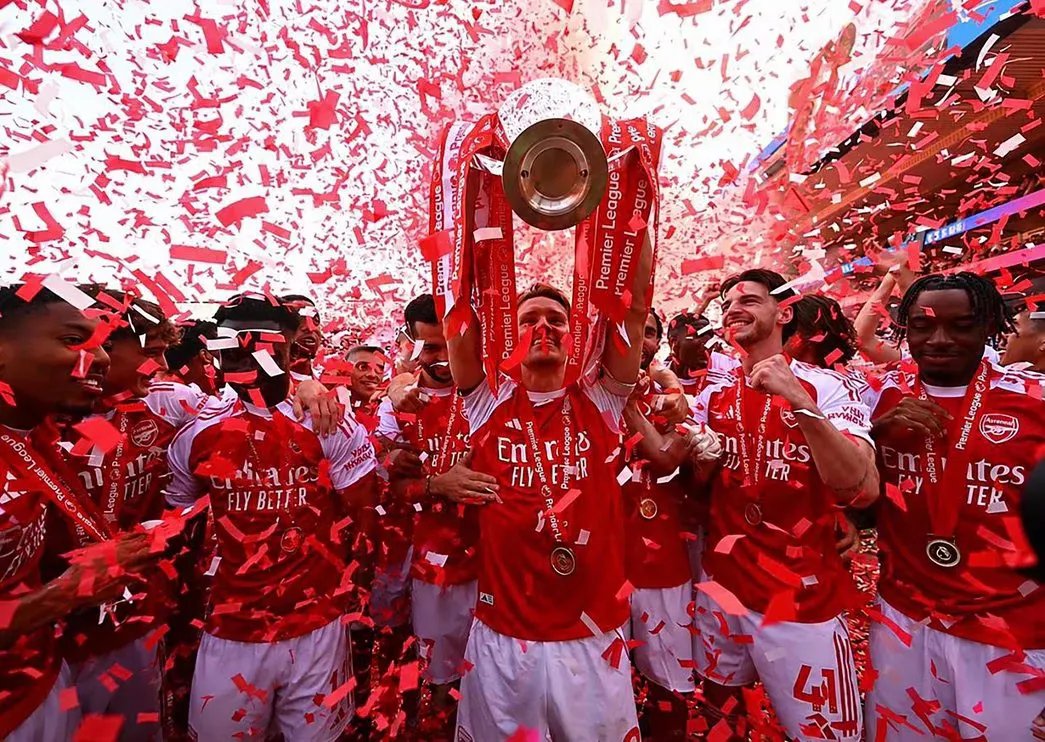
🚨 EXCL: Arsenal exploring move to sign Vinicius Junior from Real Madrid. #AFC interest early stage + clubs not yet in talks but idea approved at all levels. Much rests on contract process as no breakthrough yet & #RMFC do not want free exit @TheAthleticFC https://t.co/qYdS5vlfE6
@FantasyWorldW1 This is just senseless. Everytime the producers aura farm instead of making a logical show.
The only right choice here is retreat. But they had to have vhagar bite of her neck
"cause I'm old and I'm already rich, and I'm not trying to get clips"
T-Pain explains why he hasn't been interacting with other content creators at Streamer University
GO AGAIN
I've spent the last few weeks looking at the Arsenal season (and analytics from @Gradient_Sports) to help inform what we do next: six strengths to fortify, five tangible ways to improve, and what it all means for the summer business. Link in replies.
🇿🇦 South Africa has the highest income inequality of any country on Earth.
Top 10%: earn 66% of all income.
Bottom 50%: earn 6%.
For context in Sweden, the bottom 50% earn 25% of income.
South Africa's Gini coefficient: among the highest ever recorded for a major economy.
The legacy of apartheid didn't end with apartheid.
It compounded, through land ownership, education, and access to capital, into the most unequal income distribution on the planet.
I grew up convinced my dad had a favorite. Every Saturday morning, he’d take my younger brother out for breakfast. Just the two of them.
It became such a routine that eventually nobody questioned it. I never asked why. Partly because I didn’t want to sound jealous.
The other part was that I was afraid I already knew the answer. If I was being honest, it hurt. Not enough to start an argument, just enough to quietly notice it every weekend.
Then one Saturday, my brother came down with the flu. My dad knocked on my bedroom door instead. “Want to come with me?”
I almost said no. Not because I didn’t want breakfast. Because I didn’t want to feel like I was only getting an invitation because someone else couldn’t go.
@Aiprotips1 This is a con man. Had Brazil - Morocco 2-1.
Has edited original tweet to mislead people. Same to Qatar Switzerland, and Haiti Scotland.
Those are the ones I remember. He's already wrong on Germany -curacao
Screenshot this for after the game when he edits his tweet
La Russie du grand méchant Vladimir Poutine pendant la Coupe du monde 2018 :
- entrée gratuite sans visa pour tous les supporters
- trains gratuits pour se déplacer entre les 11 villes hôtes
- transports locaux gratuits (bus, métro, navettes)
- pas de tarification dynamique pour les billets
- contrôles administratifs simplifiés
- aucune interdiction de séjour discriminatoire
- aucune place destiné aux supporters supprimés
- pas de fouille humiliante à l’arrivée des joueurs comme si c’était des criminels
This is the Knicks hidden advantage. Parks in walkable cities to Wemby are the equivalent of strip clubs to Harden. Surprised he hasn’t missed a game playing chess in Union Square
Two math olympiad champions wrote a training manual in 1993 on two old Macintosh computers, and every American kid who has won a major math competition in the last decade learned to think from it.
Their names are Sandor Lehoczky and Richard Rusczyk. The book is called The Art of Problem Solving. Most people in math know it as AoPS.
Since 2015, every single member of the US International Math Olympiad team has been an AoPS student. Not most of them. Every one.
That statistic sounds impossible until you understand what the book actually does.
Lehoczky and Rusczyk were not professors. They were competitors. Lehoczky earned the sole perfect AIME score in 1990 and led the national first place team. Rusczyk was a USA Mathematical Olympiad winner and a perfect AIME scorer in 1989. They had both survived the same brutal selection process the book was designed to train students for.
And the first thing they decided was that almost every existing math textbook was teaching the wrong thing.
School math gives you formulas. You memorize them. You apply them. You pass the test. Then you sit down in front of a real competition problem and the formula does not apply, and you have nothing underneath it.
That is the gap. The gap is not knowledge. It is thinking.
The entire premise of AoPS is that problem-solving is a transferable skill, not a bag of memorized tricks. A student who genuinely understands why a technique works can adapt it, combine it with something else, and deploy it in a context they have never seen before. A student who only memorized the technique freezes the moment the problem looks different.
The book teaches the difference between a formula and a method.
A formula tells you what to compute. A method tells you how to see. The students who win olympiads are not the ones who know more formulas. They are the ones who have trained themselves to look at an unfamiliar problem and recognize its structure. To see that this problem is secretly asking the same question as a problem they solved three weeks ago, just dressed differently.
Rusczyk calls this "learning to read the problem." Not reading the words. Reading what the problem is actually asking underneath the words.
The second thing they built into the book is tolerance for being stuck.
Most students treat confusion as a signal to stop. The book treats confusion as the starting point. Every chapter pushes students past the point where the obvious approach runs out. That moment of running out is not failure. That is where the actual thinking begins.
Lehoczky once described it this way. If you can solve a problem quickly, you are not learning. You are performing. Learning only happens when you are past the edge of what you already know.
The book was written on old Macintosh computers in 1993. Rusczyk launched the AoPS website in 2003. Today the community has over one million users. Thousands of students enroll in AoPS online courses every year. Most winners of every major American math competition are AoPS alumni.
A platform built by two kids who were good at math competitions has become the infrastructure that produces the next generation of mathematicians, engineers, and scientists who are good at thinking.
The formulas you memorized in school will eventually be obsolete.
The thinking you trained will not.
What is one problem in your life right now that you have been avoiding because you do not yet know the right formula to solve it?