Google isn't saying “don’t use AI”, it's saying low effort content is a big problem
Google recently updated its guidance around helpful, reliable, people-first content (see here: https://t.co/Xl9k2zkMgM)
One of the examples it now gives of low-effort content is using generative AI to produce large amounts of text without proper oversight.
Google’s quality guidance focuses on four things:
-effort
-originality
-talent or skill
-accuracy
That's a pretty good checklist for content whether AI's involved or not.
Mass-produced content can rank well initially.
Then once it's reassessed by google, visibility can fall away just as quickly.
And... in AI search, self-promotional content (such as placing your company top of a 'best-of' list on your site) is increasingly becoming an ineffective tactic.
So, create something worth citing.
That might mean:
-using your own customer data
-adding first-hand experience
-running your own tests
-using real examples
-answering the question immediately
-including original research
-speaking to experts
-building useful tools, calculators or visualisations
-or simply covering the topic better than anyone else
We use AI throughout our content process.
Research. Outlines. Content gaps. Drafting. Optimisation. Even helping identify the information that AI search may want to cite.
But we use it to increase the quality and efficiency of the work.
If the input's lazy, AI just helps you create lazy content faster.
If the strategy, research and experience are strong, AI can help you create something genuinely useful that will rank and grow your business.
That's the difference.
We've all been wondering how often ChatGPT actually mentions our businesses.
Now we can finally see some of it.
OpenAI has launched Businesses in ChatGPT, including a new Business Hub where eligible businesses can claim their profile, keep their information up to date and see how people are interacting with them.
https://t.co/ObakArYw0m
The bit I find most interesting is Insights.
For the last 28 days, you can now see things like:
-how often your business is mentioned
-how many people click through to your website
-the topics and themes where your business is being discovered
It's probably the closest thing we have had so far to a Search Console for ChatGPT.
But... and there's always a but
The dashboard is not going to magically make ChatGPT recommend you more often.
It's just showing you what's already happening.
The real work is still making sure your business gives AI systems enough reason to find, understand and trust it in the first place.
That means things like:
-a properly structured website
-clear information about what you actually do
-useful content that answers real questions
-strong reviews
-consistent business information
-mentions and citations elsewhere online
-and genuine authority around the services you want to be known for
So the first thing I would be doing is claiming the business and taking a screenshot of where you are now.
Then you have a baseline.
And from there, the job is increasing those mentions, clicks and discovery opportunities over time.
If you need help with that then drop me a dm
The first red flag wasn’t their rankings, it was that nobody could tell me whether the SEO was actually working.
When I took over the account, there was no Google analytics set up and no Google search console either, yet the business had been paying an ongoing SEO retainer for months.
So before I even started looking at rankings, content or backlinks, I had one pretty obvious question: What had they actually been measuring?
This is why I think every business owner should be able to ask their SEO provider one simple question: What did you actually do this month and why?
The answer shouldn't need a load of jargon.
It might be that we:
-improved a service page because it was starting to gain impressions
-built out another priority location
-strengthened internal linking
-worked on the Google business profile
-added content around a genuine search opportunity
-fixed something technical that was holding the site back
The exact work can change from month to month and it should.
SEO shouldn't just be the same checklist repeated forever because that's what happens to be included in the package.
The work should be driven by the data, the opportunities and what is most likely to move the business forward.
You should know what has been worked on.
You should know why it was worked on.
You should know what the data is showing.
And you should know what happens next.
If you're paying for SEO and none of that is clear, that's not a reporting problem, that's an accountability problem.
Ranking #1 on Google is great, but if the website doesn’t make people want to book, you’ve only done half the job
One of our local beauty clients started with no website and pretty much no online presence, now they’re averaging 150+ bookings a month directly through the website
The SEO obviously matters because you need to get found in the first place, but what happens after someone clicks matters just as much
Does the site immediately make it clear what you do?
Can people see the services they’re looking for?
Does the business look trustworthy?
Is it easy to book?
Does the website actually feel like the business they’re thinking about spending money with?
This is why I’ve never really seen SEO and web design as two completely separate things
Visibility gets you the opportunity, the website then has to turn that opportunity into an enquiry, booking or sale
Getting found is important, being easy to choose is what makes it valuable
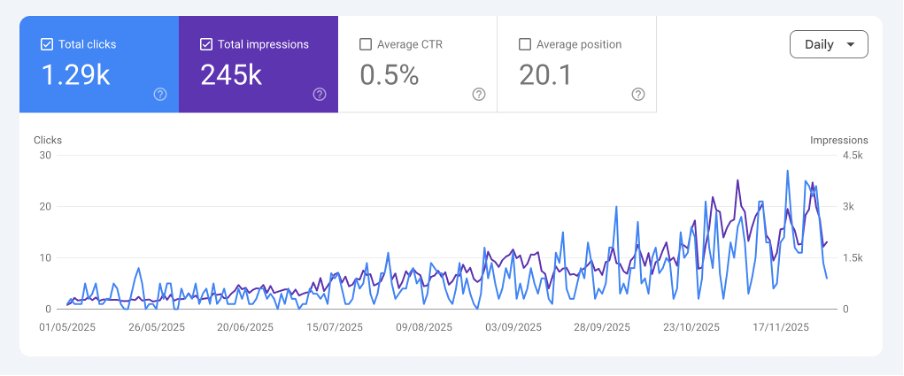
The interesting part of this SEO campaign wasn't the 425 visits, it was what we did when there were only 57
When we started in May, the website had limited organic visibility across its core services and locations, and there were plenty of things we could have worked on straight away
We didn't try to tackle everything at once
We started with the foundations, getting the site structure right, focusing on the priority services and locations, and optimising around the searches that actually mattered to the business
Then, as visibility started to build, we expanded
By November, organic visits had increased from 57 to 425, but traffic wasn't the only thing moving
Position #1 keywords increased from 2 to 13, Top 10 keywords went from 15 to 151, and the website generated more than 245,000 search impressions between May and November
That's why I like to think of SEO as something you build out in phases
Get the foundations right, build visibility around the things that matter most, then expand from there
You don't need to try to win everything on day one
A new website isn't an SEO strategy. I wish more designers said that upfront.
You can spend months planning a redesign - new branding, new photos, better layouts, cleaner navigation, a site that finally looks like the business you've built.
Then it goes live.
You wait.
And six months later, the phone's no busier than it was before.
That is usually when the question comes: “Why isn’t the new website bringing us more customers?”
Because looking better and being found are two completely different jobs.
A redesign can improve trust, usability and conversion.
But if nobody's properly looked at:
-what your customers are actually searching for
-which services deserve their own pages
-which locations you want to target
-search intent
-page titles and meta descriptions
-internal linking
-Google business profile optimisation
-local SEO
-competitor gaps
-existing rankings that need protecting
-and the content required to build authority
then all you really have is a better looking website.
Sure, that's not necessarily a bad thing, but it's not the same as having a website built to generate organic visibility.
This is where a lot of businesses get caught out; they think the redesign itself is the marketing.
It's not.
The redesign is the foundation.
What happens around it is what determines whether more people actually find the business.
And there's another danger too.
If SEO isn't considered during a redesign, you can actually lose visibility.
Old URLs disappear, pages get removed, content gets shortened, internal links change and redirects are missed.
And suddenly the shiny new website is ranking worse than the ugly old one.
That's why when we build or redesign a website, SEO is part of the process from the beginning.
Not something we bolt on six months later when the enquiries haven't arrived.
A website should look good, but it also needs to be found, trusted and built around the searches that can actually bring you business.
If you've recently launched a new website and expected more enquiries than you are getting, drop me a DM.
I’ll tell you what I would look at first.
One of the first things we do when onboarding a new local SEO client is to take a baseline.
Before doing anything, we want to know exactly where they're starting from.
The screenshot below is from a new client.
20+ ranking in every point on the map, so now we have our benchmark.
We can come back in 30, 60 and 90 days and see whether the work we are doing is actually moving the needle.
One of the tools we use for this is Localo.
We choose a small group of keywords that genuinely matter to the business, particularly the searches most likely to trigger the local map pack.
That normally means looking at things like:
-the services they actually want more enquiries for
-the locations they serve
-how customers really describe those services
-actual search data rather than guessing
-whether the keyword triggers local results
-and whether the term is commercially useful, not just nice to rank for
We still track normal organic keyword rankings too, but local rankings are different.
Someone searching from one side of a town can see a completely different map pack from someone searching a few miles away, that's why these grid maps are so useful.
They show where a business is genuinely visible across its service area rather than giving us one single ranking number.
We can even use them before someone becomes a client: Run a visibility scan, show them exactly where they're being found and show them where they're invisible.
Then, if they come on board, that same baseline becomes the starting point for measuring progress.
From there, clients get a monthly report showing things like:
-ranking movement
-calls
-website clicks
-Google business profile activity
-and how their visibility is changing over time
For this client, the goal's simple: Turn as much of that red into top 3 visibility as we can.
And because we took the baseline first, we'll be able to prove whether we got there.
Ranking first on Google is not enough if the business below you looks more trustworthy.
Visibility gets you considered, but everything else decides whether you get the enquiry.
When someone searches for a local service, they rarely choose a business based on position alone.
They compare:
-review ratings and recent feedback
-photos of the team and completed work
-how professional the website looks
-whether the service they need is clearly explained
-how easy it is to call, book or request a quote
-whether the business feels established and trustworthy
You can rank in the top three and still lose the customer to a competitor with better reviews, stronger photos and a website that makes the decision easier.
That's why SEO can't stop at rankings.
Getting found is only the first job, the next job is giving people enough confidence to choose you.
For local businesses, that means your Google Business Profile, website, reviews, imagery and messaging all need to support each other.
Being easy to find gets you into the race, but being easy to choose wins the enquiry.
Want to know whether your business is easy to choose as well as easy to find? Drop me a DM and I’ll take a look.
Your social posts can now be tracked inside Google Search Console.
You'll be able to see how content from Instagram, TikTok, X and YouTube performs across Google Search, Discover and Google News.
You can see which searches are driving traffic, spot posts gaining traction and compare performance across different platforms and formats.
Another clear sign that SEO and social media are becoming much less separate.
I’ll be testing this across client accounts over the next few weeks.
I handed a writer a content brief recently. She said it was the most detailed one she'd ever received. Here's what was in it.
Before anyone starts writing, I want them to understand exactly what the page needs to achieve, who it's for, what search intent it needs to satisfy and why it deserves to rank.
Because a brief that simply says: “Write 1,000 words about this keyword” isn't a brief.
That starts with checking what Google is already showing for the target keyword. Are the top results: how-to guides, list posts, service pages, product pages, comparison articles or local results?
If Google is clearly rewarding one type of content, there is little point creating something completely different and hoping a few keywords will save it.
The brief will then normally include:
-the primary keyword
-supporting keywords and entities
-the search intent
-the intended audience
-the recommended content format
-the main question to answer immediately
-the heading structure
-the topics strong competitors already cover
-the gaps those competitors have missed
-useful facts and AI Search information to include
-internal links to add
-examples, screenshots and first-hand insight
-the commercial journey and call to action
-title and meta description guidance
-tone, readability and formatting requirements
I also review the current top-ranking pages, but not to copy them. The aim is to understand the depth Google is already rewarding, cover the important points properly and then add something the other pages don't have.
That could be a clearer explanation, a real client example, original photographs, first-hand experience, a useful local angle or an answer to a question everyone else has ignored.
One prompt I sometimes use during the research stage is: “What is missing from this outline that could help me more thoroughly satisfy the user’s search intent? Research current discussions across Reddit, YouTube, LinkedIn and other relevant platforms to identify fresh questions, objections and user signals.”
That helps uncover the questions and concerns people are actually discussing, rather than simply repeating what's already ranking.
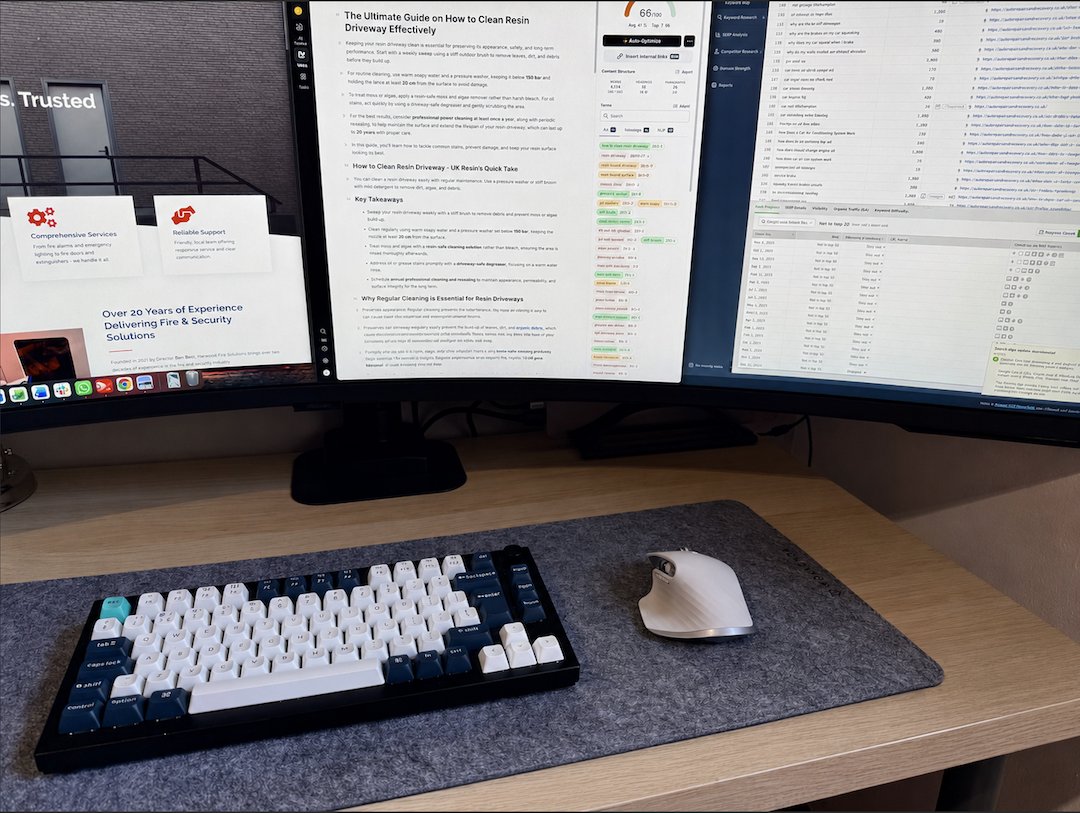
SurferSEO then adds another layer of guidance around topical coverage, relevant entities, competitor benchmarks, SEO optimisation and information that may help the page appear in AI search
But the tool doesn't make the strategic decisions for us.
It doesn't know which insight will build trust, what's most likely to convert and it doesn't know which details come from genuine experience.
That's what the brief needs to provide.
By the time the writer starts, they shouldn't have to guess what the page is trying to achieve.
Because the difference between content that ranks and content that disappears is often decided before the first sentence is written.
Some businesses are publishing more content than ever, yet their rankings are dropping.
The problem's not AI, it's using AI to create hundreds of pages that should never have existed in the first place.
AI has made it incredibly easy to produce content at scale:
-New service pages.
-Location pages.
-Comparison pages.
-Blog posts for every imaginable keyword variation.
On a proposal, that may sound impressive “500 new SEO pages.”
In reality, it can leave a business with a bloated website full of pages that follow almost identical templates, compete against each other for the same searches, swap out little more than a keyword or town name, contain no first-hand experience or original insight, offer users nothing they could not get elsewhereand exist primarily to manipulate rankings.
The danger is not simply that those pages fail to rank, but that they can create a whole heap of mess.
Important pages can become buried inside a bloated site structure, google can spend time discovering and assessing URLs with little value, similar pages can fight against each other instead of building one strong result and large parts of the site may never be indexed.
And if the strategy crosses into scaled content created mainly to influence rankings, you are no longer just dealing with weak SEO, you're risking a spam policy problem.
Cleaning that up is not a quick and easy job either.
It can mean:
auditing hundreds or thousands of URLs
removing or deindexing weak pages
consolidating overlapping content
rebuilding internal links
adding redirects
rewriting pages properly
and then waiting for Google to reassess the site
That recovery can take months.
There is a legitimate place for programmatic SEO, but it requires proper data, genuinely distinct pages, careful quality controls and a clear reason for every URL to exist.
For most small businesses, publishing 500 near-identical pages is not a clever move, it's a liability waiting to be cleaned up.
We use AI in our content process.
But before creating any page, I ask:
-Does this page genuinely deserve to exist?
-Does it serve a distinct search intent?
-Can we add real experience, original information or something competitors have missed?
AI can help you publish faster, but it can also help you damage a website faster.
The difference is whether there is any real strategy, judgement or value behind what gets published.
Before paying someone to flood your website with AI-generated pages, ask them one question: What will make each page genuinely worth finding?
A lot of marketing tries to create attention.
SEO captures demand that already exists.
There's a big difference.
When someone searches:
“emergency plumber near me”
“car repair Brighton”
“best electrician in Chichester ”
“24 hour locksmith near me”
they're not casually scrolling, they already know what they need, the problem's been identified and they're actively looking for a solution.
And in many cases, they're ready to call, book or request a quote.
That's what makes search so valuable.
You're not interrupting someone and trying to convince them to care, you're showing up at the moment they're already looking.
Of course, not every search is ready to buy immediately.
Blog content, guides and informational searches can introduce people to a business much earlier in the journey.
But for high-intent service and location searches, the gap between discovery and action can be very small.
That's why rankings alone aren't the real goal, the goal is to appear for the right searches, with:
-a result people want to click
-a website they can trust
-clear services and pricing where appropriate
-strong reviews
-and an easy route to call, book or enquire
Because being visible when demand already exists is powerful.
You don't always need to manufacture interest, sometimes you simply need to make sure your business is the one people find when they're ready.
Are you showing up when your customers are searching?
Drop me a DM and I’ll take a look and tell you honestly where you stand.
We rank our clients in the top 3.
Want to know one of the tools we use to get them there?
SurferSEO
It’s a tool we use when building service pages and blog posts for clients, and it’s genuinely useful.
It helps give a clearer steer on things like page structure, topical coverage, NLP and entity terms, what the current top-ranking pages are already doing and what google is broadly expecting to see on a topic. And now, it also gives you AI Search info to cover too.
So it's not just looking at traditional SEO signals, it's also trying to show you the kinds of information LLMs are likely to cite and pull into AI search.
When I'm building a page, I’m not just thinking about organic rankings, I'm also thinking about whether the page covers the right information clearly enough to be surfaced in AI-generated answers too.
So, I often start inside Surfer’s content editor.
That means the page is being shaped with data, not guesswork.
But... Surfer is only part of the job.
What it doesn't tell you is:
-what your market actually cares about
-what is most likely to convert
-how to shape the page commercially
-how it should support your Google Business Profile
-how it fits into your internal linking
-how it supports the wider topical cluster
-and where the real opportunity gaps are against competitors
That's the work we do around the tool and that's usually where the results come from.
The pages that perform best are not just well optimised in Surfer, they're built around search intent, customer questions, commercial relevance, site structure, internal links, local SEO, and the wider strategy behind the site.
So if you're using Surfer and not getting much out of it, the problem is probably not the software, it's probably everything around it.
It's a very good tool, but on it's own, it's not enough.
Want content that ranks? Get in touch.
AI isn't replacing local SEO.
If anything, it's making the fundamentals even more important.
A recent Yext consumer search report showed that after an AI recommendation, most people still go off and verify the business elsewhere.
That means they search google, visit the website, check reviews, click sources and look at social profiles.
That tells me that getting mentioned by AI is not enough on its own, because if someone finds you through ChatGPT or Gemini, then lands on a dated website, sees weak reviews, a neglected Google Business Profile, or dead social accounts, the recommendation starts to fall apart.
This is exactly why the basics still matter so much:
-a strong website
-a properly optimised Google Business Profile
-recent reviews
-accurate business information
-and an online presence that actually looks alive
AI will get you discovered, but your wider digital presence is still what helps them trust you.
That's why I don't see AI visibility and local SEO as separate things, they work together.
Link to the Yext report in comments.
One thing I don’t talk about enough is how important your partner is when you decide to change your life.
When I quit my job to try and build my own business, a lot of people didn’t understand it.
Some thought it was risky, that it wouldn’t work and some said I should “stay where it’s safe.”
But my wife backed me without hesitation.
Every late night.
Every weekend working.
Every big decision.
Every moment of doubt.
She supported it all.
And looking back now, I realise how lucky that makes me, because if your partner isn’t aligned with what you’re trying to build, you’re going to find it 10x harder.
You can have the right strategy, the right skills, the right motivation... but the wrong environment will slowly wear you down.
The right partner, though? They make the hard days more manageable, help you stay focused when the doubts creep in and they give you the confidence to take the risks you need to take.
Honestly, a supportive partner can be the difference between giving up and pushing through.
So this is just a simple message of gratitude and a reminder: Who you share your life with as a business owner matters just as much as the work you do.
Surround yourself with people who genuinely want you to win.
It changes everything.
Most SEO reports tell you what ranked.
They don't tell you what was actually done that month.
That's a problem.
Because if a business is paying a monthly SEO retainer, they should not be left guessing what the work actually involved.
A good SEO month is rarely just one thing, it's usually a mix of work based on the site, the data, and where the best opportunities are.
For me, that can look like:
-creating and optimising a new location or service page
-publishing a blog post around a clear search opportunity
-improving older content that already has some visibility
-building backlinks to support authority
-sorting redirects and consolidating overlapping pages
-publishing Google Business Profile updates
-reviewing keyword movements, traffic and local visibility
-and keeping plugins, performance and site health in check
That's what a real SEO month often looks like, not random tasks for the sake of it, or vague “ongoing optimisation” and not hiding behind jargon that no one understands, either.
Just clear activity tied to a reason.
What was done, why, what moved and what comes next.
And no, every month doesn't need to be dramatic.
Some months are about building, some are about refining and then some are about fixing things that quietly hold performance back.
But... a client should always be able to understand what their retainer is paying for.
That's where I think a lot of agencies get it wrong, because they report outcomes without explaining the work behind them.
It should feel like a clear plan, consistent execution, and steady progress over time.
If that's not what you're getting, get in touch.