This is what I worry Europe will get negatively polarized into: an ideology taking pride in a neat, sanitized online environment free of evil corporate and fascist pathogens.
I hope European govs do not go this way, and instead take a Pirate Party approach of user empowerment.
First, what's wrong with the tweet I'm quoting:
The idea that there should be "no space" for something you dislike is fundamentally a totalitarian and anti-pluralistic impulse. It's incompatible with being in an environment that you do not fully control.
This is especially true for categories that are subjective and controversial, because you end up trying to fully remove things you think are pathogens, when other people have good faith disagreements, and because you give yourself the maximalist goal of not even giving them breathing room, you create conflict and end up building the machinery of technocratic authoritarianism to impose your victory in the conflict.
So sorry, if you want to be a free society, you have to bite the bullet that some people, somewhere, will be selling things that you consider dangerous and saying things you consider disinformation and vicious lies.
What is the goal to shoot for?
You want to create an environment where those things don't dominate. This is the problem with twitter today: not that it's a safe space where 1000 people talk to each other in a corner about how heritage americans are the master race and putin is good or whatever, but that that crap gets shoved in our face on a mass scale, and the algorithms actively favor it.
The right metaphor is not castles and walls, but biological - think, why European forests don't have tropical lizards.
Having incentives for social media platforms to have less of those things instead of more is fundamentally reasonable, @audreyt has talked about how Taiwan has done something similar.
You also want to do this in a way where it's clear what the underlying principle is, so it's not a vehicle for imposing arbitrary and frequently changing expert-consensus agendas.
You also want to empower users, rather than working against them. People want to see and buy good things instead of bad things. Often the problem is that competition is too difficult in the current market. I actually supported the USB-C standardization mandate; it created more interoperability and thus improved competition and convenience. I would support incentivizing social platforms to be more open, and to be more transparent (eg. my proposal to require algorithms to be continuously published with a 1-2 year delay, with zk-proofs to ensure that the algorithm being used in real time exactly equals the one that gets published later)
Being able to better identify what messages are coming from what communities is also good, though I don't support the direction of banning anonymity of individual posters, rather I would want to see more macro-scale analytics, eg. seeing what communities are most strongly saying and amplifying content that semantically matches a particular idea; this can be done in privacy-preserving ways.
There is a real opportunity to reaffirm freedom of speech in a unique and different way, that emphasizes pluralism and pushes against unbalanced attempts to manipulate the discourse by individual powerful actors. We want to do this, not go down the dark path of having something that claims to support fundamental rights but actually is not trusted by anyone to be anything other than the fundamental right to follow the footsteps of a few technocratic experts.
THE PHYSICS OF MONEY JUST CHANGED FOREVER
For 10,000 years, humanity faced one impossible problem: Energy cannot be stored. Energy cannot be transported. Energy dies the moment it is born unused.
Until now.
Jensen Huang, CEO of the $4.5 trillion company that powers artificial intelligence, just stated what changes everything:
“Bitcoin is taking excess energy and storing it as a new form called currency. You take that currency wherever you’d like. You took energy from one place and transported it everywhere.”
Read that again.
The numbers are staggering.
In 2024 alone, Texas was forced to throw away 8 terawatt hours of wind and solar energy. Brazil discarded 28 terawatt hours in eight months. Globally, over $20 billion in clean energy vanishes annually because grids cannot absorb it.
Bitcoin mining now consumes 211 terawatt hours per year. 52.4% from renewable and nuclear sources. Miners co-locate at stranded energy sites, converting worthless surplus into globally transferable value.
This is not digital gold. This is something physics has never permitted before.
For the first time in human history, energy has become portable. Joules transformed into hashes. Hashes settled into satoshis. Satoshis moved across borders at the speed of light.
The sun sets in Arizona. That captured sunlight arrives in Tokyo as money.
Wind dies in West Texas. That momentum resurfaces in London as settlement.
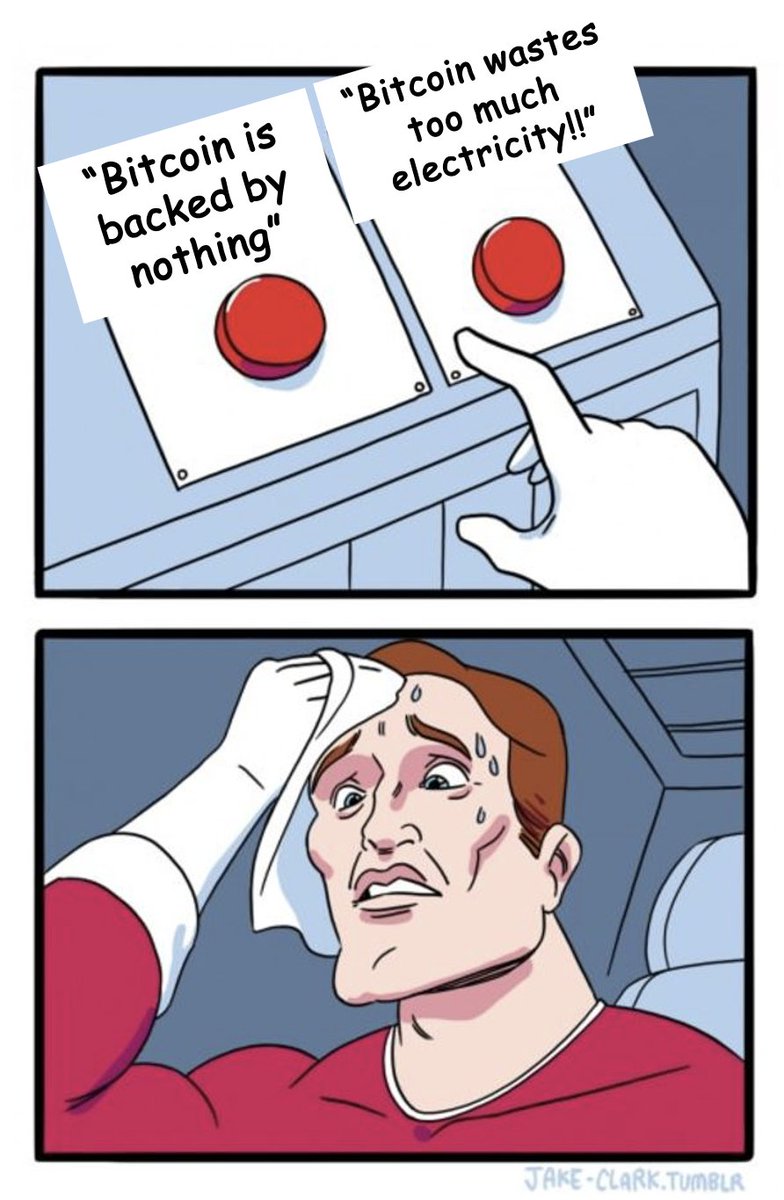
Critics said Bitcoin wastes electricity. The man whose chips process most of the world’s AI workloads just told you the opposite: Bitcoin is the battery that never existed. The transmission line that needs no wire. The export of energy without the tanker.
The implications are civilizational.
Stranded renewables become profitable. Remote regions become energy exporters. The economics of electricity generation inverts permanently.
Energy is no longer trapped.
Energy is now free.
@Diditaihuttu NEXO works well - been using it around the world for several years now: https://t.co/iZx7UIQKee - it’s my ref link and the reward goes also to the new user, just sayin’ 😎
@MikolajTomczakX Wg mnie @Nexo jest warte rozważenia. Dłuższy czas na rynku, stabilnie działają, jasne zasady, prosta obsługa. Kursy wymiany mają słabe, ale to można obejść. Mój ref link, jakby co: https://t.co/RXF9Fl9vgv ;)
Here's an embedded version of the Broken Money video.
-An analysis of the past, present, and future of money, and how technology impacts it over time.
-How the current disequilibrium (transactions way faster than settlements) creates centralized and corrupted money clusters:
I wonder how many really understand the bitter opposition by policymakers to Bitcoin and especially an ETF.
Gary Gensler doesn't really hate it because of investor protection (that's only a minor reason). Elizabeth Warren doesn't actually think its criminal use is significant. Obscure members of Congress who seem to pop up out of nowhere -- with Bitcoin, of all things, strangely on their minds -- and who repeat these tiresome objections (often in laughable letters to the SEC) are in many cases quietly pushed to do so by others, including from the Fed, who understand the real threat:
In a system that depends on irresponsible government spending (especially for perpetual war) and fiat printing to cover that irresponsibility, alarm bells cannot be allowed to work. There must be no pure price signals. And above all, an alarm bell must not also serve as a life-raft that's easily accessible to everyone, especially the general public, in the form of an ETF. There must be no escape hatch.
This is an unstated but important motivation for the longstanding resistance to Bitcoin and especially an ETF. It's also why the three-judge panel of a federal appeals court that in 2023 essentially forced the SEC to approve the ETFs may ultimately turn out to be the most unsung but consequential people in the history of U.S. financial markets. After that court's ruling, you could almost hear public policymakers and some influential private-sector figures -- names that everyone knows, and some very important ones who stay out of the news -- smack their foreheads and say, "Those damn judges, don't they realize what they've done?"
The system's defenders have always understood that life-rafts and escape hatches can't be allowed. Here's Christine Lagarde talking about Bitcoin in 2021 (ostensibly about the need for global cooperation on regulation, but the larger point was clear): "If there is an escape, that escape will be used." Here's a seminal essay by Alan Greenspan in 1966, when he was still in the private sector:
An almost hysterical antagonism toward the gold standard is one issue which unites statists of all persuasions...In the absence of the gold standard, there is no way to protect savings from confiscation through inflation. There is no safe store of value. If there were, the government would have to make its holding illegal, as was done in the case of gold. The financial policy of the welfare state requires that there be no way for the owners of wealth to protect themselves.
I'd say the antagonism towards Bitcoin qualifies as "hysterical," wouldn't you? And in terms of "protection," in a political system defined by profligacy and incompetent policy (especially monetary policy in recent years), a free-trading asset that serves as protection and -- via its price action -- starkly highlights those two faults is resented and hated.
This is why the Bitcoin ETFs in particular are so important, and why they were bitterly resisted for so long and the SEC only approved them after being forced to do so by a court decision. Gold is usually slow-moving and can be suppressed -- and even if it does rise to $2500 or $3000, DC and the Fed certainly won't like it, but it won't set off systemic alarms and the public mostly wouldn't notice. But if the ETFs help drive Bitcoin into the hundreds of thousands of dollars, the headlines will be screaming and the public will start asking uncomfortable questions. With the Fed desperate to cut rates and a potential second inflation wave looming, it's easy to see why, from a policymaker perspective, the timing of ETF approval could not have been worse. And now Bitcoin and the ETFs -- as permanent, fast growing and highly visible canaries in the financial system -- will be perpetual burrs under the policy saddle.
A telling postscript: Decades after Alan Greenspan wrote that essay about gold, Ron Paul asked him to autograph a copy of it as Fed chairman, and he asked if Greenspan wanted to add a disclaimer to it. Greenspan replied "I stand by every word" and signed it.
#Bitcoin 101: Satoshi's Innovation
Understanding why and how Satoshi Nakamoto used proof of work to crack the code that unlocked the best money in human history.
Gold is stuck in the ground, #Bitcoin is stuck in the future.
My keynote presentation at @BitcoinAtlantis:
@Cosmos_Airdrops This $AARK claim process doesn't work - please validate before posting news like this... Hopefully @Aark_Digital will give us some updates soon and fix their website! So far it's a waste of time unfortunately :/
Listen carefully, very carefully. This is the most important climate change clip you will ever watch - and only 4mins long. Watch and judge yourself. ABSORB the graph shown. THINK on it. USE your brain.
Everything else I will explain over the coming months.
"The magic of #Bitcoin is not transferring money to someone 10,000 miles away. It's transferring money to someone 10,000 days away." – Michael Saylor / @saylor
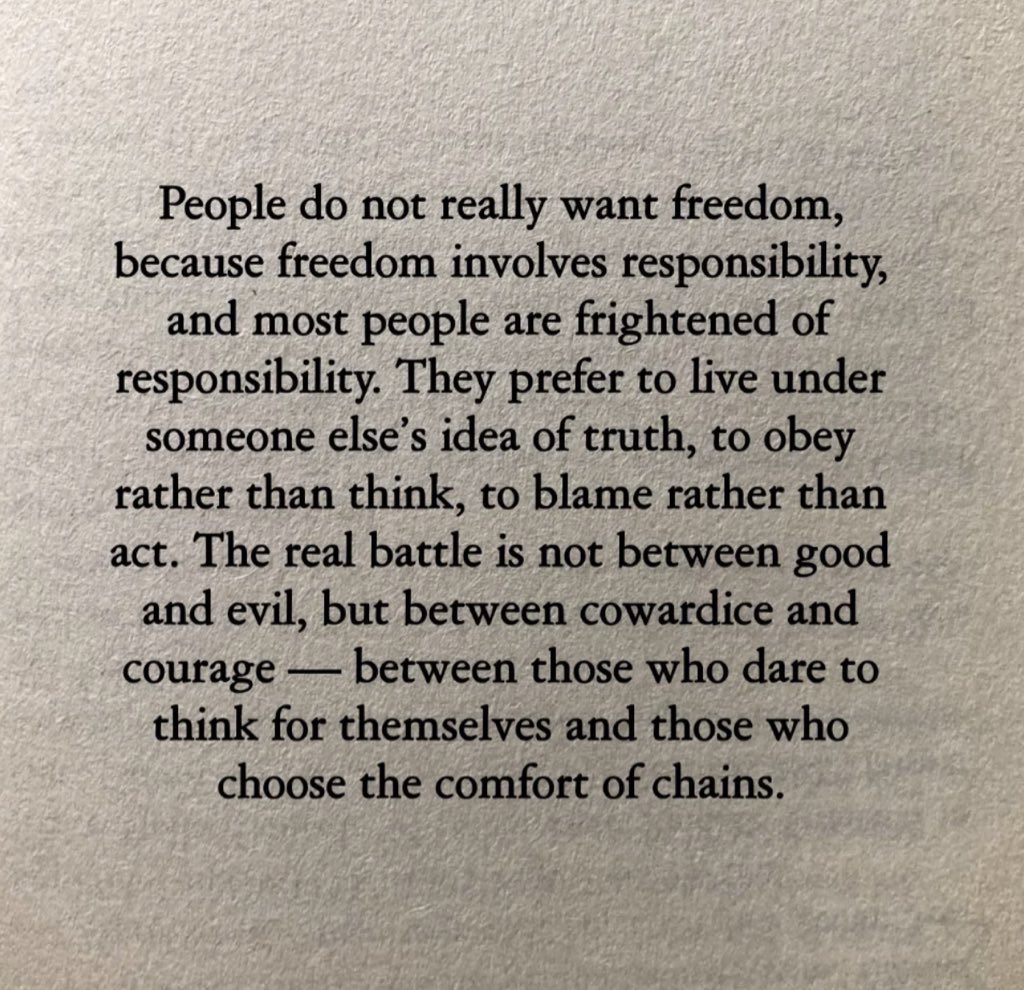
Human tendency to conform, especially when in large groups, is terrifying. Propaganda machines leverage this throughout human history.
The way out is to think freely, detached from the divisive narratives of the day that masquerade as universal truths.
This often feels lonely.