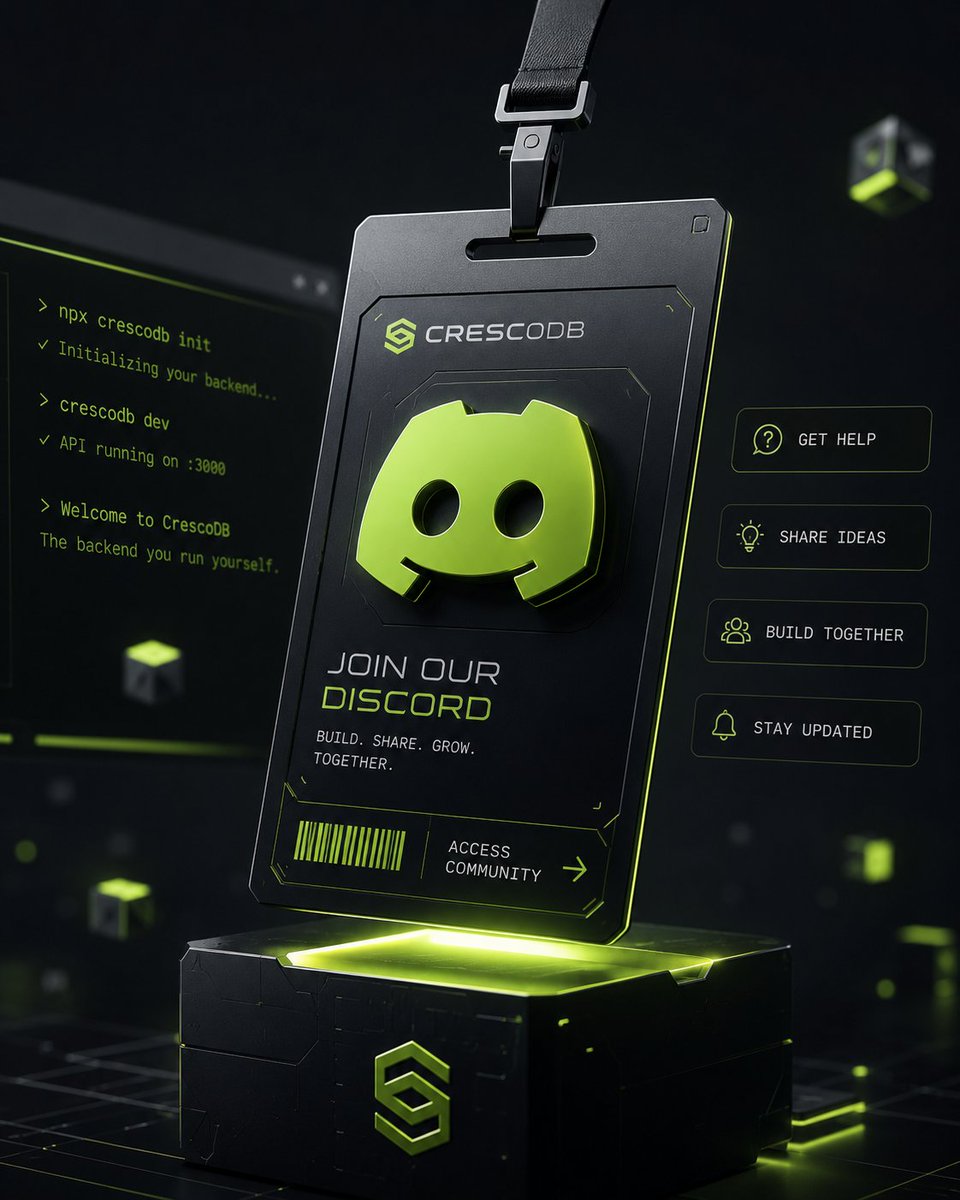
🚀 CrescoDB is live — and we're building with developers, not just for them.
We've opened the doors to the CrescoDB Discord community.
If you're building apps, working with backend infrastructure, experimenting with AI coding agents, or just interested in making backend development less painful, come join us.
We'll be using the community for:
• 🛠️ Developer support & troubleshooting
• 💡 Feature discussions and feedback
• 🧪 Early access & product updates
• 🤝 Building alongside other developers
• 🏆 Hackathons and community events
• 🚀 Showcasing what you're building with CrescoDB
We're just getting started, so the people who join now will help shape what this community becomes.
Come build with us.
👇 Join the Discord:
https://t.co/nWerAl8rY9
#CrescoDB #BuildInPublic #Developers #Backend #DevTools
Scotto is live on Product Hunt.
Both sides of a live conversation, out loud. Built for the doctor's appointment, the lease signing, the government office. Not for tourists.
I have never had this problem myself. Everyone around me speaks English. https://t.co/pQD6Vkk97S
Imagine spending your entire twenties trying to become financially stable, only to realise you have no memories of actually being young.
Just deadlines, client revisions, tutorials, unpaid invoices and the occasional vacation you couldn't afford to enjoy.
@MuawiyahDev Worth splitting those two. I tested three self-hosted products this week. One restored perfectly, every row identical, then refused to start: credentials were encrypted and the key wasn't in the dump.
Does your restore test start the app, or only load the data?
Scotto goes live on Product Hunt tomorrow.
It translates both sides of a live conversation out loud. Built for the clinic and the housing office, not for tourists.
Follow the page and you'll get told the moment it's up. https://t.co/XdAy5Xz7zz
@michaelbeal1 This is the trap. Patch fast and a bad update takes the box down. Patch slow and you are exposed. On-prem has neither a canary nor a rollback.
Faster patching does not fix that. An update that checks its own health and rolls itself back when the check fails does.
@AidHamza Patching is the easy half. Self-hosted means the fix lands only when someone on the customer's side notices, schedules and runs it.
I have been installing self-hosted products from their own docs this week. Most ship with no restart policy, never mind an upgrade path.
@PalmerLuckey Port Harcourt is full of people who live this. Generators because the grid is a maybe, boreholes because the water is a maybe. You end up building your own infrastructure because nobody else is coming. The hard part was never the law. It is who maintains it in year three.
I built a translator for a problem I have never had.
I live in Port Harcourt. Everyone around me speaks English.
Scotto does both sides of a real conversation, out loud, with a transcript you keep. Free 30 minutes a month.
https://t.co/S7nr5slTXV
@__mohamed_amine The idle hours are what kill it. Break-even is really a utilisation question, and below a certain requests per hour you are renting an expensive space heater. The cost nobody models is the one that shows up once, when it breaks and you are the on-call.
That's the easy case though. One machine, nothing on fire. The vendor isn't the one awake at 3am when a customer's database is gone, so the guide has no reason to cover it, and mostly it doesn't.
I'm doing fifteen of these. Then I'll publish what happened.
First one came back clean.
Tables: 153 before, 153 after.
Migrations: 1,218 before, 1,218 after.
Every customer and every usage event: identical checksum.
Backup took 2 seconds. Restore took 28.
Sunday morning, and I'm finally saying what I've been building.
CrescoDB is still up. No update since August, and I won't pretend otherwise.
Scotto: two people talk, it translates out loud both ways, keeps the transcript. In Play review.
Good way to spend a Sunday
AI coding agents have an amnesia problem.
Every time you start a new turn in Claude Code, Codex, or Antigravity, it re-reads 30 files to understand what you already explained yesterday.
I built SaintStack to fix this.
It’s a persistent, cross-project memory server:
Centralized in Neon Postgres (1GB free)
Deployed on Cloudflare Workers edge via MCP
Syncs decisions, architecture notes & session handovers across all your tools and devices
Totally open-source and free to self-host: https://t.co/AfQcyeInjr
and please star the repo while you there 🙂
🚨 Omo, things getting serious.
After several board meetings (with myself), I’m officially launching the Innocent Public Offering (IPO). 😂
Invest in the IPO. No dulling.
Drop your startup/business link let's see what y'all are building. 👀
Three weeks on Pro is the part that would make me nervous, not the bug. While support works it, pull a pg_dump and export your auth users so the account isn't the only copy of anything. If it turns out to be an auth row or a stuck migration, having the dump means you can rebuild elsewhere in an afternoon instead of waiting
That makes sense, the machine decides where you write, not where it runs. So where does NamoLux actually live now, and who notices when it falls over? I ask because the part that bites once something is reachable is what happens at 2am when it stops. Backups you've restored, an alert that tells you what broke, that kind of thing. Have you got that sorted, or is it still on the list?
Not feeling the most motivated this morning.
Took yesterday off completely to rest my head. Didn't touch anything. Woke up today still not really feeling it.
But building a company isn't about motivation, so here's the post I've been putting off since the 2nd:
CrescoDB deploys can now target a directory inside your repo. Before this, a deploy assumed the repo root was the app, so if your backend lived in /backend next to your frontend, you were stuck.
Now /backend ships on its own and the frontend doesn't come with it.